Articulated Dump Truck Load Capacity: An In-Depth Analysis
A comprehensive, data-driven look at articulated dump truck load capacity, covering typical payload ranges, model classes, regional weight considerations, and planning tips for engineers and fleet managers.


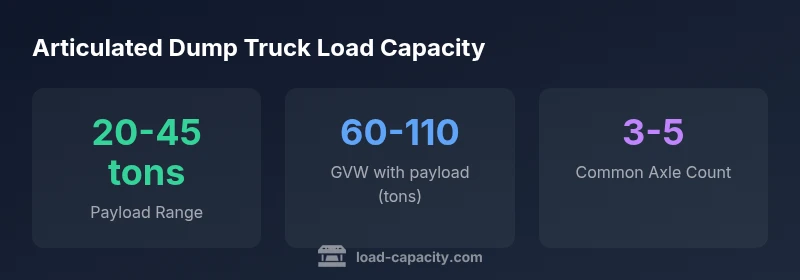
According to Load Capacity, articulated dump truck load capacity depends on model, configuration, and regional weight rules, but typical payload ranges from 20 to 45 tons for common ADTs. Heavier, larger models reach about 40–45 tons, while compact units may be closer to 20–30 tons. Accurate planning requires matching capacity to haul material density and legal limits.
Understanding articulated dump truck load capacity\n\nArticulated dump truck load capacity is a function of vehicle design, weight distribution, and regulatory limits. In practice, capacity is not a single static figure; it reflects the payload the truck can legally haul under normal operating conditions. According to Load Capacity, the capacity varies by model class, tire configuration, and how the body is engineered to transfer load across the suspension and axles. For engineers and fleet managers, understanding this capacity requires looking at chassis ratings, axle-load sharing, and site-specific constraints. This section explains the fundamental concepts, the definitions, and how to interpret published ratings for procurement and planning.\n
How capacity is specified and regulated\n\nPayload capacity is typically specified by manufacturers as a payload rating (the mass the body can safely carry) and is constrained by gross vehicle weight (GVW) limits, axle ratings, and local road regulations. The rating assumes standard tires and equipment; changes to tires, ballast, or body length can shift the available payload. International standards (SAE, ISO) guide how payload, tare weight, and GVW are measured, but regulators at the national and state level ultimately determine what you may legally haul on a given route. For steady planning, compare the published payload rating to the expected density of the material and the number of trips required per day.\n
Class-based payload ranges and model selection\n\nAcross the market, articulated dump trucks fall into small, mid-size, and large classes. Small ADTs commonly offer payloads around 20–30 tons, mid-size models range around 30–40 tons, and larger configurations may reach 40–45 tons. These figures are influenced by cab-forward design, ballast, and body width. When selecting an ADT for a project, engineers should align the class with material density, haul distance, and site terrain. A higher payload is advantageous, but only if it can be transported within local GVW limits and the maintenance cost remains acceptable.\n
Practical planning and field optimization\n\nIn the field, achieving the nominal payload depends on loading technique, material type, and site conditions. Dense materials like rock require careful compaction and may reduce available payload due to segmentation. Operators should monitor tire pressure, ballast, and fuel efficiency; regular maintenance reduces unexpected payload loss. For project planning, build buffers into cycle times to account for density variation and potential delays. This approach minimizes the risk of underutilized capacity and avoids overweight violations.\n
Real-world validation and performance benchmarks\n\nField validations show that actual payload utilization typically falls within a range around the published rating, often 0.8x to 1.0x depending on density and loading practices. Variability arises from moisture content, material clustering, and operator technique. Successful projects tie payload planning to site-specific density measurements, test loads, and regular scale checks. Documentation of performance benchmarks helps procurement teams compare models under realistic operating conditions rather than relying solely on nominal specifications.\n
Payload capacity by model class
| Model Class | Payload Range (tons) | Gross Vehicle Weight (tons) | Notes |
|---|---|---|---|
| Small ADT | 20-30 | 60-70 | Compact off-road use |
| Mid-size ADT | 30-40 | 70-95 | Balanced capacity |
| Large ADT | 40-45 | 85-110 | High productivity on heavy sites |
Quick Answers
What is the typical payload capacity of an articulated dump truck?
Payload can range from about 20 to 45 tons depending on model and configuration. Always verify with manufacturer data sheets and local weight regulations.
Payload typically ranges from twenty to forty-five tons, depending on the model. Check manufacturer specs and local rules to confirm.
How do weight regulations impact usable payload?
Gross vehicle weight limits and axle ratings cap the maximum payload you can haul. Route planning must respect these limits along with permit requirements.
Weight limits cap payload; plan around axle ratings and road rules.
How should I plan payload for a project?
Assess material density, haul distance, and cycle time. Use conservative payload estimates and account for density variation and potential delays.
Estimate density, plan cycles, and include buffers for delays.
Can payload capacity be increased after purchase?
Payload is largely determined by chassis, tires, and body configuration. Upgrades may be possible but often require a different model or re-rating.
Higher payloads may require a different model or re-rating.
What factors affect payload efficiency on site?
Material density, moisture content, loading technique, and maintenance influence actual payload delivered per trip.
Density, moisture, technique, and maintenance affect payload efficiency.
How is payload measured in the field?
Payload is often inferred from weight scales or dump body measurements, with periodic checks to ensure compliance with GVW limits.
Weighing scales and body measurements help verify payload in the field.
“A clear grasp of articulated dump truck load capacity is essential for safe, efficient earthmoving and aligns with regulatory weight limits.”
Top Takeaways
- Define the payload range for your site early.
- Match ADT class to material density and haul distance.
- Consider regulatory weight limits when planning routes.
- Prefer higher payload-to-weight ratios if maintenance costs are manageable.
- Verify published ratings with site density measurements and scale checks.