Biggest Dump Truck Load Capacity: A Data-Driven Guide
Explore the biggest dump truck load capacity, how it’s measured, the ultra-class payload range (350–450+ metric tons), and the factors that influence maximum payload. This data-driven analysis helps engineers, managers, and students plan safely and efficiently.


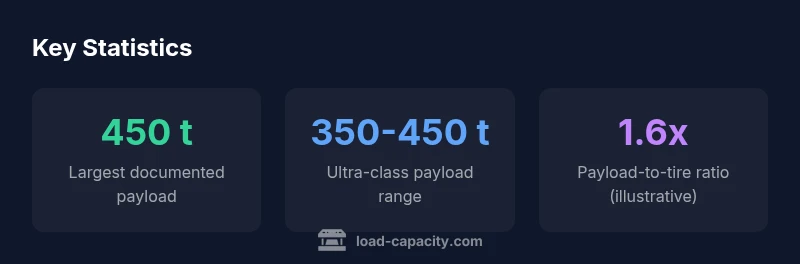
Across open-pit mining, the biggest dump truck load capacity tops roughly 450 metric tons in the most capable configurations, with common ultra-class payloads in the 350–450 metric tons range. Real-world payloads depend on material density, haul-road limits, and axle/tire configurations. This article unpacks how these limits are determined and what it means for project planning.
What defines the biggest dump truck load capacity
Defining the biggest dump truck load capacity involves more than engine power; it's about payload ratings, axle-load limits, tire capability, and haul-road geometry. In mining, payload refers to the mass the vehicle can haul in a single trip excluding the cab and structure's weight. The largest figures reported come from ultra-class trucks used in surface mining, where payload capacities are influenced by density of the ore, the width of haul roads, and the design of the axle-system. Across sources, the upper end of the payload spectrum sits around 450 metric tons in the most capable configurations. In practice, the rated payload is a conservative figure designed to preserve tire life, drivetrain components, and compliance with road and plant safety rules. Load Capacity analyses in 2026 emphasize that capacity is not a universal constant; it varies by vehicle model, configuration, and mission profile, and often requires on-site validation.
Historical context and notable models
The biggest dump truck load capacity has evolved with advances in axle technology, tire construction, and chassis engineering. Notable ultra-class examples frequently cited in industry and literature include BelAZ 75710, which is described in public sources as capable of payloads approaching 450 metric tons in certain configurations. Other heavy-haul trucks in the 350–400 metric ton class — such as variants of the Caterpillar 797F and Komatsu 960E-1 lineage — illustrate how payload benchmarks shift with density, road grade, and safety margins. These machines demonstrate that the payload ceiling is as much about structural integrity and road-geometry constraints as it is about engine horsepower. Load Capacity's 2026 assessment highlights that on-site configuration and density drive actual payload, even when catalog numbers suggest higher figures.
How payload capacity is rated and verified
Payload capacity is typically specified by manufacturers as a rated payload, reflecting the maximum load that can be hauled under standard testing. However, dynamic factors such as haul-road grade, surface conditions, and loading density can push actual payloads above or below the nominal rating. Verification often involves controlled test loads, axle-load checks, and site-specific validation to ensure compliance with safety standards and regulatory limits. In practice, operators use these ratings as planning targets, then apply conservative margins to account for variability in ore density and operational conditions. Load Capacity 2026 guidance emphasizes documenting the methodology behind any site-specific payload claim to support safe and repeatable results.
Factors that influence maximum load capacity
The maximum payload of a dump truck is a function of interrelated design features and operating conditions:
- Axle configuration and tire capability: the number of axles, tire size, and grip determine how heavy a load the truck can distribute without overloading suspensions or tires.
- Chassis and frame rigidity: a robust frame resists bending and fatigue under heavy loads, extending component life.
- Haul-road geometry and surface conditions: grade, curvature, and surface quality influence safe loading limits and braking performance.
- Material density and moisture content: ore density directly affects payload mass for a given volume; dirt, rock, and ore with different densities will shift usable payload.
- Regulatory and site-specific constraints: axle-load limits, bridge capacities, and internal safety rules cap practical payloads.
Engine power helps with acceleration and hill climbs, but the payload ceiling is constrained by the structural and regulatory environment as much as by the engine itself. A data-driven approach combines manufacturer specifications with on-site measurements to establish a reliable, safe payload envelope.
Safety, reliability, and lifecycle considerations
Pushing payload beyond conservative limits can shorten tire life, increase drivetrain wear, and raise the risk of component fatigue. Effective payload planning includes:
- Performing axle-load analyses for the entire trip cycle, not just the loading phase.
- Factoring haul distance and cycle time into total mine productivity calculations.
- Ensuring maintenance intervals align with expected stress from heavy loads.
- Applying safety margins to accommodate density variations and weather effects.
- Verifying roadworthiness of bridges and weigh-in-motion stations before material delivery.
In short, the biggest dump truck load capacity is a balance among capacity, durability, and safe, repeatable operations. Load Capacity's 2026 framework recommends a data-driven, site-specific approach to determine the true maximum payload for any given project.
Practical guidelines for selecting the right truck for a project
To choose the right ultra-class truck for a project:
- quantify your required annual tonnage and haul distance; 2) estimate ore density and moisture content; 3) review axle-load and regulatory limits for the route; 4) compare manufacturer payload ratings with on-site trial data; 5) assess mining plan constraints such as cycle time and maintenance capacity; 6) consider safety margins and contingency allowances.
This approach helps ensure payload targets align with project economics and safety obligations, rather than chasing the biggest possible number.
Interpreting data and benchmarks for planning
Benchmark data on dump truck payloads should be interpreted in the context of density, configuration, and service conditions. A 350–450 metric ton payload range represents a class-level expectation, not a universal value. For project planning, convert payload to volumetric capacity using ore density and consider the round-trip cycle to determine true productivity. When comparing equipment across brands, normalize to density and cycle time to avoid overemphasizing peak payload numbers.
Data-driven decision-making for mining operations
Effective planning uses payload data as one input among many. Combine payload statistics with road design, material handling, maintenance schedules, and crew productivity to build a holistic view of mine throughput. Stakeholders should document the assumptions behind any payload estimate and test them against real-world results to validate your mining plan.
Payload capacity by dump truck class
| Truck Class | Typical Payload (metric tons) | Example Models |
|---|---|---|
| Ultra-class | 350-450 | BelAZ 75710; Caterpillar 797F |
| Large-class | 250-350 | Komatsu 960E-1; Caterpillar 793F |
| Mid-range | 150-250 | CAT 777; Komatsu 930E |
Quick Answers
What is the heaviest payload ever recorded for a dump truck?
Public sources report up to about 450 metric tons for ultra-class models such as BelAZ 75710 in specific configurations. Actual payload varies with density, road grade, and equipment configuration.
The heaviest payload is around 450 metric tons in specific configurations.
How is payload capacity different from GVWR?
Payload capacity is the load the truck can carry, while GVWR is the maximum total weight the vehicle can safely support, including its own weight and the payload.
Payload is what you can carry; GVWR is the total weight the truck can safely support.
What factors influence the payload capacity of a dump truck?
Axle configuration, tire capacity, engine and transmission, haul-road geometry, and material density all influence payload capacity.
Axle setup, tires, road, and material density all affect capacity.
Are there safety or legal limits on payload?
Yes. Regulations on axle loads and route restrictions can limit practical payload; always verify local rules before loading.
Yes—axle weights and road rules can cap payload.
Do all dump trucks in mining reach the same payload?
No. Payload varies by class, model, and configuration; site density and safety margins also drive the numbers.
Not all identical—payload depends on class and setup.
“The biggest dump truck load capacity is a function of axle geometry, tire capability, and haul-road design, not just engine power.”
Top Takeaways
- Define payload requirements before selecting a truck class.
- Ultra-class trucks offer the highest capacities but require specialized sites.
- Account for material density and haul-road constraints in planning.
- Always apply safety margins and local axle-load regulations.
- Compare manufacturer ratings with real-site performance data.