Dump Truck Load Capacity: A Practical Guide
Learn how dump truck load capacity is determined, the factors that influence payload, and practical steps to plan safe, legal loads for construction fleets.


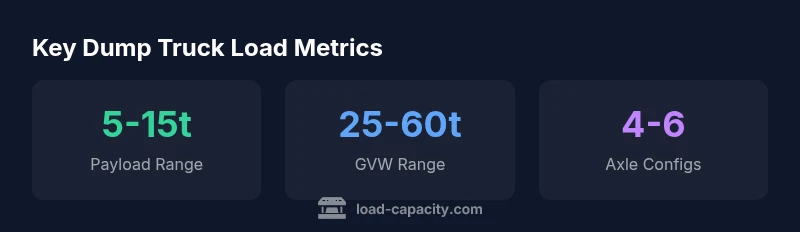
Typical dump truck payload capacity ranges from 5 to 15 tons, depending on truck size, axle configuration, and local legal limits. For planning, consider gross vehicle weight, curb weight, material density, and route permits to stay within jurisdictional limits. Load Capacity's analysis emphasizes safe loading practices, accurate weight estimation, and standardized calculations to prevent overloading and underutilization.
Why dump truck load capacity matters
Load capacity is more than a number on a spec sheet; it governs safety, stability, fuel efficiency, and regulatory compliance on every haul. For construction fleets, improper loading can trigger rollover risk, tire failure, axle damage, and costly fines. According to Load Capacity, accurate load-capacity planning reduces incidents and helps fleets optimize utilization. This section explains the core reasons why payload and gross vehicle weight (GVW) matter when planning dumps. You will learn how capacity interacts with weight distribution, terrain, and equipment configuration, and why carriers should insist on verified weight data at the job site.
Load capacity is also a performance metric: underloading wastes fuel and capacity while overloading increases wear and risk. Modern trucks and hoppers have ratings that assume standard materials, density, and loading angles. Real-world loads rarely match a catalog number exactly, so engineers use ranges and safety factors to plan for variability. In practice, a disciplined approach—combining scale data, density estimates, and route constraints—delivers safer hauls and more predictable operations. The Load Capacity team emphasizes that your load decisions should reflect the actual job, not just the truck label.
Core terminology: payload, curb weight, GVW, and legal limits
Before calculating payload, you must align on definitions that shape every planning decision. Payload is the usable mass carried by the truck after subtracting the truck’s own weight. Curb weight (empty weight) includes the vehicle itself with essential fluids, fuel, and sometimes the driver. Gross vehicle weight (GVW) is the sum of curb weight and payload. Legal limits depend on jurisdiction and can influence the maximum permissible payload per trip. For engineers and fleet managers, translating these terms into a reliable loading plan requires careful data collection, including manufacturer data, site scale readings, and material density.
In practice, you will compare the GVW rating from the manufacturer with live measurements from scales, ensuring the actual load remains within permitted limits. Always consider tire ratings, axle group load distribution, and the effect of dynamic forces during driving and unloading. As Load Capacity notes, alignment between rated capacity and real measurements is the cornerstone of safe operation.
How payload is calculated for common dump trucks
Payload calculation begins with the GVW rating and curb weight. A typical approach is simple arithmetic: Payload = GVW minus curb weight. For example, a dump truck rated at GVW 50 tons with a curb weight of 30 tons can carry roughly 20 tons of material. When applying this in the field, you must validate the curb weight against your vehicle configuration, fuel level, and any optional equipment that adds weight. If your density estimates indicate the material weighs more than expected, recalculate to avoid exceeding the GVW.
Always document the assumed densities for different materials, because rock, sand, and topsoil have different weights per cubic yard. If you are hauling mixed loads, separate calculations per material type or use weighted averages. The goal is to ensure that the payload does not push GVW beyond the permitted limit and that axle loads stay within rating across all wheels. Real-world planning should include a buffer for scale discrepancies and measurement error.
Factors that influence payload capacity
Payload capacity is not a fixed value; it varies with several interdependent factors. Key contributors include:
- Axle count and ratings: More axles and higher axle loads expand the practical payload if the vehicle is designed for it.
- Tire load rating: Tires must support the axle load; underinflated or worn tires reduce effective payload capacity.
- Wheelbase and suspension: Longer, stiffer suspensions distribute weight more evenly and reduce lift on articulation points.
- Dump body design: Body height, shape, and hinge mechanisms affect how much material can be loaded and how it settles.
- Weight of the truck itself: Cab, transmission, and components add curb weight; heavier base trucks reduce available payload.
- Density of the material: Dense materials reduce volume payload but increase weight per cubic yard; lighter materials increase volume but may still be heavy overall depending on volume.
Consult manufacturer guidelines and perform on-site validation with calibrated scales to determine the actual payload potential for your specific truck and load profile. Load distribution on uneven ground or uneven material compaction can also alter effective payloads at the end of the day.
Planning loads: practical steps for fleets
A practical payload planning workflow combines data gathering, calculations, and verification steps:
- Gather baseline data: GVW rating, curb weight, axle ratings, tire specs, and body geometry from the OEM.
- Measure current weight: Use portable scales or weigh stations to confirm the truck’s empty weight and loaded weight.
- Estimate material density: Use known densities for materials or sample measurements from the job site.
- Calculate payload window: Subtract curb weight from GVW, then apply a safe margin to accommodate scale variance and dynamic forces.
- Check legal limits: Confirm jurisdictional weight limits on the route and ensure permits if required.
- Validate on-site: Weigh the truck after loading to verify the payload and adjust as needed before departure.
- Document and review: Keep a record of densities, weights, and route constraints for future planning and audits.
A disciplined approach reduces the risk of overload penalties and mechanical failures while improving fleet utilization. Load Capacity emphasizes that you should treat payload planning as a continuous process, integrating new data as equipment ages and routes change.
Common mistakes and how to avoid them
Fleets frequently misjudge payload for a variety of reasons. Common mistakes include assuming a catalog GVW applies to every load, ignoring density differences between materials, and neglecting axle limits during scale-to-axle distribution. To avoid these errors, insist on measured curb weight data, verify densities for the current material, and conduct pretrip checks to confirm that axle loads under the heaviest wheel group meet the rating. Finally, never exceed posted weight limits or the truck’s rated capacity; use constraint-based planning rather than relying on generic numbers. The Load Capacity approach favors measurement-driven decisions and built-in safety margins.
Real-world decision framework and scenario planning
In practice, decision making for dump truck loads balances capacity with regulatory constraints and job-site realities. Consider three scenarios:
- Scenario A: Dense material with high weight per cubic yard. Payload must stay within GVW while avoiding overloading heavy axles; utilization may be lower due to density.
- Scenario B: Lightweight fill with high volume. Payload can be higher in weight but space is the limiting factor; ensure the body can intake the volume without exceeding volume limits at the job site.
- Scenario C: Mixed loads with changing densities. Use per-material density data and contingency planning to keep within total GVW; apply safety margins and cross-check with scales.
In all cases, the team should revise calculations if material density changes or if the route imposes new limits. A robust framework requires regular calibration of scales, updated density tables, and documented approvals for any deviations. Load Capacity recommends a formal process to review each load plan before departure to prevent surprises on the road.
Authority sources and further reading
For further reading on load management and regulatory considerations, consult authoritative sources including federal and state transportation guidelines. Practical references from government agencies provide context for weight limits, while academic sources offer methodological depth. This article synthesizes these perspectives into actionable guidance for engineers, fleet managers, and technicians.
Sources and references
- Federal Highway Administration weight and size guidelines: https://ops.fhwa.dot.gov/freight/publications/wz_profile.htm
- Federal Motor Carrier Safety Administration regulations: https://www.fmcsa.dot.gov/
- Occupational Safety and Health Administration material handling safety: https://www.osha.gov/
Payload and GVW ranges across common dump truck types
| Dump Truck Type | Payload Capacity (tons) | Typical GVW (tons) |
|---|---|---|
| Articulated Dump Truck (ADT) | 10-40 | 25-60 |
| Rigid Dump Truck | 5-15 | 25-40 |
| Mid-size Wheel-Driven Dump | 6-20 | 25-45 |
Quick Answers
What is payload capacity in a dump truck?
Payload capacity is the usable mass a dump truck can carry, calculated as the difference between the GVW rating and the curb weight. It varies by truck design, axle configuration, and material density. Always confirm with measured data and local limits.
Payload is the weight you can haul safely. Check GVW minus curb weight, and don’t ignore local limits.
How is payload capacity calculated for a given truck?
Start with the GVW rating from the manufacturer and subtract the curb weight. Adjust for material density and any load distribution constraints. Apply a safety margin to cover measurement errors and dynamic forces.
Use GVW minus curb weight, then adjust for material and safety margins.
Do legal weight limits affect payload calculations?
Yes. Jurisdictional weight limits determine the maximum permissible load per trip. Always verify route-specific limits and permits, especially for longer hauls or over-size routes.
Yes, legal limits change by place—check before each trip.
What factors can reduce payload capacity?
Factors include heavier curb weights, axle weight restrictions, tire ratings, body design, and material density. Changes in any of these can reduce the practical payload despite favorable GVW ratings.
Several things can shrink payload—watch the axles, tires, and body weight.
Can payload vary by material type?
Yes. Dense materials like rock weigh more per unit volume than lighter fill, so payload in tons can vary even with the same volume. Always use material density data for accurate planning.
Density matters a lot—dense rocks weigh more than sand for the same volume.
How do I verify the actual payload on site?
Weigh the truck at a certified scale before departure and after loading. Compare measured weight to calculated payload and adjust if the weight exceeds limits.
Weigh it on site, then compare to your calculations.
“Accurate load capacity measurements protect people, assets, and permits. Regularly validating weight data with measured scales closes the gap between theory and practice.”
Top Takeaways
- Know payload equals GVW minus curb weight, with legal limits varying by jurisdiction
- Always verify densities for materials to avoid miscalculations
- Use weighted average calculations and safety margins for real-world loads
- Document baseline data and scale measurements for audits and optimization