Wood Load Capacity Calculator: Learn, Calculate, and Apply
A practical, educational wood load capacity calculator that estimates safe bending loads for rectangular beams using width, height, span, and Fb. Learn the math, interpret results, and apply safely in projects with Load Capacity guidance.


Why wood load capacity matters
Wood load capacity is a fundamental concept in any project involving beams, joists, or decks. Knowing capacity helps prevent structural failure, protects occupants, and supports code compliance. When engineers translate geometry and material properties into safe loads, they reduce risk and guide material choices. According to Load Capacity, starting with a clear understanding of capacity sets the foundation for sound design decisions and safer construction outcomes. In real-world scenarios, a beam's ability to carry bending and shear loads depends on species, grade, moisture, knots, and how the beam is oriented relative to the load path. A calculator focused on wood capacity lets students, technicians, and professionals explore "what-if" scenarios without expensive testing. The objective isn't to replace professional engineering, but to illuminate how width, height, span, and Fb influence capacity and to foster intuition about safe planning.
How the calculator works: inputs and outputs
The Wood Load Capacity Calculator uses four practical inputs to estimate a safe, uniform load along the beam. The first two inputs set the cross-section: Beam Width (mm) and Beam Height (mm). The third input defines how long the beam spans between supports: Span (m). The final input specifies Fb, the allowable bending stress for the wood species and grade (MPa). Using these values, the calculator conceptually converts geometry and material strength into a maximum moment and a corresponding distributed load. The result is given in kilonewtons per meter (kN/m). This unit aligns with common deck and floor design calculations and makes it easier to compare alternative beam sizes. A clear, numeric result helps you compare scenarios quickly—be mindful that real designs should also account for shear, deflection, fasteners, and supports.
Understanding the math behind the calculation
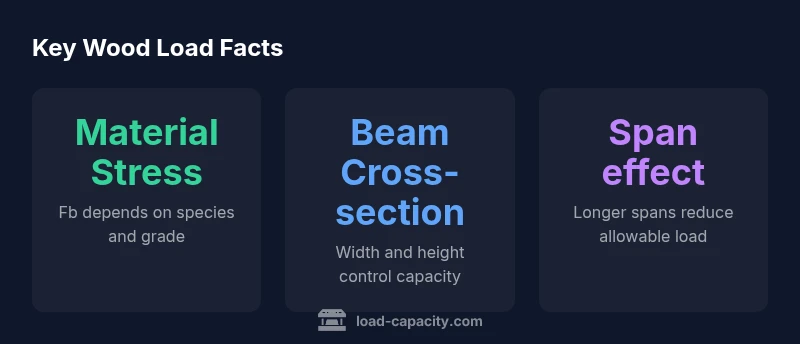
At the core is a simple, teachable chain of equations. First, compute the section modulus for a rectangular beam: S = (width × height^2) / 6, using width and height in millimeters. Next, determine the maximum bending moment: M = Fb × S, with Fb in MPa and S in mm^3, yielding moment in N·mm. For a span between two supports, convert the span to millimeters: L = span × 1000. The maximum allowable uniform load (per meter) is then w = 8 × M / L^2, which yields a value in N/m. Because N/m divided by 1000 equals kN/m, the units align with the common engineering practice. While these steps assume a simple simply supported beam with a uniform load, they illustrate how larger cross-sections or tougher Fb values increase capacity, and how longer spans reduce it. The approach is purposely educational and simplified for learning purposes.
Practical scenarios and tips
Use the calculator to compare lumber species (via Fb) and cross-section choices for typical projects. For a deck joist, increasing height dramatically improves capacity because the height is squared in the S term. For floor beams, the span is often longer, so you’ll see stronger effects from increasing width or selecting higher-grade timber. Start with a conservative Fb if you’re unsure about the wood's condition or moisture content. Remember that this tool focuses on bending capacity; shear, stiffness, and connector details also influence real-world performance. The Load Capacity team suggests testing several input combinations and documenting the results to inform design discussions with stakeholders.
Interpreting results and safety cautions
Your output, expressed in kN/m, indicates how much distributed load the beam could safely support under the specified conditions. If your result seems low, consider increasing the height, choosing a stronger species (higher Fb), or shortening the span. If results look unrealistically high, verify that input values match the actual material and support conditions; small changes in Fb or dimensions can produce large changes in the computed load. Moisture content, defects, and knot patterns reduce actual capacity compared with ideal calculations. The educational nature of this calculator means it provides insight, not a final design, and should be used in conjunction with building codes and professional judgment.
How to use the calculator in design workflows
Integrate early in planning: run several scenarios during concept development, then verify promising options with more detailed structural analysis. Use the data table below to understand input ranges and to prepare a quick reference for common beam sizes. Document the chosen inputs and the resulting kN/m to support procurement decisions and communications with engineers, inspectors, and contractors. The calculator acts as a learning tool that can accelerate discussions and foster understanding across teams.
Common mistakes and limitations
One common error is assuming Fb is constant across all grades and moisture conditions; wood strength varies with species, age, and water content. Another pitfall is neglecting shear and deflection — bending capacity alone doesn't guarantee serviceability. The model also assumes a simple, uniform load and simple supports; real-life loads require more complex analysis. Finally, do not rely on a single calculator result for critical structures; use codes, tables, and professional guidance to corroborate findings. By recognizing these limitations, you can use the tool effectively for education and planning rather than for final design decisions.
Next steps for learners
Explore additional inputs like wood species, straight-grain orientation, and end-connection details to broaden understanding. Cross-check with standard timber design tables or code-approved calculators to build confidence. Use the included data table to memorize typical input ranges and practice converting between mm and m consistently. The goal is to develop intuition about how geometry and material strength control wood load capacity, enabling safer, smarter construction choices.