2x6 Load Capacity Calculator for Wood Beams
Learn how the 2x6 load capacity calculator estimates safe loads for 2x6 lumber beams. Explore inputs, formula, and practical tips for planning decks, joists, and light-framed structures.

Load Capacity Team
·5 min read

Why a 2x6 Load Capacity Calculator Matters\n\nFor engineers, technicians, and DIY enthusiasts, understanding the load a single 2x6 lumber beam can safely carry is foundational to safe, economical designs. The 2x6 load capacity calculator provides a quick, repeatable way to estimate allowable loads under a defined set of conditions. In practice, accurate results depend on several interacting factors, from the actual cross-section of the lumber to how supports are arranged. According to Load Capacity, starting with the right inputs reduces surprises during construction and helps you compare options early in the planning stage. This calculator is especially useful when evaluating deck framing, garage joists, or light-framed structures where 2x6 members are common.
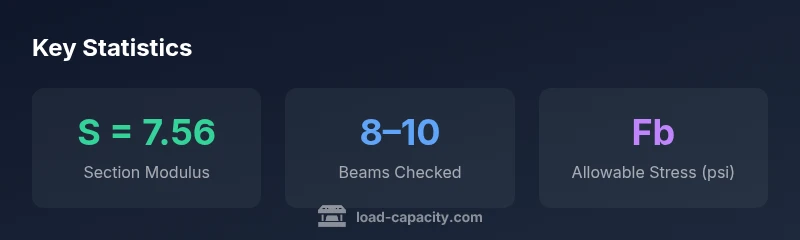
How the Calculator Works: Key Inputs and Formula\n\nThe calculator focuses on a simple yet powerful engineering relationship: the allowable bending load depends on the beam’s cross-section (width and depth), the material’s bending strength, and the span between supports. The primary inputs are: Span (ft), Depth (in), Width (in), and Fb (psi), the allowable bending stress for the wood. The core formula estimates the maximum uniform load a simply supported beam can carry: w_max = Fb × S ÷ (1.5 × L^2), where S is the section modulus S = (b × depth^2) / 6. The calculator rounds the result to a convenient value for planning. Unit consistency is essential: convert all inputs to inches where needed before computing w_max in pounds per foot.
Material Properties: Species, Grade, and Moisture\n\nWood strength varies widely by species, grade, and moisture content. In grading terms, a No. 1 piece generally delivers higher bending strength than No. 2 or utility grade stock. Moisture reduces Fb, so dry or kiln-dried lumber behaves differently from green lumber. Our calculator asks you to specify Fb, which you can bottom-line from manufacturer data or building codes for your chosen species and grade. If you are unsure, start with a conservative Fb value and adjust as you validate the design.
Geometry and Load Scenarios: Span, Supports, and Orientation\n\nSpan length and end conditions (simple support vs continuous or fixed ends) influence the bending moment in the beam, and thus the allowable load. The 1.5 factor in the formula reflects typical conservative assumptions for a simply supported beam under a uniform load. If your scenario involves point loads, multiple beams, or unequal supports, you should adjust inputs or use more advanced methods. Always verify that deflection limits are also met, not just bending capacity.
Practical Examples: Common Scenarios\n\nConsider a common deck joist scenario: a 2x6 member with a 10 ft span, depth 5.5 in, width 1.5 in, Fb of 1200 psi. Using the calculator, you would compute S ≈ (1.5 × 5.5^2) / 6 ≈ 7.56 in^3, then w_max ≈ (1200 × 7.56) / (1.5 × 10^2) ≈ 60 lb/ft. This is a planning value, not a guarantee; always confirm with local codes and a professional.
Safety Considerations and Limitations\n\nSafety comes first. The calculator provides estimates for planning and design checks, not final code-compliant values. For safety-critical applications, rely on building codes, factor in deflection criteria, and consult a licensed structural engineer. Document all assumptions (Fb, span, species, grade) to support audits and future reviews.
Interpreting Results: Units, Confidence, and Next Steps\n\nResults are presented in pounds per foot (lb/ft) to align with typical beam-load planning. If the calculated w_max is below your anticipated loads, explore increasing beam depth, reducing span, or adding support points. Always cross-check with code requirements and site-specific factors (moisture, fasteners, and exposure). Keep a record of inputs for reproducibility.
Using the Calculator in Projects: Field Applications\n\nIn practice, use the calculator during early design meetings for quick comparisons between beam configurations. It helps stakeholders visualize options and avoid overdesign or underdesign. For decks, attic storage, or light-framed buildings, use the results as a planning tool while ensuring compliance with local codes and professional guidance when needed.
Common Pitfalls and Best Practices\n\nCommon mistakes include assuming green wood strength, ignoring moisture effects, and overlooking end conditions. Always base Fb on species/grade data, ensure consistent units, and validate results with code-based methods. Treat this tool as a first-pass screen rather than a final design authority.