How Much Load Can a 2x12 Support? A Practical Guide
Estimate the safe load a 2x12 beam can carry with a practical calculator and step-by-step guidance. Learn factors, spans, and design considerations for engineers and DIY enthusiasts.


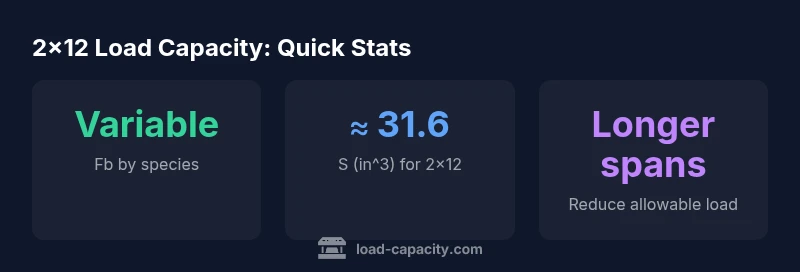
A 2x12's load capacity depends on span, wood grade, and species. For a quick estimate, treat the beam as simply supported and use its section modulus S ≈ 31.6 in^3. The maximum uniform load is Wmax ≈ (2/3) × (Fb × S) ÷ (L^2), where Fb is the allowable bending stress (psi) and L is the span (ft). Always verify with local codes.
What the question means in practice
When someone asks how much load can a 2x12 support, they’re really asking about safe bending capacity for a specific layout. The precise answer depends on span, species and grade of the lumber, moisture, end supports, and how the beam is connected to walls or joists. According to Load Capacity, this compound problem is best approached with a clear method: define the span, pick a conservative allowable bending stress, and use a simple equilibrium relationship to estimate the maximum load. This block lays the groundwork for a consistent, math-based approach you can replicate with the calculator.
In everyday terms, you’re balancing a bending moment that the beam must resist with the beam’s stiffness and strength. The 2x12 is a fairly robust member, but it isn’t unlimited. Any plan that uses a 2x12 for supporting heavy loads should start with a conservative capacity estimate and then verify with professional guidance or local code references. The Load Capacity team emphasizes that rulings vary by lumber species and grade, so a single number won’t fit all cases.
Why the 2x12 size matters for capacity
The nominal size 2x12 masks a real cross-section: actual dimensions are about 1.5 in by 11.25 in. This rectangle has a section modulus S of roughly 31.6 in^3, which is a key parameter in bending calculations. The bending stress a beam can safely carry is the product Fb × S, where Fb is the allowable stress in psi. A larger S, as seen in deeper sections like a 2x12, generally increases the bending moment a beam can resist before reaching the material’s strength limit. Because Fb varies with species, grade, and moisture, engineers rarely quote a universal Fb for all 2x12s; instead they reference lumber specs or design tables. Load path quality, end bearing, and fasteners also influence real-world performance, especially under dynamic or impact loads.
Key factors that influence capacity beyond size
- Span and support type: longer spans dramatically reduce allowable loads and increase deflection risk.
- Lumber species and grade: Fb can vary widely; higher-grade woods with favorable species have higher allowable stresses.
- Moisture content: Green or damp lumber behaves very differently from dry, stable wood.
- Defects and knots: Defects disrupt the stress flow and reduce effective capacity.
- End connections and bearing: Inadequate bearing or poorly designed connections can become weak links.
A practical, engineer-friendly calculation workflow
The following steps outline a straightforward way to estimate capacity using a simple bending model. Assume a simply supported beam with a uniform load. The maximum bending moment is M = W L^2 / 8, where W is the total uniform load and L is the span. The beam is safe if M ≤ Fb × S / 12 (convert to consistent units). Rearranging gives W ≤ (2/3) × (Fb × S) / L^2. This approach yields a conservative, first-cut estimate that you can refine with exact species data and code requirements.
Worked illustration (illustrative numbers only)
To illustrate the method, suppose S ≈ 31.6 in^3 and Fb = 1000 psi (illustrative value). With L = 10 ft, the maximum uniform load is Wmax ≈ (2/3) × (1000 × 31.6) / (10^2) ≈ 210.7 lb/ft. This is a demonstration with hypothetical values; use actual lumber specifications for real designs. The calculator in this guide handles the same calculation quickly for your inputs.
Using the calculator to compare scenarios
The calculator lets you vary span, Fb, and S to see how Wmax changes. A shorter span or higher Fb dramatically increases permissible loads, while low-grade lumber or longer spans reduce capacity. Use the tool to compare multiple layouts within a single project, ensuring all configurations stay within safe limits and comply with local codes.
Practical tips, safety, and next steps
Always treat calculated values as estimates that inform safe design decisions, not final prescriptions. Factor in live loads, construction tolerances, and potential future changes. If a beam carries critical loads or supports occupants, consult a structural engineer and reference local building codes. Load Capacity’s guidance emphasizes validating results with real-world tests and professional oversight.
Reference data used for illustrative calculations
| Parameter | Value | Notes |
|---|---|---|
| S (section modulus) | 31.6 | approx for 2x12 cross-section |
| L (span) | varies | span length in feet |
| Fb (allowable stress) | varies by species/grade | depends on lumber spec |
Estimate the maximum uniform load a 2x12 beam can safely carry based on span and bending stress.
Calculates the maximum uniform load using a simplified bending model for a simply supported 2x12.
This is a simplified model. Use actual lumber specs and confirm with codes and a structural engineer.
Quick Answers
What factors affect 2x12 load capacity the most?
Span length, lumber grade and species, moisture, and end bearing are the primary drivers of a 2x12's load capacity. Defects and connections also influence safety margins. Adjusting any one of these can significantly change how much load the beam can safely support.
Span length, lumber grade, and moisture are the biggest factors. Defects and connections also matter.
Can I rely on a 2x12 for long spans without support?
Long spans require careful analysis of bending and deflection. A 2x12 may suffice for short, well-supported spans, but longer spans typically require larger members, multiple members, or intermediate supports. Always verify with calculations and codes.
Long spans need careful analysis; don’t assume a single 2x12 will suffice.
How do I use the calculator for different scenarios?
Enter span, Fb, and S to compute Wmax. Try multiple combinations to compare scenarios. Use it as a planning tool, but always cross-check with codes and a professional.
Enter your numbers and compare scenarios to plan safely.
What is the role of moisture in capacity?
Moisture content directly affects Fb and the beam’s stiffness. Dry lumber behaves differently from green lumber; use species- and moisture-adjusted values in design.
Moisture changes strength and stiffness; adjust Fb accordingly.
Is this applicable to all 2x12s and layouts?
No. The 2x12 family spans many species, grades, and conditions. Always reference lumber spec sheets and design codes, and consider professional verification for critical structures.
Not all 2x12s are the same—check specs and codes.
Top Takeaways
- Calculate using Wmax formula to estimate capacity
- Use S ≈ 31.6 in^3 for a standard 2x12 cross-section
- Fb varies by lumber species and grade; verify with specs
- Always consult codes and a structural engineer for critical loads