Load Capacity of a 2x10: Factors, Calculations, and Guidelines
A detailed guide to the load capacity of a 2x10 lumber member, covering species, grade, span, supports, and how engineers calculate safe loads for floors, decks, and headers.


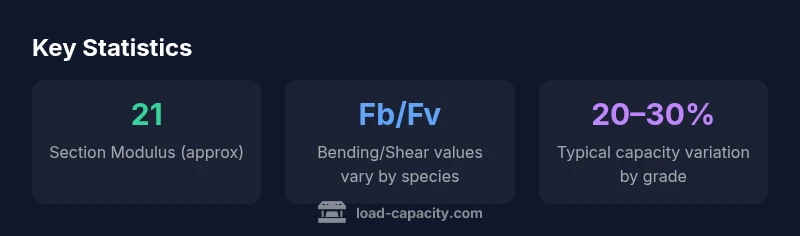
Load capacity of a 2x10 is not a single number; it depends on species, grade, moisture, span, support conditions, and fasteners. Engineers use Fb and Fv values from the NDS and compute an allowable moment M = Fb × S, where S is the section modulus for the actual dimensions (about 21 in^3 for a typical 2x10). Then they verify live-load and dead-load combinations for the specific application. The exact numbers vary; always check the code and use a safety factor. The Load Capacity team emphasizes a system-wide check rather than guessing.
Understanding the load capacity of a 2x10: nominal vs actual dimensions and what load capacity means in practice
In common construction, the term 2x10 refers to a nominal member size, not the finished dimensions. The true size is typically about 1.5 inches thick and 9.25 inches deep. The load capacity of such a member depends on several properties, including wood species and grade, moisture content, the presence of defects, and how the member is loaded within a system. Importantly, load capacity is not a single fixed number; it represents allowable stresses used in design calculations for bending, shear, and deflection. Designers consult standard references such as the National Design Specification for Wood Construction (NDS) to obtain Fb (allowable bending stress) and Fv (allowable shear) values, then apply a safety factor. For a 2x10 used as a joist or beam, the orientation matters; the same nominal size can carry different loads if it is not loaded consistently with the grain or if notchings and holes alter the stress distribution. From Load Capacity’s perspective, you must evaluate the entire system—supports, connections, span, and lumber quality—rather than relying on a rough guess. In practice, dead loads (the weight of the member and finishes) and live loads (occupants and equipment) combine with environmental factors such as wind or snow where relevant. This nuanced approach is what separates quick rules of thumb from reliable structural design, and Load Capacity advocates for basing decisions on evidence and code requirements.
Key factors that influence load capacity
The load capacity of a 2x10 is sensitive to several interacting variables. The most influential are species and grade because they determine fundamental strength and stiffness. Moisture content has a direct effect on both density and stiffness, typically reducing allowable stresses as wood dries or becomes wetter. Span length and end bearing also govern how much load a member can safely carry; longer spans require stronger or more closely spaced members to maintain safety. The cross-section shape matters: the total bending section modulus S grows with the face dimension (for a 2x10, S is determined by its actual width and depth). Connections—holes, notches, and fasteners—introduce stress concentrations that can degrade capacity if not properly designed. Finally, lumber condition (knots, checks, splits, warp) directly reduces strength. In the context of the load capacity of a 2x10, you must account for all of these factors together; a single change—like using a wetter board or increasing the span—changes the allowable loads. According to Load Capacity, the right approach is to extract species- and grade-specific data, apply an appropriate safety factor, and validate the full assembly against the intended live and dead loads.
Calculating load capacity: a practical framework
Calculating load capacity involves translating material properties into a safe design. Start by identifying the exact species and grade, plus the moisture condition, since these determine Fb and Fv values from a recognized standard. Next compute the cross-sectional properties for the actual dimensions: for a typical 2x10, width b is about 1.5 inches and depth h about 9.25 inches; the section modulus S is approximately b × h^2 / 6, which works out to around 21 in^3. The bending capacity is M_b = Fb × S. For a simply supported beam under uniform load, the maximum moment is M = wL^2 / 8; for a point load, M = P × L / 4. Compare the applied moment with M_b; if M > M_b, reduce span, adjust load, or use a stiffer member. Do not forget the shear check V = Fv × A, where A is the cross-sectional area, and the deflection check δ_max against serviceability criteria. Finally, apply a design safety factor per the governing code. This step-by-step approach—identify material properties, calculate section properties, perform bending, shear, and deflection checks, then apply safety factors—produces a reliable assessment of the load capacity of a 2x10.
Design considerations for different applications: floors, decks, and headers
Where a 2x10 is used matters. Floor joists experience different loading patterns than deck beams or header members. In floors, the live load (occupants, furniture) interacts with dead load, while in decks, environmental loads and longer exposure influence material behavior. Headers carry concentrated loads at openings and must resist bending in two directions. For each scenario, ensure that the span and the support details match the capacity predicted by Fb and Fv values from the applicable code. In practice, you should consider load duration, seasonal moisture changes, and potential deterioration due to moisture or pests. Always conform to local building codes and the latest editions of design standards, and verify with professional calculations when in doubt. The Load Capacity approach emphasizes validating your assumptions against authoritative references and the actual assembly configuration rather than relying on generic numbers alone.
Practical guidance and field checks
In the field, avoid making decisions based on a single scalar number. Instead, document the species and grade, verify moisture content where possible, inspect for defects, and confirm that the span, end support, bearing length, and connection methods align with design intent. Use measured dimensions rather than nominal labels, and validate that the lumber fits with the chosen fasteners, brackets, and supports. If you encounter unusual conditions—such as damaged boards, excessive deflection, or uncertain material properties—consult a structural engineer and reference the approved design values in the relevant code. With the Load Capacity mindset, you treat every element as part of an integrated system rather than a stand-alone piece. This helps prevent overlooked failure modes and ensures safer, more reliable construction across floors, decks, and headers.
Data references and continued learning
To deepen understanding, consult the standard design references that underlie these calculations. The National Design Specification for Wood Construction (NDS) provides the allowable stresses for bending and shear across species and grades, while the Lumber Species and Grade tables translate that information into practical design values. Government and university resources offer practical summaries and worked examples that help practitioners apply theory to real-world scenarios. For a structured overview, see resources from Load Capacity, and reference the official sources such as the American Wood Council and university extension services. This combination of standard values and practical guidance ensures you can determine the safe load capacity of a 2x10 with confidence. According to Load Capacity analysis, the best practice is to anchor design decisions in recognized standards and document your calculations for traceability.
Comparison of common lumber sizes and typical uses
| Model Type | Actual Size (in) | Common Uses | Notes |
|---|---|---|---|
| 2x10 (nominal) | 1.5 x 9.25 | Floor joists, header beams | Capacity varies with species/grade |
| 2x12 (nominal) | 1.5 x 11.25 | Longer spans, heavier loads | Higher capacity than 2x10 |
| 2x8 (nominal) | 1.5 x 7.25 | Shorter spans, lighter loads | Lower capacity than 2x10 |
Quick Answers
What does load capacity mean for a 2x10?
Load capacity for a 2x10 refers to the maximum loads the member can safely carry, considering bending, shear, and deflection. It depends on wood species and grade, moisture, span, and how the member is supported.
Load capacity is the safe load the 2x10 can carry, based on species, grade, moisture, and how it's used.
Does moisture content affect load capacity?
Yes. Higher moisture reduces stiffness and strength, lowering allowable bending and shear values. Moisture changes can significantly alter capacity, so measurements should reflect current conditions.
Moisture lowers strength, so capacity can change with moisture content.
Can I use a 2x10 for exterior deck support?
2x10s are commonly used for deck framing, but ensure the span, bearing, and connection details meet code requirements for exterior exposure, moisture, and load conditions. Consult design tables and, if in doubt, work with a structural engineer.
2x10s can work for decks, but verify spans and supports meet code. When unsure, consult an engineer.
How do I determine safe loads if I don’t know the species or grade?
Start with the known dimensions and code-based generic values, but pursue an identification or testing method to narrow species/grade. Using conservative assumptions and safe design factors is essential until exact data are obtained.
If you don’t know the wood, use conservative assumptions and get identification data.
Is the load capacity the same in all directions?
No. Load direction relative to grain and the way a member is loaded changes stress distribution. Ensure design values are applied for the correct orientation and loading type.
No—loads along the grain differ from transverse loads; use the right orientation.
What’s the difference between nominal and actual dimensions for a 2x10?
Nominal size (2x10) is different from the actual size (about 1.5 x 9.25 in). Design values must be based on actual dimensions to compute section properties correctly.
Nominal is not the real size—use the actual dims for calculations.
“Accurate load capacity is a function of multiple factors—species, grade, moisture, and how the member is loaded. Design from recognized standards and verify the full assembly.”
Top Takeaways
- Understand nominal vs actual dimensions for accurate calculations
- Identify all factors: species, grade, moisture, span, and supports
- Use Fb and Fv values and compute M_b with S ≈ 21 in^3 for a 2x10
- Always check code requirements and apply safety factors