What is the load capacity of a 2x4? A practical guide
Learn how to estimate the load capacity of a 2x4 lumber member, including factors like species, grade, moisture, and orientation. This guide provides ranges, tables, and practical steps for engineers, contractors, and DIY enthusiasts to assess safe loads.


The load capacity of a 2x4 depends on several variables including species, grade, moisture content, orientation, and end conditions. In typical applications, a single 2x4 can support modest axial or bending loads when installed per code, but structural uses require checking code-prescribed tables and sometimes engineering input to confirm safe limits.
Overview: What a 2x4 Really Is and Why Load Capacity Varies
A 2x4 is a staple lumber member in both professional construction and DIY projects. The term is nominal; the actual finished dimensions are typically about 1.5 inches thick and 3.5 inches wide. This cross-section governs how much bending, axial, and shear load the member can safely carry in a given orientation. The primary drivers of strength are wood species (for example, southern pine, spruce-pine-fir, or Douglas-fir), grade (No. 2, Select Structural, etc.), and moisture content. In wall framing, studs primarily carry vertical loads and must resist lateral forces; in deck or roof framing, bending moments may be higher. For engineers, this means moving from a single fixed value to data-driven decisions based on species- and grade-specific data. For practitioners, recognizing these nuances helps avoid unsafe assumptions and enables safer, more economical designs.
How Load Capacity Is Determined: The Core Variables
Load capacity is not a single number but a function of several interacting variables. The most important ones include: the wood species and its mechanical properties; the lumber grade, which reflects defect density; the moisture content, which reduces strength relative to oven-dry values; the cross-sectional orientation (strong axis vs. weak axis); and how the member is connected at ends or along its length. Engineers use published tables and formulas that tie Fb (bending), Fc (compression parallel to grain), and Fv (shear) to these factors. In practice, kiln-dried lumber typically has lower moisture and higher strength potential than green lumber, but actual service conditions, such as temperature and humidity, can shift performance. When in doubt, treat the 2x4 with conservative assumptions and verify against code-prescribed allowances.
Bending Capacity of a 2x4: Concept and Range
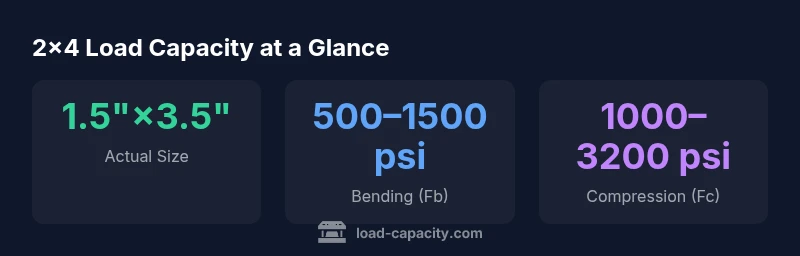
Bending strength is highly sensitive to species and grade. For common softwoods used in residential framing, short-term bending capacities (Fb) can range roughly from several hundred to over a thousand psi. Higher grades or denser species will yield higher values, while knots, grain deviations, and checks reduce effective capacity. The practical takeaway is that a 2x4 should be treated as a non-uniform member: its capacity will vary along its length and from one piece to another. When designing or validating a member for bending, use the specific species and grade data from code tables or manufacturer data, not a generic assumption. This approach guards against under- or over-design and improves structural reliability.
Axial Load Capacity: Studs, Posts, and Longitudinal Loads
Axial load capacity (compression along the grain) also varies with species and moisture. Short 2x4 segments may tolerate a few thousand psi in compression for dry, high-grade stock, but real-world service conditions usually yield lower safe values. Orientation matters: the slenderness of a stud or post, end conditions, and reinforcement details influence buckling risk. In practical terms, engineers translate these properties into allowable axial loads using published tables that account for length, end supports, and fixity. Always align design assumptions with the relevant code allowances and, for critical applications, consult a structural professional.
Shear and Connection Considerations in Framing
Shear strength across the grain governs how well a 2x4 can transfer loads at joints and connections. While cross-sectional area contributes, the presence of knots, grain runout, and species-specific shear properties also play roles. Fastener type, spacing, and edge distances further influence the actual shear capacity of a connection. In typical wood-frame assemblies, careful detailing of nails, screws, and metal connectors is essential to avoid weak links that could compromise the entire member system. When estimating connection performance, include both member strength and fastener capacity in the same assessment.
Reading Code Tables and Using Manufacturer Data
Modern practice relies on code-prescribed load tables (IBC/ICC or equivalent regional codes) and lumber manufacturer data. These sources summarize how Fb, Fc, and Fv vary with species, grade, moisture, and end conditions. To use them correctly, identify the exact species and grade of your 2x4, determine the moisture content, convert nominal sizes to actual dimensions, and apply the correct end conditions. For complex or critical designs, supplement tables with a professional engineer’s analysis.
Step-by-Step: From Material Selection to Safe Load Considerations
- Determine the application and required safety margins. 2) Identify the wood species and grade (No. 2, Select Structural, etc.). 3) Measure or estimate moisture content; kiln-dried lumber is typically drier than green stock. 4) Convert the nominal 2x4 to actual dimensions (1.5 in x 3.5 in). 5) Consult code tables for Fb, Fc, and Fv for the given species, grade, and moisture. 6) Consider end conditions, connections, and load duration. 7) If the calculated load approaches the table values or the structure bears critical risk, consult a licensed engineer.
Common Mistakes and How to Avoid Them
A frequent error is treating all 2x4s as if they have the same strength. Another pitfall is ignoring moisture implications or misreading grade designations. Overreliance on nominal dimensions without converting to actual dimensions leads to errors in area and moment calculations. Finally, neglecting to account for end conditions, such as pin supports vs. fixed connections, can produce inaccurate safety margins. By systematically checking species, grade, moisture, and connection details, you improve safety and performance.
Practical Workflow: From Material Choice to Safe Installation
Start with a clear design objective and identify the required loads. Pick a 2x4 with appropriate species and grade for the job. Verify moisture content, convert to actual dimensions, and review code table allowances. Document any assumptions about end supports and connection methods. When assembling the structure, document the fastener type, spacing, and edge distances. Finally, conduct a post-installation review to ensure alignment with code requirements and intended service life.
Representative load ranges for common 2x4 lumber by context
| Context | Species/Grade | Typical Load Range (psi) | Notes |
|---|---|---|---|
| Bending strength (Fb) parallel to grain | Softwood No. 2 (e.g., SPF) | 500–1800 | Species/grade dependent |
| Compression parallel to grain | Softwood No. 2 | 600–3200 | Depends on moisture and end conditions |
| Shear strength | Softwood generally | 100–900 | Cross-section and knot impact strength |
Quick Answers
What is the actual dimension of a 2x4?
Nominal 2x4 boards finish at about 1.5 inches by 3.5 inches. Always convert to actual dimensions before calculations, and account for moisture-driven dimensional changes.
A 2x4 isn’t actually 2 by 4 inches; it’s roughly 1.5 by 3.5 inches. Convert to those actual dimensions when planning loads.
Does grade affect load capacity?
Yes. Higher grade and certain species have fewer defects, which raises achievable strength. Always reference grade-specific tables for Fb, Fc, and Fv.
Grade matters a lot—stronger grades with fewer defects carry higher loads. Use the code tables for the exact values.
Can I rely on a single 2x4 for a load-bearing member?
Often not for critical structural loads. Use appropriately sized framing and verify against code requirements; consult an engineer for safety-critical designs.
Usually not safe to rely on one 2x4 for a load-bearing member. Check code tables or ask an engineer.
How do I determine safe loads for a 2x4?
Identify species and grade, measure moisture, convert to actual dimensions, and consult code tables for Fb, Fc, and Fv. For critical work, seek professional analysis.
Look up the exact species and grade, check moisture, convert to actual size, and use the code tables or get an engineer to review.
Are there online resources for 2x4 load capacity?
Yes. Use building codes, extension service publications, and manufacturer data. Ensure sources are current and regionally applicable.
There are good online resources, including building codes and university extensions. Make sure they’re current.
“There is no single fixed load rating for a 2x4; its capacity varies with wood species, grade, moisture, and how it's used. Always verify with current code tables and engineering judgment.”
Top Takeaways
- Identify species and grade before calculating loads.
- Use code tables for critical structural loads.
- Convert nominal to actual dimensions in calculations.
- Account for moisture content and timber season in planning.
- Consult a licensed engineer for safety-critical designs.