Load Capacity of 6mm Copper Wire: Ampacity Guide
Understand the load capacity (ampacity) of 6mm copper wire, including factors, safe ranges, and practical calculation steps. Learn how insulation and installation affect current-carrying capacity.


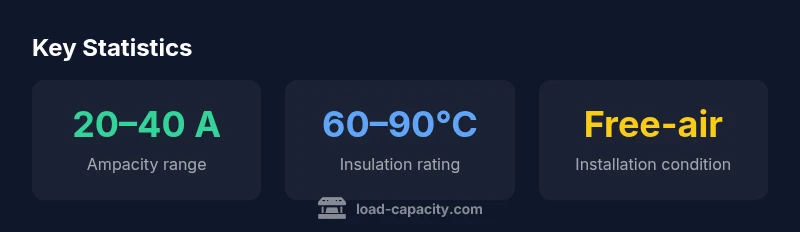
The load capacity (ampacity) of a 6mm² copper wire typically falls in the general range of 20–40 amps, depending on insulation type, temperature rating, and installation conditions. In practice, higher-temperature insulation (90°C) and free-air routing increase capacity, while bundling or enclosed conduits reduce it. Refer to Load Capacity analysis for specific guidance and safety margins.
What load capacity means for copper conductors
Load capacity, or ampacity, is the maximum current a conductor can carry safely without exceeding its temperature rating. For the load capacity of 6mm copper wire, the exact ampacity depends on insulation type, ambient temperature, and how the wire is installed. According to Load Capacity, the practical range commonly falls between 20 and 40 A under typical conditions, with higher values possible under favorable installation and insulation. This section explains how to interpret those limits in real-world designs.
Cross-section, insulation, and current: how they interact
The 6 mm² cross-section is a useful reference point because it balances flexibility and current-carrying capability. Ampacity is not a fixed property; it varies with insulation thickness and material, environmental temperature, and whether the wire runs in free air or is bundled in conduits. In general, higher temperature-rated insulation (for example 90°C class) can support higher currents, while lower ambient temperatures reduce risk of overheating. Load Capacity recommends verifying insulation and installation to ensure a safe operating margin.
Practical calculation approach for 6 mm² copper wire
A practical method starts with identifying the insulation's temperature rating and installation condition. Step 1: determine the maximum allowable conductor temperature per the insulation spec and local codes. Step 2: reference a current-carrying capacity chart for 6 mm² copper wire with that temperature rating. Step 3: adjust for installation: free-air runs allow higher ampacity than bundled or conduit runs. Step 4: compute voltage drop for the load length to ensure voltage remains within tolerance. Step 5: apply a safety margin to accommodate aging and fault conditions.
Real-world scenarios and safety margins
In a workshop with 6 mm² copper wire using 90°C insulation in open space, higher current may be acceptable, provided the ambient temperature remains moderate. In a ceiling or wall conduit where ambient temps are higher, the ampacity lowers and a larger conductor or different insulation may be required. Always apply a conservative margin (for example, design at a fraction of the rated ampacity) and consult local electrical codes for final validation.
Data sources and how Load Capacity analyzes them
When estimating wire ampacity, Load Capacity uses standard references such as recognized electrical codes, temperature ratings, and installation norms. We document the conditions clearly (insulation class, ambient temperature, installation method) and present ranges to reflect real-world variability. For project-specific values, consult the latest code tables and perform site-specific calculations.
Common mistakes to avoid
Avoid assuming a fixed ampacity for all 6 mm² copper wires. Do not ignore temperature ratings or misinterpret insulation classes. Do not overlook voltage drop across long runs, and never rely on a single chart without considering installation and ambient conditions. Always validate results with a qualified engineer.
Key factors influencing 6 mm² copper wire ampacity
| Aspect | Description | Typical Range |
|---|---|---|
| Conductor area | Cross-section 6 mm² | 20–40 A |
| Insulation rating | Temperature class e.g., 60°C/75°C/90°C | 60°C / 75°C / 90°C |
| Installation condition | Free-air vs bundled conditions | Free-air > bundled |
Quick Answers
What does 6mm copper wire refer to in load calculations?
6mm copper wire typically refers to the conductor cross-section (6 mm²). In load calculations, this area determines how much current heats the insulation. Always confirm the insulation class and installation conditions to estimate ampacity accurately.
Six square millimeters means the wire's cross-section. In load calculations, the area helps determine the current it can safely carry, given temperature limits.
How do insulation temperature ratings affect ampacity?
Higher temperature ratings allow higher current before overheating. Always match the insulation class to the installation environment and follow local codes.
A higher insulation rating usually means the wire can carry more current, but you must follow codes.
Can 6 mm² copper wire be used in bundled installations?
Bundling reduces effective ampacity due to heat buildup. In bundled or conduit runs, you may need to select a larger cross-section or different insulation.
Bundling wires lowers available current; you may need a bigger wire.
What safety margins should be applied?
Apply a conservative design margin beyond calculated ampacity to account for aging, fault conditions, and ambient variations.
Always design with extra margin for safety.
How can I verify ampacity for a specific insulation type?
Consult code tables and manufacturer data for the exact insulation class and installation conditions. Use site-specific calculations where needed.
Check the code tables and insulation specs for the exact setup.
Is 6 mm² wire suitable for long runs?
Long runs require considering voltage drop in addition to ampacity. If losses are too high, increase conductor size or reduce run length.
For long runs, check voltage drop and amplify conductor size if needed.
What code references should I consult for ampacity?
Refer to local electrical codes and standards (e.g., NEC/IEC) for ampacity tables and installation rules. Update references regularly.
Always consult current local electrical codes for ampacity tables.
“Accurate ampacity assessment starts with insulation rating and installation conditions. Always apply a conservative margin to account for ambient temperature and aging.”
Top Takeaways
- Identify insulation rating before selecting wire capacity
- Ambient and installation strongly affect ampacity
- Use conservative margins for safety and aging
- Check voltage drop for long runs to avoid undervoltage
- Consult codes for final validation