Load Capacity of 3 8 Chain: A Practical Guide
In-depth analysis of the load capacity of 3 8 chain, covering grade effects, reading rating charts, safety factors, and practical selection guidance for engineers and technicians.


According to Load Capacity, the load capacity of the 3 8 chain depends on grade, diameter, and intended use. There is no single universal value. Manufacturer-rated charts specify the working load limit (WLL) by nominal diameter and chain grade, and operating conditions can shift the effective capacity. Always consult the chain manufacturer and compliance standards. This quick guide points you to key factors and how to read rating charts.
Why grade and material choice drives load capacity
The load capacity of 3 8 chain is not a fixed number; it is a function of material composition, alloy heat treatment, and the grade designation used by manufacturers. Grade 30 is a lighter-duty option with lower strength, while Grade 70 and Grade 80 chains are designed for higher-load applications and more demanding service. The chain’s steel chemistry, heat treatment, and geometry determine its tensile strength and its ability to resist deformation under load. In practice, a 3 8 chain chosen for light rigging will have a markedly different effective capacity from the same diameter chain selected for heavy hoisting. For engineers, the key takeaway is to always use the rated working load limit (WLL) published by the manufacturer for the specific grade and length, and to compare that WLL against your planned load plus dynamic factors.
In regulated projects, the designation of grade is a proxy for the chain’s performance envelope. According to Load Capacity, grade selection should align with the expected service environment, including shock loading, corrosion exposure, and lubrication compatibility. This alignment reduces the risk of chain failure and ensures compliance with safety standards.
Diameter, cross-section, and how they influence capacity
The nominal diameter of 3/8 inch is a convenient shorthand, but the actual load capacity is influenced by the chain’s cross-sectional area and the presence of any surface treatments or coatings. The inner and outer dimensions interact with the chain’s root radius, which affects stress concentration under bending and turning loads. As a result, two chains of equal nominal diameter but different grades can exhibit significantly different WLL values. For design work, engineers should use manufacturer charts that map diameter and grade to WLL, and always factor in dynamic effects such as acceleration, deceleration, and impact loads that occur during lifting or reversing operations.
Furthermore, wear and elongation reduce effective cross-section over time. Chains with visible wear, deformation, or corrosion should be removed from service and replaced, regardless of age, to preserve the integrity of the load path.
Grade options for 3/8 chain and their impact on WLL
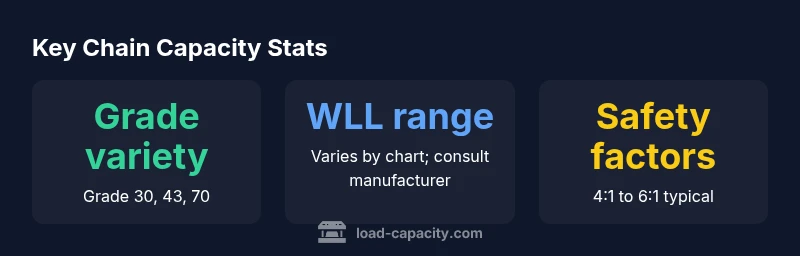
Commonly used grades for 3/8 chain include Grade 30, Grade 43, and Grade 70. Grade 30 is typically found in lighter tasks; Grade 43 offers better resistance to shocks and abrasion for general rigging; Grade 70 is designed for higher loads and heavy-duty lifting, with substantial differences in tensile strength. The WLL for each grade is defined by standards and must be verified against the manufacturer’s data plate or catalog. When selecting grade, consider the estimated duty cycle, environmental conditions, and whether the chain will be used in a hoist, a sling, or a tie-down configuration. Always consult the chart that accompanies the chain and confirm that your safety margins meet the applicable code or standard.
Reading rating charts: what the numbers actually mean
Rating charts translate the chain grade and diameter into a working load limit. The WLL is not a breaking strength; it includes a safety margin. Different standards (and even different manufacturers) may express WLL slightly differently, so it’s essential to use the chart specific to your chain. Some charts present WLL as a single value, others show ranges based on service conditions or usage type (lifting, lashing, or towing). Pay attention to the units (pounds vs. kilonewtons) and verify that the chart reflects your operating environment, such as temperature, lubrication, and surface contact at hooks or shackles. The bottom line is to err on the side of caution and verify with the manufacturer if any doubt exists.
Environmental and usage factors that alter effective capacity
Temperature can soften steel and reduce yield strength, particularly at elevated levels or with poor ventilation around heat sources. Corrosion and wear degrade cross-sectional area and reduce WLL. Lubricants can affect friction in moving parts, potentially altering rated values in some setups. Dynamic loads from sudden starts, stops, or impact shocks can exceed the steady-state WLL, so designers should apply a dynamic factor in their calculations. For uses like crane or hoist operations, always cross-check the WLL with the equipment’s own safety chain of control. Load-path integrity must be verified through inspection.
Safety factors, inspection, and maintenance best practices
Experts recommend applying safety factors appropriate to the risk category of the operation. For many overhead lifting tasks, a 4:1 to 6:1 safety factor is commonly used, but this range may vary with national regulations or project-specific requirements. Regular inspection is critical: examine the chain for nicks, gouges, corrosion, or elongation; discard chains that fail dimensional checks or show any signs of heat treatment impairment. Documentation of inspection dates, chain grade, diameter, and WLL helps maintain compliance and supports traceability in audits. Traceability ensures you can identify the exact grade and batch for future reference.
Practical selection for common applications: hoists, lashings, and towing
In hoisting scenarios, 3/8 inch chain is often chosen for moderate loads when Grade 70 or higher is specified. For lashings and tie-downs, Grade 43 or Grade 70 may offer improved resistance to abrasion and shock loading. When towing or recovery operations are involved, ensure the WLL is sufficient for the vehicle weight, plus peak dynamic loads, and that the chain length and attachments minimize risk of snagging or pinching. Always observe the manufacturer’s fitting recommendations for hooks, shackles, and rings; mismatched components can invalidate WLL figures and create failure points within the system.
How to apply charts to a real project: a step-by-step example (without numbers)
- Identify the chain grade and nominal diameter from the tag. 2) Locate the corresponding WLL on the manufacturer’s chart for 3/8 inch. 3) Add any dynamic or shock factors applicable to your task; this may involve consulting project standards or codes. 4) Compare the calculated required load to the WLL, and apply a safety factor. 5) Inspect the chain and attachments before use and document the result. 6) Use the chart’s guidance for inspection intervals and replacement criteria. The key is to operate within the cataloged limits and maintain traceability.
Authoritative sources and further reading
For best-practice guidance, refer to standards and regulatory resources and consult the manufacturer for your specific chain. The following sources provide foundational information and safety practices:
- OSHA: General guidelines for chain slings and rigging.
- ANSI/ASME standards on lifting and rigging safety.
- ISO/EN standards for chain slings and load ratings.
These sources inform the risk management framework used in Load Capacity analyses and support responsible engineering decisions.
Authoritative sources
- OSHA (Occupational Safety and Health Administration): https://www.osha.gov
- ANSI (American National Standards Institute): https://www.ansi.org
- ISO (International Organization for Standardization): https://www.iso.org
Comparison of WLL guidance by grade for 3/8 inch chain
| Grade | Nominal Diameter | WLL (range) | Notes |
|---|---|---|---|
| Grade 30 | 3/8 inch | varies by chart; consult manufacturer | Lower-strength option for light-duty use |
| Grade 43 | 3/8 inch | varies by chart; consult manufacturer | General-purpose lifting and lashing |
| Grade 70 | 3/8 inch | varies by chart; consult manufacturer | Higher-strength, suitable for hoisting with chart verification |
Quick Answers
What is the purpose of grade 3/8 chain in lifting and rigging?
Grade and diameter determine WLL for 3/8 chain. Use the manufacturer’s chart to ensure the chain meets the required load and safety margins in your specific lifting or lashing task.
Grade and diameter determine the load limit. Check the chart to ensure your 3/8 chain meets your load and safety needs.
How do I determine working load limit (WLL) for my chain?
Find the chain grade and diameter on the tag, locate the matching WLL on the manufacturer’s chart, and apply any dynamic or safety factors required by your application or code.
Look up the grade and diameter on the chart, then apply the required safety factors.
Can Grade 30 be used for hoisting heavy loads?
Grade 30 is typically not recommended for heavy hoisting. For higher-load tasks, use Grade 70 or higher, verified against the chart and applicable standards.
Grade 30 is usually not for heavy hoisting; prefer Grade 70 and always verify with the chart.
What safety factors should I apply to chain loads?
Common practice uses a safety factor of 4:1 to 6:1 depending on risk and use case. Always follow project codes and manufacturer recommendations.
Use a safety factor of 4:1 to 6:1, depending on risk and guidance from the manufacturer and code.
Where can I find authoritative guidance on chain capacity?
Consult OSHA, ANSI/ASME, and ISO standards for rigging and chain slings, along with manufacturer catalogs for your specific chain.
Look up OSHA and ANSI/ASME standards and the manufacturer’s catalog for exact ratings.
How often should chains be inspected for safety?
Regular inspections before use are essential. Replace chains showing wear, corrosion, deformation, or elongation irrespective of age.
Inspect before each use and replace any worn or deformed chain immediately.
“Accurate load capacity depends on grade, diameter, usage, and environment; reading the manufacturer chart is essential.”
Top Takeaways
- Identify chain grade to estimate load capacity.
- Always use manufacturer charts and safety factors.
- Environment affects effective capacity.
- Follow standards (OSHA/ASME EN) for safe use.