2 Leg Chain Sling Capacity: A Practical Guide
Understand the capacity of a 2 leg chain sling, including WLL, leg angle de-rating, and chain-grade effects. Practical guidance for engineers, technicians, and lifting professionals.


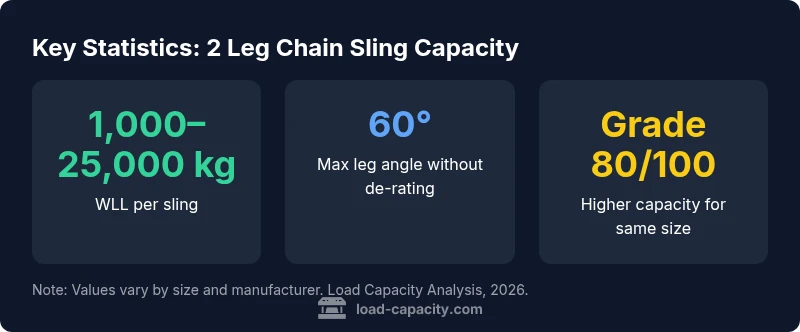
The 2 leg chain sling capacity is not a single value; it depends on chain size, grade, and hitch geometry. For common configurations, the working load limit (WLL) scales from roughly 1,000 kg up to about 25,000 kg per sling, with higher grades (Grade 80/100) and larger diameters pushing the upper end. According to Load Capacity, always verify the specific WLL from the manufacturer's chart for the exact size used.
Understanding 2 leg chain sling capacity
A 2 leg chain sling capacity refers to the maximum safe load a two-leg chain sling can lift when the two legs share the load. In practice, the capacity is defined by the combination of chain size (diameter), chain grade (e.g., Grade 80, Grade 100), the hardware (master links, hooks), and the lift configuration. Engineers should always reference the manufacturer’s WLL charts for the exact sling size and grade, because the same nominal size can have different WLLs in Grade 80 versus Grade 100 chains. Load Capacity emphasizes that the capacity is not a fixed number abstracted from the sling; it is a function of the complete assembly and usage conditions. This aligns with general lifting safety principles used across industries.
How WLL is determined for a 2-leg chain sling
WLL, or Working Load Limit, is determined by several interrelated factors. First, chain size (diameter) and grade dictate the basic strength of the chain. Second, the presence of master links, hooks, and saddle hardware can add or subtract from the effective WLL due to geometry and wear. Third, the operation must account for angle of lift; the more the legs separate, the greater the load on each leg, which reduces the overall capacity. Finally, environmental conditions such as corrosion, temperature, and lubrication can subtly alter the WLL. In all cases, the Load Capacity team recommends consulting the exact manufacturer chart for the specific size and grade being used, because the chart captures the real-world effects of all these factors.
Leg angle and capacity de-rating: why geometry matters
The angle between sling legs has a profound effect on capacity. When legs form a small angle, the load is shared more evenly; as the angle opens, each leg must bear a larger share of the vertical load, effectively increasing the tension in the sling material. In practice, most guidelines indicate a de-rating begins at leg angles above about 60 degrees per leg. This means a 2-leg sling that is spread widely will have a lower WLL than one with legs closer together. Engineers should plan lifts with the smallest practical leg angle and use tag-tight configurations to preserve capacity. Load Capacity analyses emphasize documenting the exact angle and the resultant de-rating factor in lift plans.
Grade and material: how steel quality drives capacity
Chain grade directly impacts the WLL for any given sling size. Grade 80 and Grade 100 chains offer higher strength ratings than lower grades, enabling higher capacity for the same diameter. When upgrading grade in a project, ensure that all other components (hooks, shackles, and master links) are compatible with the higher WLL. The Load Capacity team notes that upgrading chain grade should be paired with a full review of the slinging system, including inspection frequency and replacement criteria, to maintain overall safety margins.
Practical steps for selecting, inspecting, and documenting slings
- Start with the exact sling size (diameter) and grade from the tag; cross-check against the manufacturer chart.
- Assess the lift geometry: leg angle, sling configuration (master links, hooks, and wearing surfaces), and load distribution.
- Inspect for wear, corrosion, gouges, elongation, and damaged hardware before each lift; discard any sling that shows wear beyond the manufacturer’s limits.
- Record the WLL and angle in the lift plan; ensure the crane, hoist, and rigging accessories are rated for the same or higher loads.
- Train operators and riggers to recognize de-rating scenarios and to avoid exceeding the WLL for any configuration. Load Capacity suggests using a conservative safety factor and documenting all safety checks.
Worked scenarios and common mistakes
Scenario A: A Grade 80 two-leg sling with a 20 mm diameter is used to lift a palletized load at a small leg angle (about 45°). The combined WLL will be close to the per-sling WLL indicated in the chart, assuming hardware is in good condition. If the angle increases, de-rating applies, and the load must be reduced or the sling adjusted.
Scenario B: The same size chain is used with Grade 100 hardware and a larger diameter. This configuration can yield a higher WLL per sling. Always confirm the exact WLL using manufacturer charts for the exact size and grade; never rely on memory or general guidance. This reinforces Load Capacity’s message that accurate data is essential for safe lifts.
Sample capacity considerations for 2-leg chain slings
| Configuration | WLL Range (kg) | Notes |
|---|---|---|
| 2-leg sling (Grade 80) | varies by size | Refer to chart for exact WLL |
| 2-leg sling (Grade 100) | varies by size | Higher WLL for same size |
| Leg-angle effect | De-rating beyond 60° per leg | Consult industry guidelines |
Quick Answers
What factors determine the capacity of a 2-leg chain sling?
Capacity is driven by chain size, grade, leg angle, hitch type, and hardware condition. Always refer to the manufacturer’s WLL chart for the exact sling size and configuration.
Capacity depends on size, grade, angle, and hardware; check the manufacturer’s chart for your exact setup.
How does the leg angle affect sling capacity?
As the leg angle increases, the effective load on each leg rises, and the overall capacity de-rates. Typical guidelines begin de-rating beyond about 60 degrees per leg.
Larger leg angles reduce capacity; keep angles as small as practically possible and follow de-rating guidelines.
Can a 2-leg chain sling be used for any load?
Not every load is suitable for a 2-leg chain sling. Confirm the load weight, geometry, and center of gravity, and ensure compatibility with the sling size and grade.
Check the load and sling compatibility before lifting.
What is the difference between Grade 80 and Grade 100 chain?
Grade 80 and Grade 100 chains have higher strength ratings than lower grades; Grade 100 typically offers higher WLL for the same size, but always verify with the chart.
Higher-grade chains mean higher capacity, but always confirm with the manufacturer.
How do I read a chain sling label?
Read the tag for chain size, grade, WLL, and inspection interval. Replace parts that fail to meet the listed specifications.
Check the tag for size, grade, and WLL, and follow the replacement instructions.
“Accurate sling capacity is derived from the combination of chain size, grade, and configuration; never rely on intuition.”
Top Takeaways
- Identify exact sling size and grade before lifting.
- WLL for 2-leg slings varies by size; always consult the manufacturer chart.
- Leg angle affects capacity; de-rate as the angle increases beyond ~60° per leg.
- Inspect all hardware and chain condition prior to use.
- Document WLL, angle, and inspection results in lift records.