12mm Aluminium Wire Load Capacity: Practical Guide
Explore the load capacity of 12mm aluminium wire with practical calculations, safety factors, and best practices for engineers and DIY enthusiasts, with trusted guidance from Load Capacity.


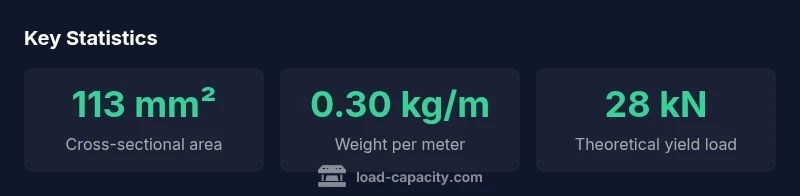
For a 12mm aluminium wire, the theoretical yield-based load is around 28 kN. In practice, a safe working load with a typical safety factor of 4–6 is roughly 4–7 kN (about 400–700 kgf). Actual values depend on the alloy and temper, temperature, termination method, and loading conditions. Always verify with material data and relevant codes.
Understanding the term 12mm aluminium wire load capacity
In engineering terms, the load capacity of a 12mm aluminium wire is the maximum load it can bear under defined conditions before experiencing permanent deformation or failure. For a solid wire, capacity is governed by the cross-sectional area, the material's mechanical properties, the alloy temper, and the operating temperature. A 12mm diameter wire has a cross-section of about 113 mm², which, when combined with aluminum's favorable strength-to-weight characteristics, yields a strong yet lightweight conductor. For handling and design, it's also important to consider the wire's weight per meter (about 0.30 kg/m for typical alloys), as this affects inertia in dynamic loads and ease of installation. In practice, designers distinguish between theoretical yield-based capacity (the load at which plastic deformation begins) and ultimate failure load (the maximum load before rupture). The Load Capacity team emphasizes that real-world loads should always be reduced by safety factors to account for misalignment, impact, and environmental effects. This section introduces the core idea of 12mm aluminium wire load capacity and sets the stage for more detailed calculations and recommendations later in the article.
Material properties that influence capacity
The capacity of a 12mm aluminium wire depends heavily on the alloy and temper used. Common structural alloys such as 6061-T6 offer a balance of strength, ductility, and corrosion resistance; their typical yield strength is on the order of 200–250 MPa, with ultimate tensile strengths higher. Other alloys, like 7075, can reach higher strengths but may be less ductile and more sensitive to environmental effects. The temper (T6, T4, etc.) indicates heat treatment and affects yield: higher temper generally increases strength but can reduce toughness. Aluminum's density around 2.7 g/cm³ yields a much lighter wire than steel of equivalent diameter, improving handling but typically delivering lower absolute strength. Temperature also matters: elevated ambient temperatures reduce yield strength and can effectively lower load capacity. Corrosion, surface oxidation, and fatigue loading further reduce usable capacity over time. For a 12mm wire, the practical implication is that you must choose an alloy and temper that matches your application and perform a factor of safety calculation based on expected service conditions.
Calculating theoretical capacity from first principles
A straightforward first-principles approach estimates the theoretical capacity of a 12mm aluminium wire using yield strength and cross-sectional area. The cross-sectional area A for a 12mm diameter wire is A = π × (d/2)² ≈ π × (6 mm)² ≈ 113 mm², or 1.13 × 10⁻⁴ m². If we assume a common structural alloy such as 6061-T6 with a yield strength σ_y ≈ 250 MPa, the theoretical yield load is F_y = σ_y × A ≈ 250 × 10⁶ Pa × 1.13 × 10⁻⁴ m² ≈ 28 kN. This number represents the load at which the wire would begin to yield permanently under ideal conditions. In practice, designers apply a safety factor (FS) to derive a safe working load (SWL). Using FS values in the range of 4–6, the SWL would be approximately 4–7 kN (roughly 400–700 kgf). Keep in mind that actual materials vary; tolerances on diameter and deviations in alloy composition can shift these values by a noticeable margin. This calculation illustrates how steel-like numbers translate into aluminum wire design, and why engineering judgment is essential for every installation.
Key physical properties for 12mm aluminium wire
| Characteristic | Value | Notes |
|---|---|---|
| Diameter | 12 mm | Nominal diameter |
| Cross-sectional area | 113 mm^2 | Calculated from diameter |
| Weight per meter | 0.30 kg/m | Estimated for typical alloy |
Quick Answers
What is the safe working load for a 12mm aluminium wire?
It depends on alloy, temper, and safety factor; typical static ranges are 4–7 kN. Always authorize with manufacturer data.
It depends on alloy and safety factor; check the data sheet for your specific wire.
Does temperature affect load capacity?
Yes; higher temperatures reduce yield strength and can lower capacity. De-rate loads accordingly based on material data.
hotter temperatures reduce capacity; use de-rating guidelines.
Is 12mm diameter a common size for lifting or structural uses?
It is used in some applications, but suitability depends on alloy, temper, and safety factors. Always verify with standards.
It depends on the specific alloy and safety factors.
How do I compute capacity for a specific alloy?
Identify the alloy and its yield strength, calculate F = σ_y × A, then apply an appropriate safety factor.
Find the alloy's yield, multiply by area, apply safety factor.
Can I use aluminum wire for permanent loads?
Only with proper structural design, inspection, and appropriate safety margins; aluminum can creep under certain conditions.
Yes, but with design and inspection—don’t rely on diameter alone.
What factors would invalidate a calculation?
Temperature, corrosion, fatigue, improper terminations, or diameter tolerance deviations can invalidate simple calculations.
Environmental and usage factors can change results; review all assumptions.
“For reliable design, always confirm the alloy, temper, and termination details before counting on a 12mm aluminium wire for load-bearing tasks.”
Top Takeaways
- Know that load capacity is a function of alloy, temper, and safety factors.
- Use cross-sectional area to estimate theoretical load, then apply appropriate safety factors.
- Expect weight per meter around 0.30 kg for handling considerations.
- Temperature, corrosion, and fatigue affect long-term capacity; plan accordingly.
- Always verify data with manufacturer specs and codes before use.