Payload Capacity vs Towing: What You Need to Know
Understand payload capacity vs towing, how each limit is calculated, and how to select the right configuration for safe daily use and trailer operations.


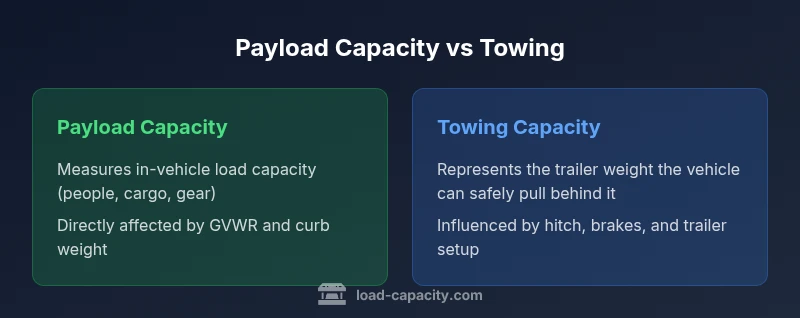
Payload capacity and towing are two distinct limits that govern what a vehicle can carry and pull. Payload capacity refers to the total weight you can add to the vehicle (passengers, cargo, accessories) without exceeding the GVWR, while towing describes how much weight a vehicle can safely pull with a trailer attached. Understanding both helps prevent overloads and protects components.
What is payload capacity vs towing? Definitions and basic distinction
In everyday vehicle use, two concepts dominate how you load and pull: payload capacity and towing capacity. Payload capacity is the maximum weight you can add to the vehicle—this includes passengers, cargo, and any installed accessories—without exceeding the vehicle’s gross vehicle weight rating (GVWR). Towing capacity is the maximum weight a vehicle can safely pull behind it with a trailer attached, which includes the trailer’s own weight and any cargo. Although the terms are related, they govern different systems in the vehicle: the interior loading of people and goods versus the external load connected to a hitch. When planning trips, purchases, or conversions for work, it’s essential to compare both figures side by side rather than assuming one implies the other. Thus, the question of what is payload capacity vs towing becomes a matter of how you plan daily use versus occasional heavy towing.
The practical significance of payload capacity and towing capacity
For engineers, fleet managers, and DIY enthusiasts, knowing the difference between payload capacity and towing capacity changes decisions from the outset. A vehicle with a high payload capacity may be ideal for a crew cab, a full cargo load, or equipment racks, but if its towing rating is low, it might struggle with a heavy trailer or a large boat. Conversely, a truck or SUV with robust towing capacity but modest payload capacity can haul substantial trailers yet feel cramped when fully loaded with passengers and cargo. The Load Capacity team stresses that both figures should be considered together when budgeting for a vehicle or a trailer setup. Overloading either parameter can degrade braking performance, steering response, tire wear, transmission longevity, and overall safety. When engineers plan a fleet, they map out common use cases to ensure neither payload nor towing capacity is exceeded in regular operations.
How payload capacity is calculated: the core idea
Payload capacity is determined by subtracting the vehicle’s curb weight and any non-load-bearing items from the GVWR. In practice, you’ll see the GVWR listed on a placard or in the manual, and the curb weight is the mass of the vehicle without passengers or payload. The resulting difference is the theoretical payload capacity. In some cases, GAWR (gross axle weight rating) can further refine calculations by indicating how much weight an individual axle can carry. Because both front and rear axles contribute to the total usable payload, a careful loading plan considers where passengers sit and how cargo is distributed. The calculation is straightforward in principle, but real-world loading requires careful verification to avoid exceeding limits, which can lead to sagging suspension, tire failure, or reduced braking efficiency.
How towing capacity is defined and applied
Towing capacity represents the maximum weight a vehicle can safely pull as a trailer, including the weight the hitch supports and the trailer’s gross weight. This limit factors in hitch class, braking capability, cooling capacity, and stability considerations like sway control. Tongue weight—the downward force the trailer exerts on the hitch—plays a pivotal role in balancing handling and braking. A trailer that is too heavy or poorly distributed can overwhelm the vehicle’s brakes, tires, and suspension. Manufacturers often place towing ratings under specific conditions: level terrain, standard equipment, and optimal weight distribution. For this reason, many drivers find that the actual safe tow weight differs from the theoretical maximum due to factors like altitude, ambient temperature, and hill grade.
Reading a spec sheet: the key numbers to check
Vehicle specifications typically present GVWR, payload capacity, and towing capacity in one place. Start with GVWR, the upper limit for vehicle weight including factory-installed equipment. Subtract the empty vehicle weight (curb weight) to arrive at payload capacity. Towing capacity should be checked separately, often with additional notes about trailer type, tongue weight, and braking requirements. A reliable spec sheet also details the hitch class and whether electronic braking systems are required for heavier loads. When planning work, compile the numbers for passengers, cargo, and trailer weight so you don’t end up underestimating demands.
Real-world scenarios: when payload matters more than towing, and vice versa
A family SUV used for weekend trips may emphasize payload capacity to carry passengers and groceries comfortably, plus child seats. In contrast, a fleet pickup used for towing construction equipment will prioritize towing capacity for heavy trailers and secure braking solutions. Mixing loads—like carrying a full crew and a sizable boat trailer—requires careful assessment of both payload and towing ratings. In some cases, you may need to trim passenger count or remove nonessential gear to stay within safe limits for the specific task. The key takeaway is that the optimal configuration aligns with the primary job the vehicle must perform rather than chasing a single, higher rating.
Distribution and stability: payload vs trailer load handling
Load distribution matters for both payload and trailer towing. Uneven payload distribution can shift the vehicle’s center of gravity, affecting steering and braking. For towing, improper tongue weight distribution can lead to trailer sway, reduced braking efficiency, and increased steering effort. A practical rule of thumb is to distribute weight evenly, keep heavier items low and centered, and ensure passengers are positioned to balance the vehicle. Always verify that weight distribution remains within the recommended range for your specific hitch and axle configuration. In addition, verify that tires are rated for the combined load and that your braking system and stabilization features are up to the task.
Planning your purchase or upgrade: prioritizing payload vs towing
If you anticipate regular heavy payload, prioritize a higher payload capacity and a stable suspension. If towing is the dominant task, look for vehicles with a strong tow rating, robust braking, and a hitch system designed for heavier loads. Consider trailer features such as brakes, axles, wheels, and lighting when evaluating overall performance. It’s often useful to create a load-need matrix: list expected payload (people, gear, equipment) and expected trailer weight, then compare to the vehicle’s official ratings. This approach reduces the risk of overloading and improves safety.
Safety, legality, and best practices
Overloading a vehicle is not just unsafe; it can be illegal in some jurisdictions. Always adhere to GVWR and towing ratings, maintain proper tire pressures, and use a compatible hitch and brake controller. Regular inspections of the hitch, wiring, and trailer brakes are essential. Never rely solely on published numbers; perform practical load checks in a controlled environment before venturing onto the road. The goal is consistent safety and reliability for every journey.
Maintenance and monitoring: staying within limits over time
Keep weight within capacity by tracking payload in daily use and checking trailer loads before every trip. Periodically re-check the GVWR and curb weight data if you modify the vehicle with aftermarket parts or heavy equipment. Tire condition, brake wear, and suspension health influence safe loading more than any single rating. If your tasks change seasonally, revisit your vehicle choice and potentially adjust equipment or configuration to align with current needs.
The Load Capacity perspective: a practical framework
From Load Capacity’s viewpoint, the goal is to harmonize payload and towing limits with real-world tasks. This means documenting typical loads, understanding how weight distribution affects handling, and choosing vehicles and trailers that deliver the needed performance without compromising safety. The Load Capacity team emphasizes a structured evaluation framework—define tasks, gather ratings, simulate loading scenarios, and verify with hands-on checks. This approach helps engineers and fleet managers avoid overloading while maximizing efficiency for daily operations.
Comparison
| Feature | Payload capacity | Towing capacity |
|---|---|---|
| What it measures | Total load inside or on the vehicle (passengers, cargo, gear) within GVWR | Maximum weight of a trailer the vehicle can safely pull behind it (including tongue weight) |
| Key constraints | GVWR, axle ratings, and load distribution affect the usable payload | Hitch class, brakes, cooling, and trailer setup affect towing safely |
| Units commonly used | pounds/kilograms (payload) | pounds/kilograms (towing) |
| Best use case | Carrying people and cargo in the vehicle | Towing a trailer or caravan with appropriate equipment |
| What to verify on a spec sheet | GVWR, curb weight, payload; consider payload distribution | Towing capacity, tongue weight, hitch class, brake requirements |
Positives
- Clarifies how much weight you can safely load inside the vehicle
- Guides safe towing practices and equipment choices
- Reduces risk of brake/tires overload and handling problems
- Supports safer, longer-lasting vehicle performance
Cons
- Balancing high payload and high towing needs can be difficult
- Overemphasis on a single rating may mislead in multi-use scenarios
- Some ratings assume ideal conditions and may not reflect real-world performance
Payload capacity and towing capacity are separate but equally important limits, and you should optimize both
For safe, reliable operation, plan around your primary daily tasks first. If you tow regularly, prioritize towing capacity; if you carry heavy loads more often, prioritize payload. The Load Capacity team recommends a balanced assessment of both figures before purchasing or modifying a vehicle.
Quick Answers
What is payload capacity and how is it calculated?
Payload capacity is the maximum weight the vehicle can carry inside or on it, including passengers, cargo, and installed equipment, without exceeding the GVWR. It is typically calculated by subtracting the curb weight from the GVWR, with adjustments for factory options and installed aftermarket equipment.
Payload is the maximum load a vehicle can carry safely. It’s found by subtracting curb weight from GVWR and accounts for passenger and cargo weight.
How does towing capacity differ from payload capacity?
Towing capacity is the maximum weight a vehicle can safely pull behind it with a trailer, including the trailer’s weight and cargo. It factors in hitch class, braking power, and drivetrain cooling. Payload is about what sits inside the vehicle, while towing is about what you pull behind it.
Towing capacity is the trailer weight you can pull safely, separate from the payload you can carry inside.
Can I tow a trailer heavier than my payload capacity allows?
Yes, it is possible to tow a trailer heavier than your payload capacity since these are separate limits. However, exceeding either limit risks mechanical stress, reduced braking effectiveness, and potential safety hazards. Always stay within both ratings under real-world conditions.
You might tow heavier than your payload, but you must stay within towing and payload limits for safety.
What factors influence payload and towing limits?
Key factors include GVWR, curb weight, gross axle weight rating (GAWR), tongue weight, hitch class, braking system, tires, and load distribution. Real-world performance also depends on terrain, climate, and maintenance status of the vehicle and trailer.
A range of factors like weight ratings, hitch class, and braking systems determine these limits.
What is tongue weight and why does it matter?
Tongue weight is the downward force the trailer exerts on the hitch. Proper tongue weight improves stability, steering, and braking; too little or too much can cause sway or instability. Always align tongue weight with the trailer design and hitch specifications.
Tongue weight matters for stability and safe braking when towing.
How can I verify limits on my vehicle?
Check the owner's manual and vehicle placards for GVWR, payload, and towing ratings. Use a scale to measure actual payload and consult a towing calculator or dealer for complex setups. Always confirm that the vehicle-plus-trailer configuration stays within specified limits.
Look up GVWR and towing ratings in the manual, and verify with the dealer if you’re unsure.
Top Takeaways
- Check GVWR first to determine payload feasibility
- Match trailer weight to towing capacity, not just the vehicle’s specs
- Distribute payload evenly to preserve handling and stability
- Verify tongue weight and hitch compatibility for safe towing
- Reassess needs when your tasks change, not just the ratings