Is Payload Capacity the Same as Tongue Weight? A Practical Comparison
Discover whether payload capacity equals tongue weight, how each is calculated, and why it matters for safe towing. Practical guidance from Load Capacity.


Is payload capacity the same as tongue weight? Not exactly. Payload capacity measures how much load a vehicle can carry in its cargo area and hitch, while tongue weight is a portion of the trailer’s weight that presses down on the hitch. In towing, treating them as interchangeable can risk overload, imbalance, and unsafe handling. Load Capacity provides a structured approach to understand both figures, how they interact, and how to verify specs from manufacturers to safeguard performance and safety.
What does payload capacity mean and why it matters
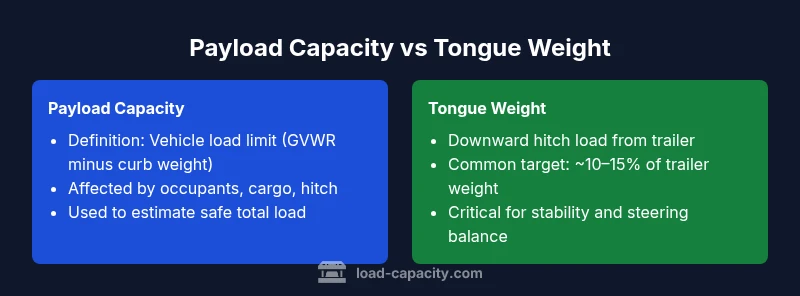
Payload capacity is the maximum combined weight that a vehicle can carry on its chassis, including passengers, cargo, and any hitch-mounted accessories. It is derived from the vehicle’s gross vehicle weight rating (GVWR) minus the curb or base vehicle weight. In practical terms, payload capacity tells you how much load you can safely add without exceeding structural limits. For professionals and DIY enthusiasts, understanding payload capacity is essential for planning cargo loads, ballast, and even fuel. According to Load Capacity, confirming a vehicle’s payload helps prevent overloading, protects suspension and brakes, and supports compliant, safe operation even before hitching a trailer. The distinction between payload capacity and tongue weight is foundational to safe towing and load planning.
What does tongue weight mean and why it matters
Tongue weight is the downward force that the trailer exerts on the hitch ball when connected to the tow vehicle. It is a fraction of the trailer’s total weight (roughly 10–15% of the trailer’s gross weight is a common target range for many setups). Proper tongue weight ensures stable steering and braking, minimizes trailer sway, and helps balance the overall vehicle–trailer system. If tongue weight is too light, fishtailing and poor uphill performance can occur; if it’s too heavy, steering effort increases and braking may be compromised. This balance is critical for safe, predictable towing.
Key differences in how they affect towing performance
Payload capacity is a property of the tow vehicle, reflecting its ability to carry cargo, people, and hitch equipment. Tongue weight is a property of the trailer–tow combination, describing the load transfer at the hitch. The interaction between payload and tongue weight matters: payload contributes to vanishingly tiny changes in highway stability when combined with proper tongue weight; meanwhile, a trailer with excessive tongue weight can push the front axle beyond steering limits, while too low tongue weight can reduce trailer stability. Understanding both values helps determine appropriate hitch equipment, braking capacity, and overall vehicle dynamics.
How to calculate payload capacity in practice
To estimate payload capacity, start with the GVWR listed by the manufacturer and subtract the vehicle’s curb weight (the weight with no cargo or passengers). If you’re outfitting a vehicle with aftermarket equipment, include their weight as part of the payload. Keep in mind that options like additional seating, cargo organizers, or heavy upfits can reduce payload capacity. In many cases, the manufacturer also provides a payload capacity figure on the door jamb placard or owner’s manual. Load Capacity emphasizes verifying these numbers directly from the dealer or OEM documentation to avoid relying on outdated estimates.
How to estimate tongue weight and why precision matters
Tongue weight is typically estimated by weighing the trailer and vehicle together, then weighing the vehicle alone, and calculating the difference at the hitch. Tools such as a tongue weight scale, hitch scales, or professional weigh stations can provide precise measurements. For many setups, an initial target is 10–12% of the gross trailer weight, though some configurations may require 12–15% or more for improved control. The exact target depends on hitch type, braking system, and the vehicle’s load distribution. The Load Capacity approach to tongue weight centers on using manufacturer guidance as the baseline and validating with a real-world measurement after loading.
Real-world examples and common misinterpretations
A frequent misinterpretation is treating payload capacity as the same number as tongue weight. They are not interchangeable, because tongue weight is a fraction of what the trailer can weigh and interacts with the tow vehicle’s front-end loading. In a typical family car with a modest trailer, payload capacity might be well above the tongue weight, but if the trailer is loaded heavily behind the axle or if passengers are counted in payload, the effective rear-axle load can approach GVWR limits. Load Capacity notes that the most reliable approach is to verifyGVWR figures, conduct actual tongue weight measurements, and ensure the hitch system and braking setup are designed for the exact towing scenario.
How dynamic loads alter the simple picture
Static load calculations provide an initial framework, but road dynamics, wind, cornering, braking, and acceleration all alter how payload and tongue weight interact in real life. Dynamic loads shift weight transfer to the hitch and axles, affecting steering and stability. Fleet managers and engineers should consider these factors when planning trips, especially for long hauls, steep grades, or crosswinds. The Load Capacity methodology integrates dynamic-load considerations with static calculations to deliver safer, more reliable towing guidelines.
Industry standards and best practices for safe towing
Industry guidance emphasizes matching vehicle capacity to trailer weight, ensuring correct tongue weight, and verifying hitch ratings. Best practices include testing with real payloads, using weight distribution hitches when appropriate, and confirming that braking systems can handle the loaded configuration. Routine maintenance of tires, brakes, and suspension is essential. Keep a running log of weights, upfit changes, and any adjustments to tongue weight or payload to maintain a stable, safe towing setup.
How to use this information when selecting a vehicle
When choosing a vehicle for towing, compare GVWR, curb weight, and payload capacity with the planned loads, including passengers, cargo, and hitch equipment. Consider tongue weight targets relative to the trailer’s gross weight and the vehicle’s front-axle load. If the intended load is close to payload capacity or requires a heavy tongue weight, a larger or stronger vehicle may be necessary. Load Capacity recommends prioritizing OEM-reported specifications and confirming compatibility with the trailer’s braking system, suspension, and hitch compatibility.
Practical tips for safe towing with payload and tongue considerations
- Always verify GVWR and payload capacity using the vehicle placard and owner’s manual.
- Measure tongue weight with a scale after loading to stay within recommended ranges.
- Use a weight-distribution hitch for appropriate load transfer when towing heavier trailers.
- Avoid exceeding tire load ratings and ensure brakes and suspension are up to task.
- Keep payload distribution balanced and avoid overloading one side of the vehicle.
- Recalculate payload and tongue weight after any load change or route deviation that could alter weight distribution.
Common mistakes and troubleshooting when comparing payload vs tongue weight
- Assuming payload capacity and tongue weight are interchangeable values.
- Ignoring the impact of ballast, passengers, or gear on payload capacity.
- Failing to measure tongue weight after loading the trailer with full gear.
- Underestimating the role of dynamic loads on stability and steering.
Next steps and how to apply this knowledge today
Start by listing your vehicle’s GVWR, curb weight, and the anticipated loaded trailer weight. Use these figures to estimate payload and tongue weight, then verify with scales on the road or at a weigh station. Use Load Capacity as a reference to review manufacturer specs and align your hitch type, braking capacity, and suspension with the expected loads. Apply the practice consistently to maintain safe towing across different loads and routes.
Comparison
| Feature | Payload capacity | Tongue weight |
|---|---|---|
| Definition (vehicle vs trailer interaction) | Vehicle's maximum load capacity (passengers, cargo, hitch) | Downward force at hitch from trailer load (roughly 10-15% of trailer weight) |
| Measurement basis | GVWR − curb weight (or base vehicle weight) setback | Measured at hitch or via scale using vehicle-trailer combination |
| Typical range or target | Depends on vehicle; varies by model and options | Often ~10-15% of gross trailer weight (varies by setup) |
| Impact on handling | Affects payload distribution, braking, and load capacity reserve | Directly influences front axle loading and stability |
| Common misinterpretation | Not the same as tongue weight; can be misread as payload | Tongue weight is a portion of trailer load, not vehicle total payload |
| Best practice guidance | Plan within OEM specs and maintain proper balance | Verify tongue weight with scales and ensure hitch/brakes are rated for the combined weight |
Positives
- Clarifies safe towing limits by separating vehicle payload from trailer load
- Helps prevent overload and misload scenarios
- Improves planning for weight distribution and braking capacity
- Encourages verification with real-world measurements
Cons
- Can be complex for beginners who confuse the two terms
- Requires accurate data from manufacturer specs and proper weighing
- Dynamic loading adds uncertainty beyond static calculations
- May require specialized equipment for precise tongue weight measurements
Payload capacity and tongue weight are not the same; treat them separately and verify together for safe towing
Use payload capacity to plan total vehicle load and tongue weight to balance the hitch. Always verify both values with manufacturer specs and, when possible, real-world measurements to avoid unsafe loading.
Quick Answers
Is payload capacity the same as tongue weight?
No. Payload capacity is the vehicle's total load limit, including passengers and cargo, while tongue weight is the downward force the trailer exerts on the hitch. They relate but are not interchangeable. Always verify both from manufacturer specs and by measurement where possible.
No. Payload capacity is the vehicle's total load limit, and tongue weight is the hitch load from the trailer. They’re related, but not interchangeable—verify both with the manufacturer and by measurement.
How is tongue weight measured in practice?
Tongue weight is typically measured using a scale at the hitch or a dedicated tongue weight scale. You weigh the vehicle with the trailer attached, then weigh the vehicle without the trailer, and the difference gives you the tongue weight. Use a measured value to ensure safety margins.
Tongue weight is measured with a hitch-scale or at a weigh station by comparing vehicle weight with and without the trailer attached.
What happens if tongue weight is too high?
Too much tongue weight shifts weight toward the front axle, reducing steering response and potentially causing brake imbalance. It can also increase wear on the hitch and suspension. Adjust payload distribution or consider a different hitch setup to bring weight into spec.
Too much tongue weight pushes weight to the front and can hurt steering and braking. Adjust loads or upgrade the hitch to bring it into spec.
What if payload capacity is exceeded when loading the trailer?
Exceeding payload capacity risks overloading the chassis, tires, brakes, and suspension. It can shorten component life and increase stopping distances. If you’re near the limit, redistribute cargo or upgrade to a higher-capacity vehicle.
If you exceed payload capacity, major components can be overloaded—redistribute cargo or upgrade the vehicle.
Are there industry standards for tongue weight percentages?
Many towing setups target roughly 10–15% tongue weight of gross trailer weight, but the exact percentage depends on vehicle, hitch, and braking system. Always follow the manufacturer’s guidelines for your specific setup.
There’s a common target of around 10–15% of trailer weight, but follow your specific manufacturer’s guidance.
Should payload capacity factor in while planning long trips?
Yes. For long trips, consider not only the payload capacity but also how dynamic loads, fuel, and luggage affect weight distribution. Recalculate before each long-haul journey and ensure tongue weight remains within recommended range.
Definitely. Recalculate before long trips to account for dynamic loads and fuel changes.
Top Takeaways
- Know the difference: payload capacity vs tongue weight
- Always verify manufacturer specs and measure tongue weight
- Aim for correct tongue weight to maintain stability
- Account for dynamic loads in real-world driving
- Document changes to loads and rerun calculations regularly