Payload Capacity vs Towing Capacity: A Clear Comparison
Is payload capacity the same as towing capacity? Learn how these ratings differ, how to calculate each, and why accurate measurements matter for safety and performance.


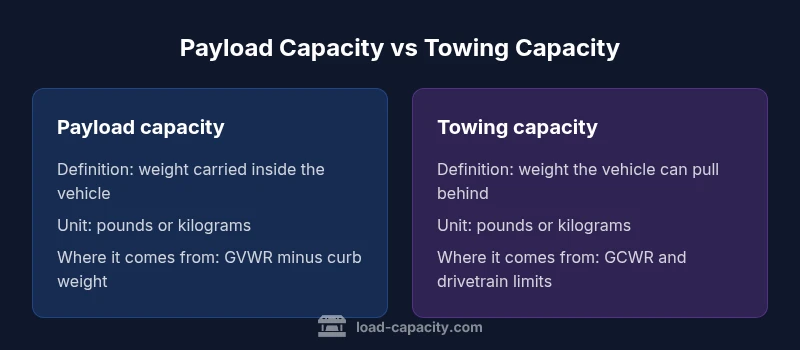
According to Load Capacity, payload capacity and towing capacity are related but not the same. Payload capacity describes the maximum weight the vehicle can carry inside (passengers, cargo, fluids, and equipment), while towing capacity is the maximum weight the vehicle can pull behind it with a trailer. Misunderstanding these limits can lead to unsafe loading or towing beyond braking capacity. Use both ratings to select a safe, capable vehicle.
Is payload capacity the same as towing capacity?
In many fleets and garages, people ask whether payload capacity and towing capacity refer to the same limit. The short answer is no, but the nuance matters for safety and compliance. According to Load Capacity, payload capacity describes the weight you can carry inside the vehicle, including passengers, cargo, fluids, and optional equipment, while towing capacity describes the weight the vehicle can pull behind it in a trailer. These values come from different parts of the vehicle’s design and testing, and they are best understood as separate constraints that must be managed together.
Why the distinction matters: If you overload payload, you can exceed the GVWR, which undermines braking, steering, and suspension performance. If you tow beyond the towing rating, you overload the drivetrain and braking system during acceleration and descent. The effects are not purely theoretical; they show up as reduced braking efficiency, longer stopping distances, and uneven handling. In practice, many drivers pursue a balance: they select a vehicle with a payload rating sufficient for their regular occupants and cargo, while also ensuring the towing rating accommodates the trailers they plan to use. The result is safer operation and better warranty protection.
Note on context: GVWR and GCWR are the governing limits. GVWR defines the maximum weight the vehicle can safely carry, while GCWR defines the combined weight of the vehicle and its trailer. Always compare ratings side by side before purchasing.
How payload capacity is defined
Payload capacity is the maximum weight the vehicle can safely carry inside the cabin and cargo area. It includes all occupants, cargo, fluids, and aftermarket accessories that contribute to weight. The rating is derived from the vehicle’s GVWR minus its curb weight and any weight from factory-installed options. The door jamb or VIN labels typically list the GVWR and sometimes the curb weight; the payload figure can be calculated by subtracting the curb weight from the GVWR. When you add passengers, luggage, and gear, you reduce available payload accordingly. Manufacturers also consider load distribution across axles to prevent exceeding axle weight ratings (GAWR). Some vehicles publish a separate payload rating for different trim levels or packages, reflecting heavier equipment or upgraded batteries. For planning, treat payload as the internal limit for people and cargo, not the towing scenario. A practical approach is to list regular occupants and cargo items, run the sum against the published payload rating, and then verify that this sum leaves margin for incidental items like fluids and emergency gear. Remember that payload capacity is a hard constraint for daily use and safety, independent of towing tasks.
How towing capacity is defined
Tow capacity is the maximum weight a vehicle can pull behind it, including the trailer’s weight and its contents. It is determined by the vehicle’s GCWR and other drivetrain and braking constraints. The GCWR is the sum of the vehicle’s unloaded weight plus all payload and tongue weight on the hitch. When towing, tongue weight, hitch type, suspension, brakes, and gearing all influence performance. The rating takes into account dynamic factors such as acceleration, braking, cornering, and hill-haul capability. Importantly, the towing capacity is not a single number; it depends on hitch configuration (e.g., weight-distribution hitches) and any modifications that affect the frame or drivetrain. For safe towing, keep the trailer’s gross weight at or below the published towing capacity, and ensure that tongue weight remains within the recommended range. If you plan to upgrade or modify a vehicle to tow heavier trailers, consult the manufacturer’s guidelines and seek a professional weight rating assessment to confirm the new GCWR remains within safe operating limits.
Practical implications for vehicle selection and loading
Choosing between payload and towing ratings requires matching use case to capability. If your primary need is carrying several passengers with cargo, prioritize a high payload rating and a generous GVWR so that occupant weight and gear stay within limits. If your work involves pulling a trailer, a robust towing rating is essential, but remember that trailer weight reduces payload capacity because of GCWR constraints. Weight distribution matters: keep tongue weight within recommended percentages and avoid concentrating heavy items in one area. Consider the impact of add-ons such as winches, ladders, or auxiliary fuel tanks, which increase curb weight and reduce usable payload. For fleets, plan loads using a load chart that shows available payload under typical duty cycles and ensure drivers understand the constraints. In all cases, always confirm the latest manufacturer specifications (GVWR, GCWR, GAWR) and ensure that the vehicle’s capabilities align with the intended use.
How to calculate and verify your vehicle ratings
Begin with the official numbers: locate GVWR, GCWR, curb weight, and GAWR on the door sticker, owner’s manual, or manufacturer literature. Compute payload capacity as GVWR minus curb weight plus any installed aftermarket equipment that contributes to the payload. For towing, confirm GCWR and consider tongue weight, hitch type, and braking capacity. Use the vehicle’s payload and tow ratings under actual configurations to determine safe limits for specific trips. If you modify the vehicle, request a formal re-rating from the manufacturer, and document all changes that affect weight and handling. For added confidence, cross-check with independent weight testing or weight-distribution charts from reputable sources, and maintain a written load plan for every trip. The goal is to keep real-world load within the published numbers and avoid last-minute surprises at the ramp, hitch, or weigh station.
Common mistakes and pitfalls
Common mistakes include assuming payload capacity equals towing capacity, overlooking weight distribution, and ignoring tongue weight when hitching a trailer. Another error is loading with a heavy cargo high in the cabin; this can shift weight and reduce stability. People also forget to update ratings after aftermarket upgrades or when adding a heavy battery or equipment, which can invalidate warranty coverage and insurance. Some drivers plan trips based on nominal capacities without considering dynamic factors such as braking performance, sway, and road grade. Finally, relying on a single rating without considering GAWR and axle ratings can lead to overstressing wheels or suspension. The most reliable approach is to treat payload and towing capacity as two linked but distinct limits and verify both before any trip.
Safety and regulatory context for engineers and fleet managers
From a professional standpoint, maintaining compliance means routinely inspecting GVWR, GCWR, GAWR, and the vehicle’s braking and steering systems in light of both payload and towing tasks. Fleet policies should require a formal load plan with explicit payload, tongue weight, and trailer weight calculations for every trip. Weight distribution, hitch selection, and braking enhancements should be considered as preventative measures. Documented load plans enable safer operations, reduce risk of noncompliance during inspections, and support accurate maintenance scheduling. Finally, training drivers and technicians on the distinction between payload vs towing capacity helps prevent costly mistakes and extends vehicle life. The Load Capacity team emphasizes that clarity on these ratings improves decision making and safety across projects.
Comparison
| Feature | Payload capacity | Towing capacity |
|---|---|---|
| Definition | Maximum weight the vehicle can safely carry inside (people, cargo, fluids) | Maximum weight the vehicle can pull behind with a trailer |
| Unit | pounds or kilograms | pounds or kilograms |
| Measurement basis | GVWR-based constraint | GCWR-based constraint |
| Impact on operation | Affects passenger/cargo planning, interior space, and safety margins | Affects trailer stability, braking, and overall drivetrain load |
| Key planning factor | Internal load handling and occupant comfort | Tow rig selection, hitch type, and braking strategy |
Positives
- Clear separation of internal loading limits from towing capability
- Improves safety and regulatory compliance
- Helps optimize vehicle choice for specific tasks
- Supports better weight distribution planning
Cons
- Confusion persists if terms are assumed synonymous
- Some models publish ambiguous or outdated ratings
- Actual towing performance depends on weight distribution and braking beyond capacity
Distinct yet complementary: treat payload and towing ratings as two sides of safe vehicle use
Choose a vehicle that satisfies both payload and towing needs. Verify that your typical load stays within payload limits and your trailers stay within towing limits to ensure safe handling, braking, and compliance.
Quick Answers
What is payload capacity?
Payload capacity is the maximum weight the vehicle can safely carry inside the cabin and cargo area, including occupants and cargo. It is derived from GVWR minus curb weight and equipment that adds weight. Always compare this rating to your planned occupants and gear before driving.
Payload capacity is the maximum weight you can carry inside your vehicle, including people and gear.
What is towing capacity?
Towing capacity is the maximum weight the vehicle can pull behind it with a trailer. It depends on the GCWR and the vehicle’s braking, suspension, and drivetrain. Check the rating when planning any trailer use to avoid unsafe conditions.
Towing capacity is the max weight you can pull with a trailer, based on the vehicle’s design and braking.
Can payload capacity equal towing capacity?
It's uncommon for both ratings to be identical, because they measure different things and rely on separate constraints. Some vehicles may show similar values, but safety and performance still depend on respecting both limits. Always verify both ratings for your use case.
They rarely, if ever, are exactly the same; always check both ratings.
How does tongue weight affect towing?
Tongue weight is the portion of trailer weight that rests on the hitch. It influences steering, braking, and suspension. Improper tongue weight distribution can destabilize the vehicle and reduce towing performance, so follow manufacturer guidance for the ideal range.
Tongue weight matters for stability; keep it within manufacturer guidance.
Where can I find these ratings on my vehicle?
Ratings are typically listed on the vehicle's door sticker, owner's manual, and factory literature. You will see GVWR, GAWR, and GCWR values. If you cannot locate them, contact the dealer or manufacturer for an official specification sheet.
Look on the door sticker or the manual for GVWR and GCWR values.
Do aftermarket modifications affect these ratings?
Yes. Aftermarket changes can alter weight distribution and total vehicle weight, which may require a re-rating by the manufacturer. Always confirm that any modifications are within the rated limits before operating the vehicle with added equipment.
Aftermarket changes can change ratings; check with the manufacturer.
Top Takeaways
- Define payload capacity and towing capacity clearly
- Always check GVWR and GCWR on labels and manuals
- Plan loads with explicit margins for safety
- Account for weight distribution and tongue weight
- Consult manufacturer guidelines for any modifications