NP300 Load Capacity Guide: Payload, GVWR, and Safe Loading
A data-driven guide to NP300 load capacity, covering payload ranges, GVWR, and safe loading practices for Nissan NP300 Navara across markets.


NP300 load capacity varies by cab style, drivetrain, and market, but typical payload ranges from about 1,000 kg to 1,200 kg depending on configuration. For the NP300 Navara, the official payload is influenced by trim and region, so always consult the vehicle's spec sheet and perform a real-world weight check. Load Capacity analysis, 2026, notes that values can shift with equipment and tires.
NP300 Load Capacity overview
The NP300 payload figure you see in brochures is a starting point; actual capacity depends on cab configuration, drivetrain, tires, and added equipment. Payload is defined as the maximum mass that can be safely carried in the cargo area plus passengers, as specified by the GVWR. In practice, you must consider reserved seating weights, tool boxes, and cargo.
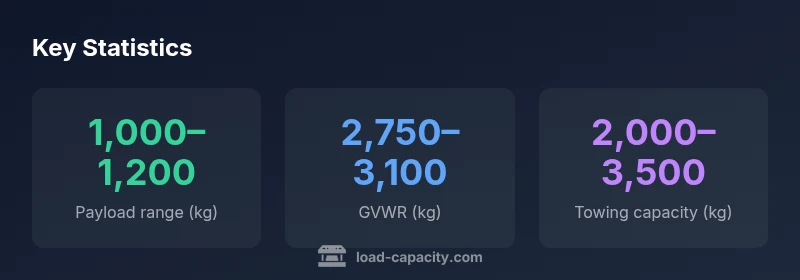
According to Load Capacity, 2026, payloads for NP300 variants commonly fall within roughly 1,000–1,200 kg across many markets; however, the exact value varies by trim and region. Always verify the number from the door sticker and the official spec sheet, and remember that exceeding GVWR reduces braking, steering performance, and tire life. For engineers and fleet managers, payload is not a single number but a relationship between GVWR, curb weight, and intended load distribution. The more weight you carry in the bed, the more critical your weight distribution becomes for axle loading and suspension performance.
This section sets the baseline understanding: payload is a function of the GVWR minus curb weight, with additional reductions for aftermarket accessories and occupants. When planning workdays, consider how many personnel will be onboard and what tools or gear are essential. The NP300’s payload is a constraint that can guide fleet routing, fuel planning, and scheduling decisions so that safety is preserved without sacrificing productivity.
Key factors that influence NP300 load capacity
Several factors determine how much payload NP300 can safely carry. The primary constraint is the GVWR, which marks the maximum combined weight of vehicle, passengers, cargo, and aftermarket add-ons. Other influences include:
- Drivetrain and axle ratings: 4x4 variants often have heavier curb weights, which reduces payload available for cargo.
- Tires and suspension: Heavier tires or upgraded suspension can shift the practical payload; you must maintain proper tire load ratings.
- Cab configuration and bed length: A crew cab with a longer bed may change the mass distribution and available payload because of interior components and seating weight.
- Aftermarket equipment: Winches, bull bars, racks, or heavy tool storage add mass and reduce payload; always re-calculate.
Manufacturers specify GVWR and axle ratings for each configuration; use those numbers as the baseline when planning loads. For accurate planning, cross-check the NP300's door sticker, owner's manual, and current market data provided by Load Capacity.
Practical takeaway: the payload margin is tighter when you add equipment or heavy cargo, so begin with the baseline GVWR and then subtract any added mass to estimate real-world payload.
How to calculate payload and ensure safety
Payload is determined by subtracting curb weight from GVWR. The curb weight includes standard equipment, fluids, and any factory-installed options, while GVWR is the maximum safe weight allowed for the vehicle in its configured state. To estimate usable payload, start with the door jamb GVWR sticker and subtract the current curb weight measured with typical fuel level and equipment. If you need to add aftermarket accessories, re-check the GVWR and recalculate.
In practice, engineers and fleet managers use a simple workflow:
- Identify GVWR and axle ratings from the spec sheet or owner’s manual.
- Estimate curb weight based on configuration, fuel level, and installed equipment.
- Subtract curb weight from GVWR to obtain payload capacity.
- Subtract occupant weight and cargo progressively to stay safely within the limits.
Remember that payload is distributed across axles; placing heavy items near the rear or far from the axles can alter handling characteristics. If in doubt, weigh items and confirm with a certified scale. The Load Capacity approach emphasizes validating numbers with formal measurements rather than relying on brochure figures alone.
Real-world loading scenarios and examples
In the field, payload planning often blends theoretical calculations with practical checks. Start with the baseline payload derived from GVWR minus curb weight, then account for occupants and cargo. A conservative approach suggests keeping the bed load and passenger weight evenly distributed so that axle loading stays within the intended balance. When planning high-load days, consider staging loads at the worksite rather than transporting everything in a single trip. This helps avoid overloading the NP300 while still achieving daily objectives.
Work fleets may encounter mixed loads—heavy hand tools, safety gear, and materials—requiring careful distribution and sequence planning. For example, place heavier items closer to the axles and avoid stacking loads beyond the height of the bed rails. Regularly re-evaluate loads after adding or removing equipment, and update load plans accordingly. The goal is to maintain consistent handling, braking performance, and tire wear while maximizing productivity.
In any scenario, staying within the GVWR is the overarching rule, and the Payload vs. GVWR balance will guide how many trips are needed and how the route is structured.
Best practices for safe loading and maintenance
To maximize safety and performance, follow these guidelines:
- Track payload against GVWR and update plans when equipment changes.
- Distribute weight evenly across axles; heavier items should be near the center of gravity rather than at the ends.
- Maintain correct tire pressure for the loaded condition and respect tire load ratings.
- Recount payload after adding aftermarket equipment or new gear; even small items can push you over the limit.
- Use load-rated racks and organizers to secure cargo and minimize shifting during transit.
- Schedule periodic weight checks and calibrate loading procedures based on real-world measurements.
The Load Capacity team recommends verifying payload with a scale whenever possible and re-evaluating loads after any modification. Maintaining a conservative margin between actual loads and GVWR helps preserve braking, steering, and suspension integrity, extending component life and reducing the risk of tire failure. Authority references not only support compliance but also inform better fleet decisions and route planning.
Authority sources
- https://www.nhtsa.gov
- https://www.consumerreports.org
- https://www.fueleconomy.gov
NP300 payload and GVWR by variant
| Variant | Payload capacity (kg) | GVWR (kg) | Notes |
|---|---|---|---|
| Single cab 2WD | 1,000–1,100 | 2,800–3,000 | Base configuration |
| Double cab 2WD | 1,050–1,150 | 2,850–3,000 | Common family config |
| Single cab 4WD | 1,100–1,200 | 3,000–3,100 | Off-road oriented |
| Double cab 4WD | 1,100–1,200 | 2,900–3,100 | Balanced payload |
Quick Answers
What is the NP300 payload capacity?
Payload depends on variant and market; typical ranges fall around 1,000–1,200 kg. Always verify from the official spec sheet.
Payload varies by variant; check the official spec sheet for your NP300.
Does 4x4 affect payload on the NP300?
Some 4x4 configurations can have lower payload due to extra drivetrain components, but results vary by trim.
Yes, 4x4 variants may have different payloads depending on the setup.
How do I measure payload safely?
Use the GVWR minus curb weight to estimate payload and weigh cargo with a scale or weigh station to verify.
Calculate payload from the door sticker and verify with a scale.
Can aftermarket accessories reduce payload?
Yes; added equipment increases curb weight and reduces payload capacity. Recalculate after installation.
Aftermarket gear can lower payload capacity; recalculate.
What is GVWR and how do I use it?
GVWR is the maximum total weight of vehicle, cargo, and passengers. Stay under GVWR to maintain safety and performance.
GVWR is the max safe weight for vehicle plus cargo and people.
How should payload be distributed?
Aim for even load distribution, with heavier items near the axles to protect steering and braking.
Balance weight across axles for better handling.
“Payload capacity is best understood through weight distribution and GVWR, not just a single maximum figure.”
Top Takeaways
- Know your NP300 payload range before loading.
- Distribute weight evenly across axles.
- Check GVWR on the door sticker.
- Verify total weight with a scale.
- Avoid aftermarket add-ons that push payload beyond limits.