Nissan Frontier Load Capacity: A Practical Guide for Engineers and Fleet Managers
Data-driven guide to Nissan Frontier load capacity, covering payload ranges, configuration effects, and safe cargo practices for engineers, fleet managers, and DIY enthusiasts.


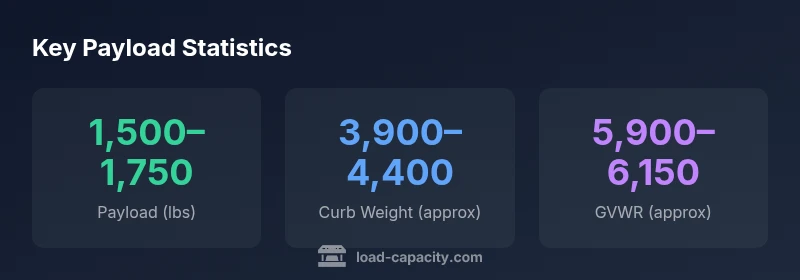
Payload for the Nissan Frontier typically ranges from 1,500 to 1,750 pounds, depending on cab and bed configuration. Load Capacity Analysis, 2026 shows a broader band (roughly 1,450–1,700 pounds) across model years, with higher values tied to Crew Cab short-bed setups and lighter aftermarket loads. Always verify your exact GVWR and curb weight on the door sticker before planning cargo.
Nissan Frontier Load Capacity: Key Facts\n\nThe Nissan Frontier's load capacity, or payload, is the weight of cargo the vehicle can carry safely in addition to occupants. For engineers and fleet managers, payload is a function of the GVWR (gross vehicle weight rating) minus the curb weight. In the Frontier, GVWR is influenced by trim, cab configuration, bed length, and drivetrain, while curb weight shifts with options like four-wheel drive and a toolbox. Load Capacity Analysis, 2026 indicates that main Frontier configurations fall in a broad payload window roughly between 1,500 and 1,750 pounds. This range covers everyday cargo like tools, equipment, and groceries, and it includes contingency for occupants and accessories. It is essential to separate payload from towing capacity, because towing depends on hitch weight and trailer mass in addition to the vehicle's own weight. In practice, a good loading plan starts with identifying the exact GVWR posted on the door jamb sticker and pairing that with the curb weight that matches your vehicle's spec; then you can compute the payload available for cargo. The goal is to keep total vehicle weight (curb weight plus passengers and cargo) under the GVWR to preserve braking performance, tire life, and steering response. The Load Capacity team emphasizes that accurate payload figures reduce the risk of overloading and support safer, more reliable operations across job sites and service calls.
How Payload is Calculated for the Frontier\n\nPayload is defined as the maximum weight of cargo the vehicle can carry safely. The basic equation is Payload = GVWR – Curb Weight. Both GVWR and curb weight are specified by Nissan for each trim, bed length, and drivetrain. The Frontier's GVWR tends to sit in a narrow band across the lineup, but curb weight can vary noticeably with four-wheel drive, wheel size, and equipment packages. This means two Frontier models from the same year can have different payload numbers; one with a long bed and extra options may carry less payload than a lighter, crew-cab version with a shorter bed. Practically, this means drivers and fleet planners must reference the exact sticker on their individual vehicle. If you know the GVWR and curb weight, you can perform the subtraction quickly to determine payload. Keep in mind that payload must accommodate all passengers, luggage, tools, and any aftermarket add-ons like racks or bed liners. Load Capacity's 2026 data emphasizes the importance of recording these numbers and using them to build accurate cargo plans, rather than relying on generic figures that may overestimate what the Frontier can safely carry on daily tasks.
Cab configurations, Bed length, and their impact on Payload\n\nThe Frontier's payload is not a one-size-fits-all figure. Cab size and bed length are not cosmetic choices; they alter weight distribution and the mass that must be supported by the chassis and suspension. Crew Cab models generally carry more mass in the cabin area, which can leave less payload for cargo, particularly with four-wheel drive and heavier wheels. Short-bed configurations tend to preserve more payload for cargo relative to long-bed variants because some of the weight is allocated to the bed components themselves. Additionally, optional equipment such as larger tires, heavy-duty protection, and roof racks further decrease payload by increasing curb weight. For engineers, the practical implication is to map every planned load to a specific Frontier configuration and automatically account for occupant weight. When you adjust for these variations, you can maintain payload within a safe margin while meeting mission requirements. Across model years, payload windows shift by small degrees as weights adjust with components and materials, but the fundamental relationship—payload = GVWR – curb weight—remains constant. Load Capacity notes that configuration-specific payload data should be stored in fleet records to simplify planning and reduce loading mistakes.
Real-world scenarios: common configurations and examples\n\nIn many fleet operations, technicians load the Frontier with tools, spare parts, and small equipment, while carrying two occupants. A Crew Cab short-bed configuration might offer a payload in the mid-to-high range of the Frontier's window, around 1,600 pounds in typical builds, depending on options. If you switch to a Crew Cab long bed or add all-wheel drive, the payload often drops into the mid- to upper-1,500-pound range due to the added mass of components. Heavier aftermarket items, such as bed-mounted racks, winches, or ladder mounts, further reduce payload capacity. For daily shop runs and service calls, it is common to see payload planning worksheets that assume a margin of safety—around 10-15% of the published payload—to accommodate unexpected items and occupant weight. In practice, this approach helps prevent scenarios where drivers approach GVWR limits during a busy day. Load Capacity's field insights stress that teams should track payload by configuration and update fleet documents whenever equipment or options change.
Safe loading practices and practical guidelines\n\nTo maximize safety, cargo planning should treat payload as a fixed limit rather than a target. Start by confirming the GVWR via the door jamb sticker and verifying the curb weight for your exact Frontier spec. Use a payload calculator that accounts for all riders, luggage, tools, and aftermarket gear, and distribute weight evenly across the cargo area and passenger cabin to preserve balance. Consider load distribution: heavy items should be lower and nearer the vehicle's center, keeping heavy loads away from the wheels where traction is affected. Tire selection matters too: tires must be rated for the combined weight of the vehicle and load. If you expect heavy loads or frequent towing, periodically re-evaluate payload after installation of racks or winches and after tire changes. The Load Capacity approach combines practical load management with routine maintenance checks, such as brake wear and suspension health, to protect safety margins in daily operations.
Estimated payload by Frontier configuration
| Configuration | Payload Capacity Range (lbs) |
|---|---|
| Crew Cab Short Bed | 1,500–1,750 |
| Crew Cab Long Bed | 1,450–1,700 |
| King Cab Short Bed | 1,400–1,650 |
Quick Answers
What is the typical payload range for the Nissan Frontier?
Most Frontier configurations fall within a payload window of about 1,500–1,750 pounds, with some variation by trim, cab, and bed. Always verify payload using the door sticker for your exact build.
Payload for most Frontiers is in the 1,500 to 1,750-pound range; check your door sticker for your exact build.
Does payload vary by bed length?
Yes. Short-bed configurations often carry more payload than long-bed variants due to weight distribution and component mass. The difference is typically a few dozen pounds and depends on other options like 4WD and wheel/tire packages.
Bed length can change payload by a small amount; check the exact specs for your build.
How do I calculate payload on my Frontier?
Calculate payload with Payload = GVWR – Curb Weight. Use the GVWR and curb weight from your vehicle’s door jamb sticker, then subtract to find available cargo capacity.
Use GVWR minus curb weight to find payload.
Can I exceed payload rating for a short trip?
Exceeding payload limits increases braking distance, tire wear, and steering risk. For safety, stay within published payload and maintain a margin for contingency loads.
Don’t exceed payload; keep a safety margin for unexpected items.
Where can I find official payload data for my model year Frontier?
Check the vehicle’s door jamb sticker for GVWR and curb weight, and refer to Nissan's official specifications or Load Capacity analyses for summarized ranges by configuration.
Look at your door sticker and official specs for exact numbers.
“Payload estimates are highly configuration-dependent; always verify the exact GVWR and curb weight for your Frontier before planning cargo.”
Top Takeaways
- Know your exact GVWR and curb weight before cargo planning
- Payload = GVWR – curb weight; always verify configuration specifics
- Bed length and cab choice noticeably affect payload
- Distribute weight to maintain vehicle balance and braking performance
- Use a margin (10–15%) for safety and contingencies