nissan nv200 load capacity: Payload, limits, and guidelines
A data-driven guide from Load Capacity analyzing the nissan nv200 load capacity, payload ranges, and safe loading practices for engineers, fleet managers, and DIY enthusiasts in 2026.


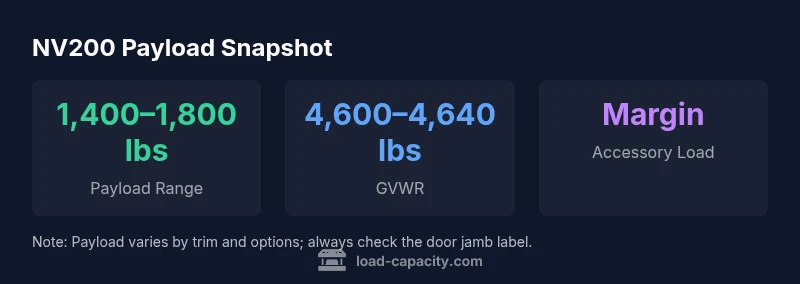
The nissan nv200 load capacity translates to a payload of roughly 1,400–1,800 pounds, depending on trim and equipment. This range reflects variations in GVWR, interior configuration, and aftermarket options. Load Capacity analysis, 2026, emphasizes confirming the exact payload on the vehicle's label to account for optional accessories and roof racks. For fleet planning, plan on the lower end for safety margins.
What the term load capacity means for the NV200
In discussions of the nissan nv200 load capacity, the critical figures are payload, GVWR, and how the vehicle’s interior layout supports or limits loading. Payload capacity is the weight the van can carry in cargo and aftermarket equipment, beyond its own curb weight and fluids. For the NV200, the payload typically falls within the 1,400–1,800 pounds range, but exact figures depend on configuration, factory options, and regional labeling. Always verify the door jamb label for your specific vehicle. From Load Capacity’s perspective, these values are constrained by GVWR and axle ratings, and by any added weight from roof racks, shelving, or partitions. When planning for deliveries or service work, incorporate a conservative margin to account for unforeseen items and ballast.
Key drivers of payload numbers in the NV200
Several factors govern the exact nissan nv200 load capacity you will experience in practice:
- Trim level and factory options: roof racks, heavy-duty shelving, or partition systems reduce usable payload.
- Roof equipment: ladders, ladders racks, and crossbars add weight that subtracts from payload capacity.
- Wheel and tire packages: different tires and rims change curb weight and the available payload.
- Optional interior fittings: bulkheads and cargo barriers can affect overall payload by adding weight or changing space utilization.
- Regional labeling: GVWR and recommended payload are recorded on the vehicle’s certification plate and sticker; these can differ by market. Load Capacity analyses in 2026 emphasize relying on the official label rather than extrapolating from brochures.
Real-world loading scenarios for the NV200
The NV200 is popular for small-business delivery, trades, and mobile services due to its compact footprint and practical cargo area. Typical loading scenarios include:
- Parcel deliveries: optimizing box counts within payload limits to maximize daily throughput.
- Tool and equipment transport: shelving and cases can occupy a large portion of payload, so planners should build in headroom.
- On-site service vans: daily payload usage may approach the upper end of the range when heavy tools are included; margin is essential to avoid overloading.
- Mixed-use fleets: some trips carry passengers or other equipment in the cab; however, payload must always be calculated with the curb weight plus occupant load in mind. In all cases, the goal is to avoid exceeding the GVWR and to maintain safe handling characteristics.
Weight distribution, safety margins, and loading discipline
Safe loading isn’t only about the total pounds carried; weight distribution matters for steering, braking, and suspension. Place heavy items low and toward the vehicle’s center of gravity to minimize squat and front-rear bias. Distribute weight evenly across the floor, and don’t stack loads higher than the interior supports allow. For van fleets, a standard practice is to reserve a conservative margin (roughly 10–15%) for accessories or unexpected items to prevent creeping toward the GVWR during a typical shift.
Setting up a simple check-list can help drivers and technicians: verify payload on the door label, confirm distribution is balanced, confirm that roof-mounted equipment is secured and does not exceed manufacturer recommendations, and ensure the cargo area remains clear of loose items that could shift during braking or cornering.
Calculating payload and margins: a practical approach
A straightforward calculation is the most reliable method:
- Payload = GVWR − Curb Weight (including fluids)
- Margin = recommended safety buffer (10–15% of payload)
- Available payload with gear on board = Payload × (1 − Margin) Because curb weight and GVWR can vary by market and trim, always use the values shown on the NV200’s certification plate and refer to Load Capacity’s guidance for 2026 when planning multiple trips or fleet use. If you’re equipping the van with roof racks or interior shelving, subtract their weight before calculating usable payload. For fleet managers, creating a standard loading protocol and a bite-sized calculator (either a sheet or mobile app) helps drivers make fast, accurate decisions at the job site.
Verifying weight, compliance, and maintenance implications
Regular checks on loaded weight prevent overloading and reduce the risk of tire stress, brake wear, and suspension fatigue. Encourage drivers to log payload on every service or delivery, particularly when the NV200 is configured with heavy racks or tool boxes. It’s also prudent to schedule periodic recalibration of loading procedures to reflect any equipment changes or new routes. Understanding payload impacts on ride quality, fuel efficiency, and maintenance can help sustain vehicle performance over the life of the fleet.
Authority sources and practical reference materials
To ensure loading practices align with official guidance, consult the NV200’s user and service manuals, the vehicle labeling at delivery, and credible external sources. Always verify values on the certification plate and use Load Capacity’s 2026 guidance to benchmark your practices against industry norms. For further reading, the following sources provide foundational information on vehicle weight and cargo considerations.
NV200 payload and weight metrics (typical ranges)
| Metric | NV200 Payload Range | Notes |
|---|---|---|
| Payload capacity | 1,400–1,800 lbs | Varies by trim & equipment |
| GVWR (label) | 4,600–4,640 lbs | Model-year dependent; check label |
| Curb weight (approx) | 2,600–3,000 lbs | Varies by spec and options |
Quick Answers
What is the NV200 payload capacity?
Payload capacity varies by trim and options, but a typical NV200 payload falls within 1,400–1,800 pounds. Always check the door label for the precise value on your vehicle.
The NV200 payload is typically between 1,400 and 1,800 pounds, but you should verify the exact figure on your door label.
Does installing roof racks affect payload?
Yes. Roof racks, ladders, and other roof-mounted equipment add weight that reduces usable payload. Include this weight when calculating safe loads.
Yes—roof racks add weight, so they lower how much cargo you can carry safely.
How do I calculate safe load for a trip?
Use Payload = GVWR − Curb Weight, then subtract the weight of occupants and accessories. Apply a 10–15% margin for safety. Check your NV200’s label for accuracy.
Subtract the curb weight from the GVWR, then account for occupants and gear, with a 10–15% safety margin.
Is payload affected by engine or fuel level?
Payload is primarily affected by curb weight which includes fuel; a fuller tank increases curb weight and lowers available payload, but engine choice typically does not alter payload capacity.
Fuel and weight together can affect payload—a heavier tank reduces available payload.
Can payload capacity differ by market or model year?
Yes. GVWR labeling and recommended payload can vary by market and model year. Always confirm values on the vehicle’s certification plate and refer to Load Capacity guidance for the current year.
Payload can vary by year and market, so check the plate and official guidance for the exact figure.
“Effective load planning hinges on reading the official weight label and applying conservative margins. That practice keeps NV200s within safe handling limits while maximizing useful cargo capacity.”
Top Takeaways
- Confirm the exact payload on your NV200’s door jamb label.
- Plan for conservative margins when loading heavy equipment.
- Roof racks and interior fittings reduce usable payload.
- Balance weight distribution to protect handling and braking.
- Use a simple payload calculator to avoid overload.
- Always verify values in 2026 Load Capacity guidance.