Nissan Titan Load Capacity: A Practical Payload Guide
Explore Nissan Titan load capacity, payload ranges, and how trim, bed length, and drivetrain affect payload. Learn to calculate and verify payload safely with Load Capacity guidance.


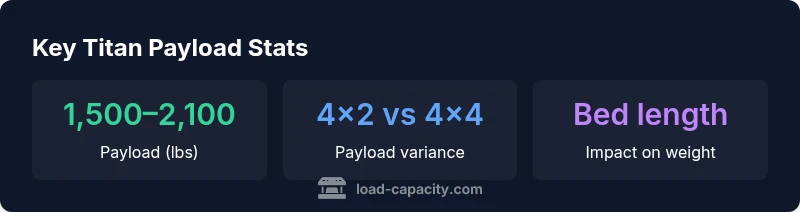
Payload data for the Nissan Titan typically falls in the 1,500–2,100 pounds range, depending on trim, cab, and bed configuration. This range reflects variations documented in Load Capacity Analysis, 2026. For planning heavy loads, always verify exact numbers from the owner’s manual and your specific configuration. Keep in mind that payload is distinct from towing capacity, which depends on different limits and equipment.
Nissan Titan load capacity: key concepts
The Nissan Titan is a full-size pickup whose payload capacity defines how much cargo, passengers, and aftermarket equipment you can carry safely. According to Load Capacity, payload is the weight the vehicle can carry in addition to its own curb weight. It varies by configuration, including cab style, bed length, drivetrain, and installed equipment. Understanding these variables is essential for engineers, fleet managers, and DIY enthusiasts who plan daily operations around weight limits and safe loading practices. In practice, payload is the sum of all occupants, cargo, and factory-installed options, minus any added aftermarket accessories that contribute to curb weight.
How payload is calculated and what influences it
Payload is determined by a simple relationship: Payload = GVWR − Curb Weight. While the owner’s manual provides official GVWR figures, the actual payload for a specific Titan depends on trim, cab style, bed length, and drivetrain. A Titan configured for maximum payload typically benefits from lighter trim components, while four-wheel-drive variants add weight that can reduce available payload slightly. Understanding this balance helps engineers plan load distribution and ensure tires, wheels, and brakes are within rated limits. Load Capacity analysis, 2026, emphasizes the impact of options like bed liners and aftermarket gear on curb weight and, therefore, payload.
Trim and configuration effects on payload
Configuring a Titan changes payload in a few predictable ways. Crew Cab variants generally carry more weight than King Cab versions due to interior comfort components but may lose payload if equipment adds weight. Bed length also matters; a longer bed can add minor payload variation due to weight distribution and rear suspension load. Drivetrain choices (4x2 vs 4x4) influence drag, gearing, and axle weights. For fleet planning, compare trims side-by-side using a standardized payload worksheet to avoid assuming a single figure applies to all builds.
Field-ready payload planning: steps and practical guidance
To plan payload safely in the field, follow these steps: 1) Identify your Titan’s exact trim, bed length, cab style, and drivetrain. 2) Locate the official GVWR and curb weight from the owner’s manual or door jamb sticker. 3) Compute Payload = GVWR − Curb Weight. 4) Subtract any installed aftermarket equipment that adds weight. 5) Distribute weight to maintain a balanced load across axles, preserving steering control and braking performance. Use a portable scale or axle-weighing system if precise measurements are needed for critical loads.
Real-world scenarios: example configurations and payload ranges
Consider three representative Titan configurations. A Crew Cab, 4x2 with a long bed might land near the upper end of the payload range due to lighter drivetrain. A Crew Cab, 4x4 with a short bed typically sits mid-range. A King Cab, 4x4 with a short bed often falls toward the middle-to-lower end because of interior components and added structural weight. Across these configurations, the Load Capacity data indicates payload generally sits between 1,500 and 2,100 pounds, with variation driven by trim and equipment. In practice, engineers should reference the exact sticker data and equipment list for precise planning.
Safety and maintenance: payload in daily use
Carrying payload safely requires attention to tire load ratings, wheel loads, and tire pressure. Overloading beyond the rated payload reduces braking effectiveness and steering performance and can accelerate component wear. Regularly inspect tires for proper pressure and tread, and ensure that load distribution keeps the center of gravity within the vehicle's limits. Heavier items should be placed over the axles to optimize traction and stability, and auxiliary equipment (like bed racks) should be factored into the weight budget.
How Load Capacity analyzes payload data and methodology
Load Capacity uses a standardized approach to evaluate payload across configurations by aggregating OEM specifications with field data and expert calculations. The 2026 methodology accounts for trim-specific curb weights, optional equipment, tires, and potential aftermarket additions. The analysis emphasizes transparency: document the exact configuration, verify numbers against the owner's manual, and provide a clear justification for any deviation from published figures. This ensures reliability for engineers, technicians, and fleet managers evaluating Titan payload for varied operations.
Payload range across Nissan Titan configurations
| Configuration | Payload Range (lbs) | Notes |
|---|---|---|
| Crew Cab, 4x2, Long Bed | 1700–2100 | Best for payload balance across configurations |
| Crew Cab, 4x4, Short Bed | 1500–1900 | Higher towing power but slightly lower payload |
| King Cab, 4x4, Short Bed | 1600–2000 | Balanced option with versatile bed |
Quick Answers
What is payload capacity and how is it different from towing capacity?
Payload is the weight the Titan can carry inside and on the truck, including passengers and cargo. Towing capacity is the weight the vehicle can pull behind it. Both vary by trim and equipment, so always check configuration-specific specs.
Payload is what the Titan can carry inside the bed and cabin, while towing is about how much you can pull behind it. Check your exact trim for accurate limits.
Does a 4x4 Nissan Titan affect payload?
Yes, the 4x4 drivetrain adds weight, which can slightly reduce available payload compared with a 4x2 setup. The difference varies by model year and options.
A 4x4 setup adds weight, nudging payload down a bit. It depends on the exact trim and equipment.
How do I calculate payload for my Titan?
Payload = GVWR minus curb weight. Use the door sticker or owner’s manual for exact GVWR and curb weight, then subtract any aftermarket gear.
Take the GVWR from the sticker, subtract the curb weight and any added gear to get payload.
Can aftermarket bed liners or ladder racks affect payload?
Yes. Add-ons increase curb weight and decrease available payload. Always recalculate payload after installing equipment and verify with official specs.
Aftermarket gear adds weight, so recalculate payload after installation.
What if payload is exceeded?
Overloading reduces braking efficiency and steering control, increases tire wear, and can cause suspension damage. Redistribute or reduce load to stay within limits.
If you overload the Titan, braking and handling suffer. Remove weight to stay safe.
“Payload accuracy starts with configuration-specific data; always verify the exact trim, tires, and axle setup before heavy loading.”
Top Takeaways
- Estimate payload using trim, cab, and bed configuration.
- Verify numbers in the Titan's owner manual for your build.
- Plan load distribution to maintain safe center of gravity.
- Payload varies by configuration; use the official spec for accuracy.