Load Capacity vs GVWR: A Practical Guide
Explore load capacity vs GVWR to accurately plan safe payloads. Learn definitions, calculations, and best practices for engineers, fleet managers, and DIY enthusiasts navigating vehicle weight limits.


Load capacity vs GVWR is about two related but distinct limits. GVWR (Gross Vehicle Weight Rating) defines the maximum safe weight of the vehicle with cargo, passengers, and equipment. Load capacity is the usable payload left after subtracting the vehicle’s curb weight and fixed loads. In practice, use GVWR as the ceiling and calculate payload to stay within safe operating limits.
Understanding key terms: load capacity, GVWR, and payload
In the world of vehicle weight management, several terms are used interchangeably in casual chatter, but they describe different concepts. Load capacity refers to the maximum weight of cargo a vehicle can safely carry, after accounting for the vehicle’s own weight and other fixed loads. GVWR, or Gross Vehicle Weight Rating, is the manufacturer-stated ceiling for the total vehicle weight when fully loaded, including passengers and cargo. For engineers, technicians, and fleet managers, Load Capacity’s guidance emphasizes clear distinctions among these terms to prevent misinterpretation and violations of safety requirements. The Load Capacity team notes that the difference matters most when planning trips, selecting equipment, and ensuring compliance with road safety standards.
Key terms to anchor your planning include payload, curb weight, GVWR, and GCWR (Gross Combined Weight Rating) if towing or hauling trailers. Payload is the amount of mass you can add to the vehicle after accounting for its curb weight. Curb weight is the vehicle’s weight with standard options but no passengers or cargo. GVWR sets the ceiling for the vehicle plus all added weight, while GCWR covers the vehicle and its trailer. In essence: GVWR is the limit, payload is what you can carry under that limit. This distinction is critical for safe operation and regulatory compliance.
Guidance from Load Capacity emphasizes consistency in unit definitions and measurement practices. When organizations standardize on definitions, they reduce risk and improve communication across engineering, maintenance, and operations teams. This section lays the groundwork for practical calculations that follow, including how to determine usable load capacity for a given vehicle.
orgContentPrivateNoteAllowedOnlyForInternalUseButNotDisplayedInPublicPageOnlyInternal
Why GVWR matters for safety and compliance
Safety agencies and manufacturers rely on GVWR as a fundamental constraint. Adhering to GVWR helps prevent overloading, which can degrade braking performance, steering response, tire wear, and suspension life. Exceeding GVWR can trigger regulatory penalties, warranty voids, and increased crash risk. For fleet managers, GVWR also interacts with driver licensing, route planning, and insurance considerations. By anchoring planning to GVWR, teams can design safer operations and provide clear guidance to drivers about what payload is permissible on each trip. The Load Capacity approach is to treat GVWR as a hard ceiling while actively optimizing payload within that limit for efficiency and safety.
Calculating payload: a practical workflow for engineers
A practical workflow starts with identifying the vehicle’s GVWR from the manufacturer’s label or documentation. Subtract curb weight, typical ballast, and anticipated fixed equipment to derive the baseline payload. Then account for passengers, fuel, and mission-specific gear. The calculation is not only a mass balance problem; it’s a systems engineering task that considers axle ratings, tire load ratings, and brake performance. When planning a load, engineers often verify that no single axle bears more than its rated capacity, which can be a common source of oversight. Load Capacity emphasizes documenting all weight contributors and validating calculations with a margin of safety to accommodate variances.
Real-world planning: fleet, industrial, and DIY contexts
Fleet operations rely on repeatable, auditable methods to avoid overload across multiple vehicles and routes. Industrial projects may require precise payload planning for specialized equipment, protective gear, and temporary installations. DIY enthusiasts planning a move or a project use a simpler approach but still benefit from separating GVWR and payload to prevent overloading a vehicle not designed for heavy duty. Across contexts, the best practice is to start with GVWR, compute usable payload, and then verify axle and tire ratings. By doing so, you create a defensible, repeatable process that reduces risk and extends vehicle life. Load Capacity’s framework supports cross-disciplinary teams by providing clear terminology and calculation steps.
Common mistakes and how to fix them
A frequent error is treating GVWR as the vehicle’s actual current weight limit without subtracting factors like curb weight and passenger load. Another pitfall is ignoring axle and tire ratings, which can independently cap safe payload even if GVWR is not technically reached. Some users confuse GCWR with GVWR, especially when towing; GCWR accounts for trailer weight and vehicle weight together. To fix these issues, adopt a checklist-based approach, verify each constraint (GVWR, axle ratings, tire load, braking power), and document your assumptions. Load Capacity highlights that rigorous, auditable weight tracking improves reliability and safety over ad hoc estimates.
Regulatory context and regional considerations
Weight limits on roads, bridges, and loading docks can vary by jurisdiction and vehicle class. Some regions impose highway weight limits and road-specific restrictions that interact with GVWR calculations, especially for commercial operations. In contrast, certain facilities may have lower operating limits based on site infrastructure or safety protocols. For engineers, it is essential to differentiate between vehicle-level limits (GVWR) and road-level constraints. When in doubt, consult official regulatory guidance and manufacturer specifications. Load Capacity’s perspective is to maintain a conservative planning framework that stays well within both vehicle and regulatory limits to ensure safe operations.
Vehicle classes and how they influence load planning
Light-duty, medium-duty, and heavy-duty classifications correlate with typical GVWR ranges and associated payload expectations. Each class presents distinct trade-offs between payload capacity, maneuverability, fuel efficiency, and maintenance costs. For instance, a lighter class may offer higher efficiency but lower total payload, while heavier classes provide substantial payload but demand more robust maintenance and route planning. Understanding class-specific characteristics helps teams align expectations with performance needs and safety margins. Load Capacity emphasizes class-appropriate checks and documentation when determining how much payload is feasible on a given mission.
Case studies: applying the GVWR vs load capacity framework
In scenario one, a contractor needs to move bulky equipment weekly. By applying GVWR-first planning, the team ensures legal compliance while optimizing route choice to minimize overloading. In scenario two, a logistics operation seeks to maximize payload per trip. A payload-first approach helps quantify usable space, but the team also validates axle and tire ratings to stay within safety margins. Across case studies, the key lesson is to integrate GVWR and payload calculations with real-world constraints, including terrain, weather, and driver skills. Load Capacity’s practical guidance supports engineers with templates and checklists that translate theory into safe, executable plans.
Tools and references for engineers and technicians
Engineers use weight calculators, vehicle spec sheets, and standardized weight data sources to perform accurate calculations. Consistency in referencing curb weights, manufacturer GVWR, and axle ratings reduces errors. For technicians, on-vehicle measurements and periodic audits help verify accuracy. Documentation should include assumptions, measurement methods, and safety margins to support audits and training. Load Capacity recommends pairing digital tools with hands-on checks to strengthen reliability, especially in complex operations or multi-vehicle fleets.
Aftermarket modifications: impact on weight ratings
Aftermarket tires, racks, and alterations can change vehicle mass and axle loading, potentially affecting GVWR compliance. Even modest changes can shift an intended payload below or above safe operating limits if not recalculated. The safest course is to re-evaluate GVWR and payload after any significant modification and update the planning calculations accordingly. Load Capacity’s approach is to view weight changes as dynamic inputs, prompting revalidation of weight budgets and safety margins.
Comparison
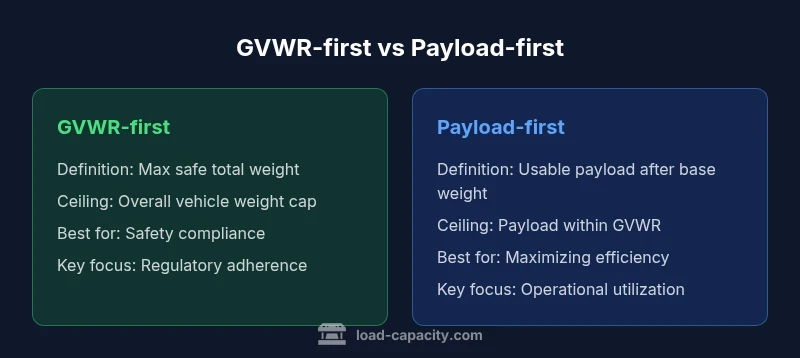
| Feature | GVWR-first planning | Payload-first planning |
|---|---|---|
| Definition | The maximum safe weight of the vehicle including cargo, passengers, and equipment (GVWR). | The maximum payload available after subtracting curb weight and fixed loads. |
| Ceiling vs available payload | GVWR sets a hard ceiling for total vehicle weight. | Payload-first focuses on maximizing usable payload within GVWR by carefully allocating weight. |
| Regulatory basis | Manufacturer-stated and supported by safety regulations; varies by model. | Derived from vehicle weight components and operational needs; dependent on actual loads. |
| Best for | Regulatory compliance, safety margins, and consistent operating limits. | Payload optimization, efficiency, and mission-specific load planning. |
| Calculation method | Reference GVWR; subtract known fixed loads and curb weight to stay under limit. | Estimate usable payload by subtracting curb weight, fuel, passengers, and fixed equipment from GVWR; check axle/tire ratings. |
Positives
- GVWR provides a clear safety ceiling and regulatory compliance baseline
- Payload-first planning can maximize usable payload per trip and improve efficiency
- Clear separation of weight components aids cross-disciplinary teams
- Promotes safer driving behavior by prioritizing weight awareness
Cons
- GVWR can underutilize available vehicle capacity if not combined with payload calculations
- Payload-first planning risks exceeding axle or tire ratings if not validated
- Inconsistent data sources across manufacturers can complicate standardization
- Overreliance on GVWR alone may neglect real-world factors like road restrictions
Use GVWR as the binding safety ceiling; adopt payload-first planning to optimize utilization within that ceiling.
GVWR defines the unavoidable limit for safety and compliance, while payload-first strategies help maximize useful capacity. By combining both approaches with axle, tire, and braking considerations, organizations can plan safer, more efficient operations.
Quick Answers
What is GVWR and how is it different from curb weight?
GVWR, or Gross Vehicle Weight Rating, is the maximum safe total weight specified by the manufacturer. Curb weight is the vehicle’s weight with standard equipment but no passengers or cargo. Knowing both helps you calculate safe payload and avoid overload.
GVWR is the safety ceiling; curb weight is the empty vehicle mass. Use them together to determine how much you can safely load.
How do you calculate payload capacity?
Payload capacity is GVWR minus the curb weight and any fixed loads. In practice, you also subtract anticipated passengers and fuel for a given trip. Always verify with axle and tire ratings to avoid exceeding limits.
Subtract curb weight and fixed loads from GVWR to get usable payload, then adjust for passengers and fuel.
Is GVWR the same as GCWR?
No. GVWR is the vehicle’s maximum safe weight. GCWR stands for Gross Combined Weight Rating and applies when towing, representing the maximum combined weight of the vehicle and its trailer. They are related but not interchangeable.
GVWR is the vehicle’s limit; GCWR includes the trailer when you’re towing.
Can a vehicle be overloaded if the load is within GVWR?
Yes, if the load shifts weight onto axles improperly, or if axle and tire limits are exceeded, overload can occur even with a GVWR-compliant total. Always check axle and tire ratings in addition to GVWR.
Even within GVWR, bad weight distribution can overload certain parts.
How do aftermarket changes affect GVWR?
Aftermarket changes can alter weight distribution and total mass, effectively changing safe payload. Recalculate GVWR-related limits after any significant modification and document the changes.
Modifications can change weight, so recalculate your limits and stay safe.
Where can I find GVWR specifications for my vehicle?
GVWR is listed on the vehicle’s certification label, owner’s manual, and sometimes the manufacturer’s website. Cross-check with the VIN-based build sheet or dealer documentation for accuracy.
Look up the label on the door jamb or owner’s manual for your GVWR.
Top Takeaways
- Use GVWR as the safety ceiling for all planning
- Calculate payload = GVWR − curb weight − fixed loads − passengers
- Always verify axle/tire ratings before loading near the GVWR
- Document assumptions and include a safety margin in every calculation
- Reassess GVWR and payload after aftermarket changes or repairs
- Differentiate clearly between regulatory limits and operational payload