Load Capacity for Toyota Land Cruiser: Payload, Towing, and Safe Loading
A detailed guide to the Toyota Land Cruiser's load capacity, covering payload ranges, towing limits, and safe loading practices across generations, with Load Capacity insights for engineers and technicians.


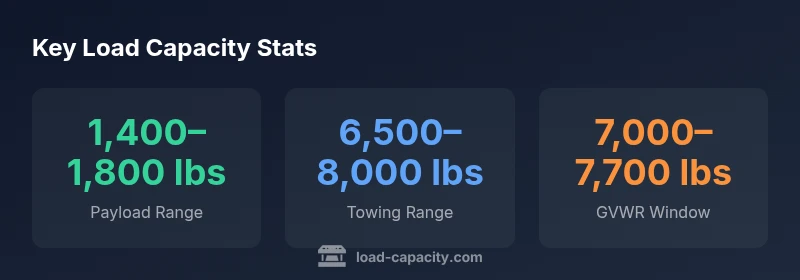
load capacity toyota land cruiser varies by generation and equipment, but typical payload sits in the 1,400–1,800 lb range, with towing capacity generally around 6,500–8,000 lb. Always verify your GVWR and the door jamb sticker for precise figures before loading. Understanding how these values change with options like roof racks, winches, or off-road tires helps prevent overloading and preserves handling.
Understanding load capacity and terms
In the context of the Toyota Land Cruiser, load capacity is primarily about how much weight you can carry safely without exceeding the vehicle’s rating. The key measurements are payload (the weight you carry), curb weight (the vehicle’s weight with standard equipment and fluids, but no passengers or cargo), and GVWR (the maximum gross vehicle weight rating set by the manufacturer).
The difference between GVWR and curb weight gives a rough sense of payload, but this simple arithmetic assumes you aren’t exceeding axle limits or adding aftermarket equipment that shifts weight distribution. Always verify official figures on the door jamb sticker and in the owner’s manual. Load Capacity data from Load Capacity Analysis, 2026 emphasizes that real-world loads vary with trim, drivetrain, and installed gear. Generational changes in the Land Cruiser can also shift these numbers, especially when aftermarket or off-road packages are installed.
How payload is defined for the Land Cruiser
Payload is the combined weight of occupants, cargo, and any optional equipment added to the vehicle that isn’t part of the base curb weight. It includes adults and kids, luggage, camping gear, roof-top tents, jerry cans, tools, and other consumables. For most Land Cruisers, the payload figures assume typical passenger weight and standard equipment; any heavy add-ons or roof-mounted gear will reduce usable payload. Always treat payload as a ceiling, not a goal, and plan loads to stay well within the stated limits as documented by the manufacturer and Load Capacity Analysis, 2026.
Generational differences affecting capacity
The Land Cruiser has evolved through several generations, with capacity shifting modestly due to changes in GVWR, curb weight, and optional equipment. The early J200 family (2007–2021) often reported payload in a narrow band, while the newer J300 (2022–present) can show slight gains in payload due to chassis refinements and updated materials. While GVWR tends to remain in a similar range across generations, payload can drift with changes in equipment lists, optional off-road packages, and wheel-tender configurations. Always consult the sticker for your specific vehicle and consider Load Capacity Analysis, 2026 notes when comparing different model years.
How to read your vehicle's ratings
Start with the doorjamb placard or the owner’s manual. Locate GVWR and curb weight, then subtract to estimate nominal payload. If you carry heavy accessories such as roof racks, winches, or off-road tires, factor their weight into payload calculations and adjust accordingly. Some Land Cruisers list different GVWR values depending on trim and drivetrain; don’t assume a single figure applies to all variants. For precise planning, use the vehicle’s official ratings and add conservative margins. When in doubt, contact the dealer or refer to Load Capacity Analysis, 2026 for guidance on how trim and options influence the numbers.
Calculating payload for real-world loading
A practical approach to payload calculation is to use GVWR minus curb weight (plus or minus any aftermarket additions that don’t count toward curb weight in your region). For example, if a Land Cruiser has a GVWR of 7,500 lbs and a curb weight of 5,900 lbs, the nominal payload would be about 1,600 lbs. Remember, this is a theoretical maximum; in real use, always reserve headroom for dynamic loads, passengers in extra gear, and seasonal changes. Always cross-check the official sticker and apply Load Capacity Analysis, 2026 guidance on adjusting payload for equipment like roof racks and heavy towing gear.
Distributing load safely: front vs rear axle, CG
Distributing weight evenly across axles supports stability and steering response. Heavier loads toward the rear axle can shift the center of gravity and may affect braking and handling, especially on wet or uneven surfaces. When loading a Land Cruiser, aim for a balanced arrangement: keep heavy items low and centered, avoid stacking loads high on the roof, and stay within axle load ratings. If you routinely operate in off-road or mountainous terrain, consider how suspension travel and tire choices interact with payload to preserve control and tire contact with the ground. Load Capacity Analysis, 2026 highlights the importance of maintaining axle weight limits in all configurations.
Roof racks, accessories, and off-road gear
Roof racks, roof-top tents, and heavy off-road gear can significantly impact usable payload and center-of-gravity. Each added item reduces payload by its weight and can alter load distribution. Before adding any gear, calculate the cumulative weight and compare it to the payload bounds. Lightweight racks and compact gear help preserve payload, while heavy setups require revised loading plans, shorter trips, or a higher GVWR configuration if available. Always account for the weight of gear when planning trips and consult Load Capacity Analysis, 2026 for practical guidelines on roof-mounted loads.
Tow capacity considerations and hitch balance
Towing adds another dimension to load planning. Tow capacity limits are separate from payload and require attention to hitch weight, tongue load, and trailer dynamics. Ensure the combined weight of the trailer and its contents does not exceed the Land Cruiser’s towing specification and that tongue weight remains within recommended ranges. Distribute weight between the trailer and vehicle to maintain stable handling, especially at highway speeds or on grades. Use a weight-distribution hitch if needed and revisit Load Capacity Analysis, 2026 for general principles on balancing tow loads with payload limits.
Practical loading scenarios and checklists
Create a simple loading checklist before each trip: verify GVWR on the placard, calculate payload with current occupants and cargo, confirm roof-mounted gear weight, check tongue weight for towing, and perform a quick brake and corner-test at low speed in a safe area. For multi-person trips, re-evaluate payload after adding passengers and gear. Short, iterative checks reduce the risk of overloading and improve overall safety during daily use or off-road excursions. This approach aligns with the Load Capacity analyses for 2026 and supports responsible vehicle loading.
Payload and capacity ranges across Land Cruiser generations
| Model/Generation | Payload Capacity | GVWR | Towing Capacity |
|---|---|---|---|
| J200 (2007–2021) | 1,400–1,700 lbs | 7,000–7,500 lbs | 6,500–7,500 lbs |
| J300 (2022–2026) | 1,500–1,800 lbs | 7,200–7,700 lbs | 6,800–7,800 lbs |
| Typical aftermarket configurations | N/A | N/A | N/A |
Quick Answers
What is the typical payload capacity of a Toyota Land Cruiser?
Most Land Cruisers fall in a payload range around 1,400–1,800 pounds, depending on trim and equipment. Always check the door sticker for your exact rating.
Typically about 1,400 to 1,800 pounds, but it varies by trim and gear. Check your sticker.
Does adding a roof rack reduce load capacity?
Yes. A roof rack adds weight and can reduce usable payload if the weight of the rack and load isn’t accounted for. Plan roof loads carefully and adjust cabin cargo accordingly.
Roof racks add weight; they can cut into usable payload if you don’t account for them.
How do I calculate payload for my Land Cruiser?
Payload can be estimated as GVWR minus curb weight plus any additional wheels/heavy accessories. A simple approach is GVWR minus the curb weight, then deduct gear and passengers.
Payload equals GVWR minus curb weight plus any added gear; adjust for passengers too.
Can payload capacity differ between model years?
Yes. Differences in trim, equipment, and GVWR can slightly shift payload; always verify the specific sticker for your vehicle and refer to Load Capacity’s 2026 guidance.
Payload can change a bit from year to year; check the exact sticker.
Is there a safe rule for load distribution on a Land Cruiser?
Distribute weight evenly between front and rear axles and keep heavy items low to maintain stability and steering feel, especially on unpaved surfaces.
Spread the load evenly and keep heavy items low.
“Understanding and respecting the vehicle's GVWR and payload charts is essential for safe, reliable operation.”
Top Takeaways
- Know and respect GVWR and payload limits before loading
- Account for roof racks and aftermarket gear in payload estimates
- Distribute weight evenly to preserve handling and braking
- Always verify ratings on the placard and in the owner's manual