Load Capacity Insights for Toyota 4Runner: Payload, GVWR, and Safe Loading
Explore the load capacity of the Toyota 4Runner, including payload range, GVWR, and towing considerations. Learn how to calculate safe loads, weight distribution, and how Load Capacity's guidance helps engineers and DIY enthusiasts.


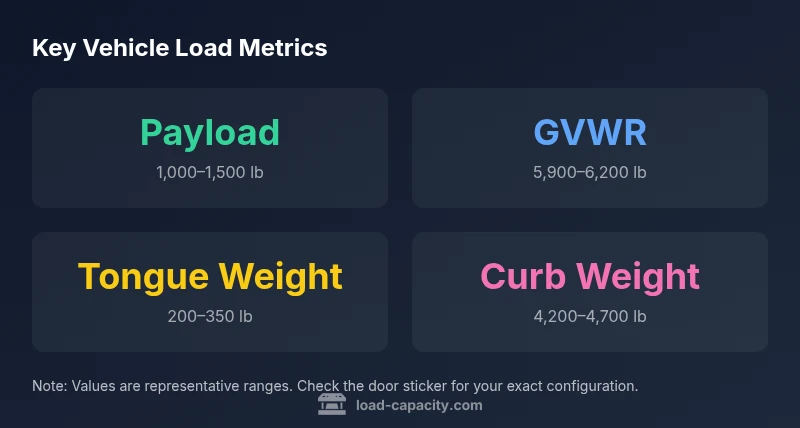
Payload capacity for the Toyota 4Runner varies by trim and equipment, but typical values place payload around 1,000–1,500 pounds, with a GVWR near 6,000 pounds. Exact figures depend on drivetrain, tires, and aftermarket gear. Always verify the door-jamb sticker on your specific 4Runner and plan loads with reserve margins. This guidance helps prevent overloading and preserves handling.
Understanding Load Capacity Concepts for the 4Runner\n\nLoad capacity, or payload capacity, is a critical parameter for the Toyota 4Runner. It represents how much weight you can safely carry in cargo and passengers without exceeding the vehicle's GVWR (gross vehicle weight rating). GVWR is the maximum combined weight of the vehicle, passengers, cargo, and accessories. The door jamb sticker on your 4Runner lists the GVWR and the curb weight (the weight of the vehicle when empty). A practical way to think about payload is: Payload = GVWR – curb weight. This means any addition of passengers and cargo reduces available payload. Load Capacity emphasizes planning with a safety margin so you never stress the structure, tires, or suspension. In Load Capacity's view, following the sticker and manufacturer guidance is essential to prevent overloading, tire failure, or handling degradation.
How Trim and Equipment Influence Payload and GVWR\n\nPayload and GVWR are affected by trim level, drivetrain, and aftermarket equipment. The SR5 trim with standard equipment generally yields a certain curb weight; TRD Off-Road adds off-road accessories that increase curb weight, reducing payload capacity, while Limited trims with luxury features may also affect curb weight and payload. The GVWR is largely fixed by the platform design, but optional equipment can push gross weight toward the upper end of the range. Load Capacity notes that payload is sensitive to wheel/tire package, winch, roof rack, bumper upgrades, and other heavy add-ons. For accurate numbers, always rely on the door sticker for your specific configuration.
Calculating Safe Loads: A Practical Method\n\n1) Find the GVWR label on the door jamb or in the owner's manual. 2) Determine the curb weight from the spec sheet or a vehicle weight scale. 3) Compute payload as GVWR minus curb weight. 4) Subtract the assumed weight of passengers from the payload. 5) Subtract cargo weight, including gear and reserves. 6) If adding roof loads, remember interior payload is reduced by the roof weight. 7) Favor even weight distribution and avoid sudden, dynamic shocks. 8) Recalculate after any modification or accessory change. By following these steps, you maintain a conservative, safe loading plan.
Real-World Loading Scenarios: Camping, Overlanding, and Daily Use\n\nAn active 4Runner owner often balances camping gear, supplies, and day-to-day cargo. Heavier items like water, fuel, and tools should be placed low and centered to minimize CG shifts. If you rely on a roof rack for extra capacity, shift some interior gear to lower payload and ensure that roof weight does not drive you beyond GVWR. In daily use, keep the interior load light and reserve payload for passengers or occasional cargo, not both at the same time. Load Capacity advocates planning ahead and validating weights against the GVWR label to avoid surprises at the scale or on the road.
Roof Load vs Interior Payload: Trade-offs\n\nRoof-mounted gear expands cargo volume but does not increase interior payload; it adds weight that still contributes toward GVWR. Roof loads reduce interior payload capacity, so you must account for roof weight when tallying total load. For example, a heavy roof rack or rooftop tent can cut your available payload by hundreds of pounds, which matters when carrying passengers or a full camping kit. The takeaway: weigh roof and interior loads separately, then combine them to stay under GVWR.
Towing with the 4Runner: Payload vs Hitch Weight\n\nTowing introduces its own set of limits and interacts with payload via GVWR. Hitch weight (the tongue weight) is part of the vehicle’s total loaded weight, so heavy trailers reduce remaining payload for passengers and cargo. Always verify hitch weight recommendations for your trailer type and ensure that combined vehicle weight remains within GVWR. A conservative approach is to treat towing as a separate constraint from interior payload and plan accordingly.
Planning for Changes: Aftermarket Tires, Roof Racks, and Accessories\n\nUpgrades such as larger tires, heavy-duty bumpers, or aftermarket roof racks can increase curb weight and reduce payload. While some upgrades improve capability, they often come with a trade-off in payload. Load Capacity recommends evaluating each modification for its effect on GVWR and payload, and adjusting loading plans to maintain a safe margin. If necessary, consider lighter components or rebalancing load distribution to preserve safety and handling.
Verification Steps: Reading Labels and Using Tools\n\nAlways start with the door jamb sticker for GVWR and curb weight. Use two-person weight estimates or a vehicle scale to measure actual curb weight after modifications. Track combined occupants and cargo to ensure you stay within payload limits. For more precision, use a digital scale or weight of individual components, and update your loading plan whenever you change equipment or seating.
Representative load-capacity ranges by 4Runner trim (illustrative)
| Trim | GVWR (lbs) | Payload Capacity (lbs) | Curb Weight (lbs) |
|---|---|---|---|
| SR5 | 5900-6000 | 1000-1200 | 4200-4300 |
| TRD Off-Road | 5900-6000 | 1100-1300 | 4350-4450 |
| Limited | 5900-6000 | 1200-1500 | 4500-4700 |
Quick Answers
What is the typical payload range for the 4Runner?
Payload varies by trim and options; typical values are around 1,000–1,500 pounds. Always verify the door-sticker figures for your exact model.
Payload is usually between about one and a half thousand pounds, depending on the trim and options. Check your door sticker for the exact number.
How do I calculate my 4Runner's payload?
Use the GVWR from the door sticker and subtract the curb weight to get the payload. Then subtract passenger weight and cargo to stay within limits.
Calculate payload by taking GVWR minus curb weight, then subtract occupants and cargo to stay safe.
Does adding roof racks reduce payload?
Yes. Roof loads are additional and reduce interior payload since GVWR accounts for total loaded weight. Plan to offset interior cargo when using a roof rack.
Roof loads take away interior payload, so plan accordingly.
Can payload be increased with modifications?
Payload is largely fixed by GVWR. Modifications may increase curb weight or GVWR; in most cases, payload decreases. Lighten components or adjust loads to protect safety.
Payload usually can’t be increased; modifications often reduce payload unless GVWR is changed.
Is payload the same as towing capacity?
No. Payload is the weight you can carry inside the vehicle, while towing capacity is the weight of a trailer you can pull. Both are constrained by GVWR.
Payload and towing capacity are different things, both limited by GVWR.
“Understanding and respecting load capacity is essential for safe operation and predictable handling. Always verify numbers on the door label and plan with a safety margin.”
Top Takeaways
- Verify the GVWR and curb weight from the door sticker before loading
- Plan with conservative margins to avoid overloading
- Distribute weight evenly and keep the heaviest items low
- Roof loads reduce interior payload and must be accounted for
- Treat towing as a separate constraint from interior payload and maintain a safe margin