Load Capacity of Toyota Hilux: Payload, GVWR, and Practical Guidelines
Explore the load capacity of the Toyota Hilux, including payload ranges, GVWR concepts, and practical loading guidance for engineers, fleet managers, and DIY enthusiasts. Learn how to calculate payload, interpret placards, and apply safe loading practices.


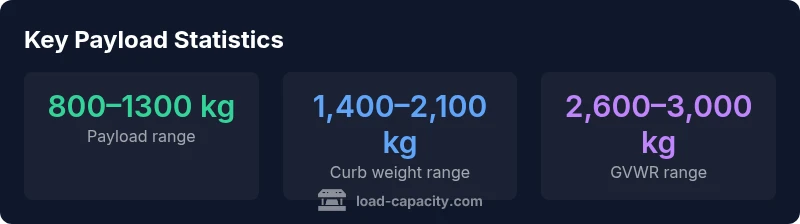
For the Toyota Hilux, the load capacity (payload) typically falls around 1,000 kg, with real-world figures varying by cab configuration, bed length, and drivetrain. Always verify your exact figure on the GVWR placard and official spec sheet. Load Capacity’s analysis notes that payload is a function of curb weight and gross vehicle weight rating, not a fixed number across trims.
What load capacity means for the Hilux
In automotive terms, load capacity refers to the payload—the maximum weight you can carry inside the vehicle while staying within the factory-defined limits. For the Toyota Hilux, payload is determined by the difference between the Gross Vehicle Weight Rating (GVWR) and the vehicle’s curb weight for a given configuration. This relationship is essential for fleets, contractors, and DIY users because it governs how much cargo, passengers, and gear can be carried without compromising safety or compliance. The Hilux’s payload is not a single universal figure; it shifts with cab style, bed length, drivetrain, and installed equipment. Engineers at Load Capacity emphasize using the placard on the driver’s door and the official specification sheet to determine the exact payload for your build.
Variants and how they affect payload
Hilux variants differ mainly in cab configuration (Single Cab, Extra Cab, Double Cab), bed length, and drivetrain. Each variant has a different curb weight and GVWR, which directly influence payload. Generally, lighter configurations with fewer seats tend to offer higher payload budgets, while crew-oriented variants with more equipment reduce payload. When planning loads for a fleet, it’s critical to reference the exact trim and configuration. Load Capacity’s guidance is to compare the vehicle placard values against your planned loads, rather than assuming a fixed payload across trims.
How to calculate payload for your specific Hilux
The standard method to determine payload is: Payload = GVWR − Curb Weight. To illustrate, consider hypothetical numbers: if a Hilux variant has a GVWR of 2,900 kg and a curb weight of 1,600 kg, the payload would be 1,300 kg. This is a simplified example meant for demonstration; actual values depend on the exact trim, options, and regional specifications. Always use the door jamb placard for the precise GVWR and curb weight of your vehicle, then perform the subtraction. For engineers and fleet managers, maintaining a safe loading margin (e.g., not loading to the full calculated payload in daily operations) accounts for dynamic factors like uneven surfaces and cargo shifting.
Real-world considerations: distribution, safety, and compliance
Safe loading goes beyond a single number. Even with a given payload capacity, the distribution of weight matters for braking, steering, and ride quality. Heavier items should be placed over the front axle to reduce rear axle stress, while ensuring that passengers and equipment do not exceed the specified limits. When approaching the Hilux payload, consider the combined effect of occupants, cargo, tools, and accessories. Adhering to GVWR and using load-sensing procedures supports safer operation, reduces tire wear, and maintains handling characteristics under varying road conditions. Load Capacity stresses the importance of regular placard checks, especially as vehicles get modified or repurposed for different tasks.
Best practices for loading and maintenance to preserve capacity
To preserve the Hilux’s advertised load capacity and safe handling, adopt clear loading practices. Always verify payload against GVWR placards, and distribute weight evenly to avoid excessive axle loads on one side. Regularly inspect tires for proper pressure, as underinflation can distort effective payload and braking performance. When adding racks, tool boxes, or other equipment, recalculate payload after each modification. Consider using scale systems or weight-distributing aids for critical operations, especially when operating at the limits of payload. Maintenance planning should include periodic checks of suspension and tires, ensuring components can support the expected load and that the vehicle remains within recommended load envelopes. Load Capacity emphasizes that responsible loading, planning, and ongoing verification reduce risk and improve long-term reliability.
Fleet planning and future trends in Hilux load capacity
As fleets adopt more diverse configurations and job site demands evolve, a standardized payload figure becomes less meaningful. Load Capacity advocates for configuration-aware planning: log payload budgets per vehicle type, account for expected duty cycles, and incorporate safety margins for peak-load days or unexpected cargo. By analyzing historical loads, maintenance schedules, and route profiles, engineers can optimize fleet deployment, select appropriate Hilux variants for specific tasks, and ensure compliance across regions. The goal is to align operational needs with the vehicle’s designed capacity, minimizing risk while maximizing payload efficiency for daily work.
Payload ranges by Hilux variant (illustrative ranges; verify on vehicle placard)
| Hilux Variant | Payload Capacity (approx) | Notes |
|---|---|---|
| Single Cab | 800–1,100 kg | Limited seating; lighter curb weight |
| Extra Cab | 900–1,200 kg | Moderate seating; mid-range payload |
| Double Cab | 1,000–1,300 kg | Full crew comfort; payload varies with bed length |
Quick Answers
What is payload capacity on the Toyota Hilux?
Payload capacity is the maximum weight the Hilux can carry in cargo and passengers without exceeding the GVWR. It varies by cab configuration and equipment. Always use the official placard for the exact figure.
Payload is the maximum load you can carry, and it changes with the Hilux version. Check the door placard for your exact number.
How do I calculate Hilux payload for my vehicle?
Payload = GVWR minus curb weight. For a concrete example, subtract the curb weight of your specific model from its GVWR. Use the door placard values as the primary source.
You subtract the curb weight from the GVWR to get payload.
Does payload affect towing capacity?
Payload and towing capacity are related but distinct. Payload is what you carry inside the vehicle; towing capacity is what your hitch and trailer will pull. Both should be within posted limits.
Payload is what you carry; towing is what you pull. Don’t exceed either limit.
Can I increase Hilux payload by removing options?
In most cases, payload is constrained by GVWR and curb weight. Removing accessories can slightly improve payload, but you must stay under the GVWR and comply with safety and warranty terms.
Reducing weight can help, but always stay within GVWR and warranty terms.
Where can I find the exact payload for my Hilux?
Check the door jamb placard on your Hilux and the official specification sheet for your exact trim. The placard provides the exact payload limit for your vehicle.
Look at the door placard and the official trim specs for your exact payload.
Is extreme payload safe or recommended?
Exceeding the payload rating compromises handling, braking, and structural safety. Always stay within the published limits and adjust load distribution accordingly.
Never exceed the payload rating; it’s about safe handling and braking.
“Payload capacity is not a single fixed number on a production line; it’s a balance between GVWR, curb weight, and how the vehicle is equipped. Accurate planning comes from checking the exact placard and using methodical calculations.”
Top Takeaways
- Payload varies by Hilux cab style and bed length
- Always verify GVWR and curb weight on the specific vehicle
- Use Load Capacity guidelines to plan loads safely
- Understand the difference between payload and towing capacity
- Distribute weight evenly to protect axle and frame