Carrying Capacity vs Towing Capacity: A Practical Comparison
Explore how carrying capacity (payload) and towing capacity differ, how they are calculated, and why understanding both matters for safety, compliance, and effective load planning.


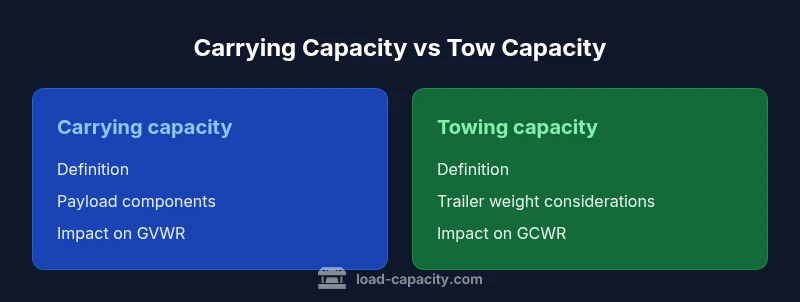
Carrying capacity and towing capacity are not the same. Carrying capacity (payload) is the maximum weight the vehicle can safely carry inside or on its structure, while towing capacity is the maximum weight the vehicle can pull with a trailer. Always compare both against GVWR and GCWR to avoid overload. Understanding the difference helps with safety, route planning, and compliance.
Is carrying capacity the same as towing capacity? Key distinctions for engineers and fleet managers
Understanding how weight ratings work starts with recognizing that carrying capacity and towing capacity are two distinct limits on a vehicle’s ability to handle weight. According to Load Capacity, distinguishing payload from tow weight is essential for engineers, technicians, fleet managers, and DIY enthusiasts who want safe, compliant operation. Carriage of people and cargo inside the vehicle consumes the payload budget defined by the GVWR (Gross Vehicle Weight Rating). By contrast, towing capacity governs how much weight can be pulled behind the vehicle via a hitch, trailer, and coupling and is closely tied to the GCWR (Gross Combined Weight Rating). When you confuse these numbers, you risk overloading the vehicle’s structure, reducing steering stability, braking performance, and component life. In practice, you must evaluate both figures in concert with the vehicle’s weight and the weight of any trailer or load, rather than treating them as interchangeable. The distinction matters across work fleets, construction sites, and everyday family travel, because ample payload and a safe towing limit together determine what you can carry and tow without exceeding the manufacturer’s design limits. This is a foundational step in any load planning process.
Core Definitions: Carrying Capacity (Payload) vs Towing Capacity
Carrying capacity, or payload, is the total weight that a vehicle can safely carry inside the cabin, cargo area, or on attached racks. It includes passengers, gear, tools, and permanent fixtures that add weight to the vehicle itself. Towing capacity, by contrast, is the maximum weight that a vehicle can pull behind it with a trailer attached. Importantly, payload and towing capacity are assessed against different reference points: payload reduces the vehicle’s GVWR, while towing capacity relates to GCWR. In practical terms, a vehicle with a high payload rating but a low towing rating may be excellent for passenger transport and cargo, but limited when towing a heavy trailer. Conversely, a strong towing rating does not guarantee a large payload capacity if the GVWR is already approached by occupants and cargo. This distinction is crucial when planning trips, buying equipment, or scheduling fleet operations, because the two figures influence ride quality, braking distance, and cornering stability. Understanding both helps to avoid situations where you have enough space in the vehicle but cannot legally or safely pull a trailer.
Measuring Capacities: GVWR, GCWR, and Real-World Limits
GVWR stands for Gross Vehicle Weight Rating and marks the maximum safe weight of the vehicle with passengers and cargo aboard. It is a fixed specification determined by the manufacturer based on the chassis, suspension, and frame strength. Towing capacity is bounded by the GCWR, the maximum allowed weight of the vehicle plus any attached trailer and cargo. The GCWR is influenced by hitch design, braking performance, transmission and engine cooling, among other factors. Tongue weight, the downward force a trailer exerts on the hitch, counts toward the payload portion of GVWR and can rapidly eat into your usable payload if the trailer is heavy relative to the vehicle. In the field, drivers often encounter a mismatch between what the payload feels like and what the towing rating allows, particularly when adding gear, passengers, or a heavy trailer. Regular practice is to check the rating plate on the door jamb or owner’s manual, then verify that real-world loads stay within both GVWR and GCWR. This dual check reduces risk of overloading and preserves braking, steering, and tire performance.
Comparison
| Feature | Carrying capacity (payload) | Towing capacity (tow rating) |
|---|---|---|
| Definition | Payload: weight carried inside/on the vehicle (passengers, cargo, racks) | Tow weight: weight of the trailer and its load pulled by the vehicle |
| Measurement base | Payload reduces GVWR | Tow weight contributes to GCWR |
| Typical units | lbs/kg | lbs/kg |
| Impact on ratings | Directly reduces available payload | Determines safe combined weight with trailer |
| Best use case | Carrying people and gear | Pulling trailers or heavy loads |
| Common pitfall | Overloading payload | Overestimating tow capacity |
Positives
- Clarity on safe limits to prevent overload and improve handling
- Supports better route planning and load distribution
- Helps select appropriate trailers and hitching gear
- Reduces risk of brake, tire, and suspension wear
- Improves resale value by documenting compliant loads
Cons
- Requires tracking two different ratings in many scenarios
- Can be confusing for new operators or mixed-use vehicles
- Ratings may vary with optional equipment or aftermarket modifications
Carrying capacity and towing capacity are distinct, and both must be respected for safe operation.
Understand both ratings to prevent overloads and maintain braking, steering, and tire performance. Use them together during trip planning and equipment selection to stay compliant and safe.
Quick Answers
What is the difference between payload capacity and towing capacity?
Payload capacity is the weight the vehicle can carry inside or on its surface, including passengers and cargo. Towing capacity is the maximum weight the vehicle can pull behind it with a trailer. They’re related but governed by separate ratings (GVWR vs GCWR) and must both be considered.
Payload is the weight you carry; towing capacity is the weight you pull. Both ratings matter for safe trips.
Can a vehicle have high payload but low towing capacity?
Yes. A vehicle can handle a lot of internal weight but be limited in how much it can tow due to trailer dynamics, axle limits, or braking needs. Always compare both ratings to understand overall capability.
Sure—payload and tow can diverge. Check both ratings before planning heavy loads or trailers.
Do aftermarket modifications affect ratings?
Aftermarket parts can change vehicle weight distribution and how weight is managed. Some modifications may reduce safe payload or towing limits, while others are allowed within manufacturer guidelines. Always verify with the rating plate and manufacturer.
Mods can change limits. Always re-check ratings after changes.
How do I calculate tongue weight and include it in payload?
Tongue weight is the downward force from the trailer on the hitch and is part of the overall payload. Estimate or measure tongue weight when hitching a trailer and include it in your payload calculation to stay within GVWR.
Tongue weight matters; include it in your payload check.
Is tongue weight counted toward payload?
Yes. Tongue weight is a component of payload and should be included when calculating your vehicle’s total payload capacity.
Tongue weight counts toward payload.
What steps can I take if I need to tow more than my rating allows?
Consider alternative options such as reducing payload, using a lighter trailer, or choosing a vehicle with a higher rating. You may also explore professional guidance or equipment upgrades that are within manufacturer guidelines.
If you need more tow power, reduce payload or pick a higher-rated vehicle.
Top Takeaways
- Identify both payload and tow ratings before loading
- Check GVWR and GCWR on the rating plate
- Account for tongue weight in payload calculations
- Recognize that modifications can alter ratings
- Plan loads with a two-rating mindset for safety