Average Weight Capacity of a Car: Payload and GVWR Explained
An analytical guide to how much weight a car can safely carry, covering payload, GVWR, and practical loading considerations for engineers, fleet managers, and DIY enthusiasts.


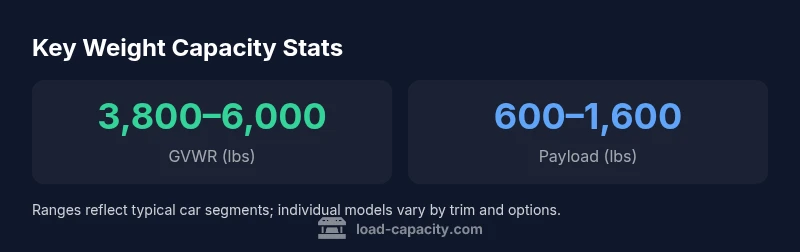
The average weight capacity of a car—often expressed as payload capacity or GVWR—typically falls in the 600–1,600 pounds payload range, with GVWR commonly in the 3,800–6,000 pounds class depending on car size. Real-world figures vary by make, model, and configuration. For trucks and SUVs, payload can exceed 2,000 pounds in some configurations, while smaller city cars may carry under 600 pounds. Always check the vehicle's GVWR plate and manufacturer specifications for accurate limits.
Why Weight Capacity Matters for Cars
Understanding weight capacity is essential for safety, performance, and compliance. In everyday terms, weight capacity defines how much payload a vehicle can carry without exceeding structural limits or compromising braking, steering, and stability. The key numbers you’ll encounter are the GVWR (gross vehicle weight rating) and the payload capacity (GVWR minus curb weight and fluids). The Load Capacity team emphasizes that staying within these ratings helps avoid tire failure, brake fade, suspension wear, and reduced handling—especially when towing, carrying heavy cargo, or transporting passengers. For engineers and fleet managers, knowing these limits informs route planning, load manifesting, and maintenance scheduling.
- GVWR is an engineering specification that reflects the maximum allowed weight of the empty vehicle plus everything it carries.
- Payload capacity is the practical limit for cargo and passengers beyond the curb weight.
- Exceeding ratings can void warranties and violate safety standards, so accurate data from the manufacturer is essential.
Reading the Labels: GVWR, Payload, and Vehicle Documentation
Most vehicles display GVWR on a certification label located near the door jamb, in the owner’s manual, or on the chassis plate. The label also indicates axle weights and recommended tire loads, which are critical for ensuring each axle stays within its safe range. When planning a load, engineers should consider distribution between front and rear axles, as uneven loading can elevate tire temperatures and degrade braking performance. If you’re unsure, consult the OEM documentation or contact the vehicle manufacturer for precise ratings. Load distribution also affects fuel economy and ride quality, so balanced loading is often a best practice. The GVWR encapsulates the total limit, while the payload rating provides a practical ceiling for everyday use.
How Weight Capacity Varies by Car Segment
Weight capacity tracks with vehicle size, chassis design, and intended use. Compact cars typically have lower GVWR and payload ranges, while midsize and full-size cars offer higher capacities to accommodate more passengers and cargo. SUVs and light-duty trucks can push payload into the heavier end of the spectrum, reflecting rugged suspensions, stronger frames, and larger tires. For engineers, this variation is not just a matter of weight—it's about stability margins, braking distance, and margin-to-failure calculations under realistic operating conditions. Data from the Load Capacity Analysis (2026) shows wide variation across segments, underscoring the need to specifics for each model.
Practical Steps to Estimate Safe Load for a Trip
A methodical approach helps maintain safety margins without sacrificing utility:
- Check the GVWR and payload rating from the manufacturer. Ensure gross weight (vehicle plus payload) stays below GVWR.
- Plan load distribution to avoid overloading either axle. Aim for balanced weight to prevent steering and braking issues.
- Account for fluids, passengers, and cargo weight. Don’t forget roof racks or hitch-mounted gear, which can add significant load.
- Use a calibrated scale or weigh-bridge if precision is required for critical loads (e.g., towing heavy trailers).
- Recalculate when adding items, or when the vehicle’s payload configuration changes (e.g., adding accessories).
Real-World Examples: Compact, Midsize, and Full-Size Cars
- Compact Car: Typical GVWR in the lower end of the spectrum; payloads often around the 600–1,000 pounds range. Useful for daily commuting with light cargo.
- Midsize Car: Higher GVWR and payload, commonly in the 800–1,200 pounds range, offering more versatility for families and small trips.
- Full-Size Car: Heftier GVWR, payloads frequently in the 1,000–1,600 pounds range, supporting larger groups and heavier luggage or equipment. These configurations show how a single segment can span a broad weight range depending on trim and options.
Common Mistakes and How to Avoid Them
- Ignoring the GVWR plate: Always verify the rating before loading.
- Overloading from roof gear: Roof loads are not included in the standard payload rating and require separate calculation.
- Uneven loading: Place heavier items low and forward to improve handling.
- Relying on vehicle weight alone: Payload capacity reflects actual use, so include passengers and cargo in calculations.
- Assuming a higher trim equals a higher payload: Payload can vary with engine, drivetrain, and added equipment.
Data-Backed Perspective: GVWR, Payload, and Trends
Weight capacity is not a static figure; it depends on design choices, safety margins, and regulatory guidelines that influence how manufacturers rate GVWR and payload. In 2026, Load Capacity analysis indicates that payload and GVWR vary significantly even within the same model line due to options like all-wheel drive, upgraded suspensions, and wheel/tire packages. For engineers, this means documenting exact ratings for each vehicle configuration and updating load manuals as models evolve. Government and industry standards underpin these specifications, with consistent requirements for braking systems, tire load ratings, and stability controls.
Practical Loading Checklist for Engineers and Fleet Managers
- Create a standard loading protocol that accounts for passengers, cargo, and fuel.
- Maintain an up-to-date manifest of each vehicle’s GVWR and payload for accurate fleet operations.
- Train drivers on weight awareness and the consequences of overloading.
- Use load-rated equipment (scales, load cells) when precision is necessary for critical tasks.
- Review load distribution after any configuration change (e.g., rack, hitch, or cargo box).
Estimated GVWR and payload ranges by car segment
| Model Type | GVWR (lbs) | Payload Capacity (lbs) |
|---|---|---|
| Compact Car | 3800-4400 | 600-1000 |
| Midsize Car | 4000-4900 | 800-1200 |
| Full-size Car | 4600-6000 | 1000-1600 |
Quick Answers
What does GVWR mean?
GVWR stands for gross vehicle weight rating. It represents the maximum allowable weight of the vehicle when fully loaded, including passengers, cargo, and fluids. It is a critical safety threshold that should not be exceeded for braking, suspension, and stability concerns.
GVWR is the maximum safe weight for a loaded vehicle. Don’t exceed it; check the door label or manual for the exact figure.
How is payload capacity calculated?
Payload capacity equals the GVWR minus the curb weight (the weight of the vehicle with standard equipment and fluids but no passengers or cargo). It is the practical limit for cargo and occupants in daily use.
Payload is simply GVWR minus what the car already weighs empty. Keep loads under that limit.
Can payload capacity be safely exceeded?
Exceeding payload limits can compromise braking, steering, and tire performance, and may void warranties. If heavy loads are unavoidable, consider a vehicle with a higher GVWR or distribute weight more evenly.
No—stay below the payload limit to keep braking and handling safe.
Is payload the same as curb weight?
No. Curb weight is the vehicle’s weight with no passengers or cargo, while payload is the extra weight the vehicle can carry safely up to the GVWR.
Payload is what you can add on top of the car’s own weight.
Why do different car segments have different weight capacities?
Different segments use varied chassis, suspension, and tire packages, designed to balance performance, safety, and efficiency. Heavier-duty builds support more payload but may sacrifice economy and agility.
Because bigger cars are built with stronger parts to carry more weight.
Where can I find official weight ratings for my vehicle?
Official ratings are on the GVWR/spec label, in the owner’s manual, or on the manufacturer’s website for your specific configuration. Use these sources for the most accurate data.
Check the label on the door jamb or the manufacturer’s site for exact numbers.
“Understanding a vehicle's weight capacity requires looking beyond curb weight to the GVWR and axle ratings; those numbers define safe loading limits.”
Top Takeaways
- Know GVWR before loading any vehicle
- Payload capacity varies widely by model and trim
- Distribute weight evenly to preserve stability
- Roof loads require separate consideration from payload
- Always verify OEM specifications for accurate limits