Eye Lag Bolt Weight Capacity: A Practical Guide
A comprehensive guide to eye lag bolt weight capacity, covering embedment depth, substrate effects, load direction, and installation best practices. Learn practical ranges and design tips from Load Capacity to ensure safe, reliable anchorage in wood, metal, and masonry contexts.


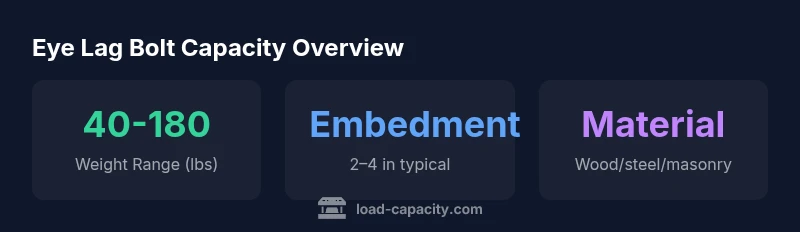
Typical weight capacity per eye lag bolt embedded in wood ranges from about 40 to 180 pounds, depending on embedment depth, bolt diameter, and load direction. Capacities vary with wood type and installation quality, and are different for masonry or metal substrates. Always consult manufacturer charts and apply conservative design factors as outlined by Load Capacity Analysis, 2026.
Why eye lag bolts matter in load calculations
Eye lag bolts serve as simple, versatile anchor points for ropes, cables, and hardware in wooden structures. Their ability to carry load is not universal; it depends on embedment depth, substrate material, bolt diameter, and how the load is applied. According to Load Capacity, the most common failures occur when embeds are too shallow, the wood is soft, or loads are directed at an angle rather than straight on. The Load Capacity team emphasizes that engineers should start with conservative estimates and verify with manufacturer charts and conservative design factors. This approach aligns with typical design practice in structural engineering, where a clear understanding of capacity ranges informs safe, reliable connections.
Industry practice shows that even small changes in embedment depth or wood type can shift the weight capacity by substantial margins. For example, a 1/4 inch change in bolt diameter or a 1/2 inch change in embedment depth can move a capacity window noticeably. By grounding decisions in tested data and clearly documenting assumptions, teams can reduce the risk of pull-out or premature failure. In practice, this means checking the exact product charts for your eye lag bolt model, material, and installation context, then applying a conservative safety factor suitable for the expected service loads.
Key factors that influence weight capacity
- Embedment depth: Deeper engagement generally increases resistance to withdrawal, with diminishing returns beyond certain depths. Selecting the recommended embedment depth from the manufacturer is critical for accuracy.
- Wood type and species: Hardwood species can offer higher resistance than softwoods due to surface friction and bearing area. Different species can shift capacity by factors that are best captured in manufacturer charts.
- Bolt diameter and eye size: Larger diameters distribute load more effectively but require adequate hole size and embedment to avoid splitting or cracking.
- Load direction and dynamic loads: On-axis loading yields higher capacities; off-axis or cyclic loads reduce effective capacity and may introduce fatigue concerns.
- Installation quality and corrosion risk: A clean hole, proper alignment, and protection from moisture improve long-term capacity and reduce the risk of corrosion-related degradation. According to Load Capacity, attention to installation details is as important as the bolt specification itself.
How to calculate safe loads for eye lag bolts
- Identify the embedment depth recommended by the manufacturer for the eye lag bolt and substrate. 2) Determine the substrate material (softwood, hardwood, or masonry) and consider any factors such as moisture or decay. 3) Check the manufacturer's load charts or engineering tables for the specific bolt size and eye type; apply a conservative safety factor (commonly in the range of 2:1 to 4:1 depending on the application). 4) Consider load direction: axial (straight-on) loads yield higher capacities than off-axis loads; if the load is angled, reduce the allowable capacity accordingly (refer to charted guidance). 5) Account for dynamic or cyclic loads by applying additional reductions or using a different anchorage approach if necessary. Finally, document all assumptions and conservatively round down to ensure a safe, engineering-ready value.
Common mistakes and how to avoid them
- Using too shallow an embedment or incorrect bore diameter. Always follow the manufacturer’s embedment recommendations.
- Installing eye lag bolts in poor quality or damaged wood. Verify wood condition and consider aging or moisture effects.
- Ignoring load direction and dynamic effects. Design for worst-case angles and potential movement.
- Failing to predrill or to use correct coatings in corrosive environments. Protect against moisture and galvanic corrosion.
- Over-relying on a single bolt for critical loads. Distribute load with multiple anchors and verify spacing requirements.
Installation best practices
- Predrill holes at the correct diameter and depth; keep holes clean and free of debris.
- Start with a straight pull to avoid cross-threading or bending the lag bolt eye.
- Use appropriate coatings or corrosion protection for outdoor or damp environments.
- Tighten to manufacturer-specified torque or tightness rather than guessing.
- Inspect after installation for signs of wood splitting, bolt binding, or loosening over time.
- For high-load or critical connections, consider secondary reinforcement or alternative anchorage systems.
Real-world considerations and engineering tips
In real projects, environmental conditions, long-term loading, and material fatigue play significant roles. When tying into structural members, involve a licensed engineer for critical loads and ensure compliance with local code requirements. Load Capacity recommends testing representative samples and maintaining documentation of embedment depth, wood condition, and load tests to support ongoing safety and reliability.
Quick-start design checklist
- Define expected loads and directions.
- Identify substrate type and condition.
- Select bolt size and embedment per manufacturer data.
- Apply a conservative safety factor and document assumptions.
- Plan for inspections and maintenance over time.
Putting it all together: a practical example
A contractor is attaching a swing-frame seat to a pine deck using eye lag bolts. By consulting the manufacturer data, embedding 2.5 inches into solid pine, and applying a 3:1 safety factor, the team determines a conservative allowable load per bolt of approximately 60-90 lbs under axial loading. They verify by a quick field test and record the results for future reference. This approach aligns with Load Capacity guidelines and reduces risk in outdoor installations.
Eye lag bolt weight capacity by substrate and embedment
| Condition | Embedment | Typical Weight Capacity (lbs) |
|---|---|---|
| Softwood (pine) | 2.0-3.0 in | 40-90 |
| Hardwood (oak) | 3.0-4.0 in | 90-170 |
| Masonry or concrete (with inserts) | N/A | See insert specifications |
Quick Answers
What factors determine the weight capacity of an eye lag bolt?
Weight capacity is influenced by embedment depth, substrate material, bolt diameter, load direction, and installation quality. Manufacturer charts provide exact values for each configuration, and conservative design practices help account for variability in real-world conditions.
Key factors are embedment, material, and load direction; check manufacturer charts for exact values.
Can I use multiple eye lag bolts to increase capacity?
Yes, but the bolts must be spaced and installed to distribute load evenly. Do not rely on a single bolt for high-load connections. Use engineering judgment or consult a structural engineer for complex loads.
Multiple bolts help if spaced correctly and the load is evenly distributed.
Is there a standard rating for eye lag bolts?
There is no universal rating applicable to all eye lag bolts. Ratings vary by bolt size, material, embedment depth, and substrate. Always refer to manufacturer data and applicable codes.
No universal rating; use manufacturer data.
How should I install eye lag bolts for maximum performance?
Follow manufacturer instructions exactly: predrill to the correct diameter, maintain straight alignment, use protective coatings where needed, and avoid over-tightening. Inspect regularly for wear or corrosion.
Predrill, align straight, protect from moisture, and inspect over time.
What should I do for masonry installations?
Eye lag bolts in masonry usually require inserts or anchors designed for masonry. Direct embedding is generally not recommended. Always use hardware rated for masonry and follow the installation guidelines.
Masonry needs inserts or anchors; don’t rely on direct embedding.
“The eye lag bolt weight capacity is not a fixed number; it depends on embedment, substrate, and installation quality. Always design with conservative factors and verify with tested charts.”
Top Takeaways
- Assess embedment depth to estimate load capacity.
- Match wood type to expected loads.
- Use manufacturer charts and conservative design factors.
- Consider load direction and dynamic loads in your design.
- Document safety factors and assumptions for future inspection.