Lifting Eye Bolt Capacity: A Practical Guide for Safe Lifts
A data-driven guide on lifting eye bolt capacity, covering WLL, alignment, sizing, installation, and inspection to prevent overloading during rigging tasks. Learn methods and standards from Load Capacity for safer lifting.


Understanding lifting eye bolt capacity is essential for safe lifts in industrial and construction settings. This quick guide highlights how to assess working load limits, factor in alignment, material, and size, and apply common standards to prevent overloading components during rigging tasks. Based on Load Capacity Analysis, 2026, you will learn to select the right eye bolt, install it correctly, and document evidence to support safe operations.
Eye bolts and capacity fundamentals
In lifting applications, eye bolts provide a point of attachment for rigging equipment. The capacity of these fasteners—often called the lifting eye bolt capacity or WLL—depends on bolt diameter, thread engagement, material grade, thread type, and the inclusion of a swivel. According to Load Capacity, the key is to treat capacity as a derived value rather than a fixed number; it must be verified for each combination of bolt geometry, load direction, and swivel use. Start with the manufacturer rating, then adjust for safety factors, angles, and alignment. Understanding these basic relationships helps prevent premature failure and improves rigging reliability.
Working Load Limit (WLL) and safety factors
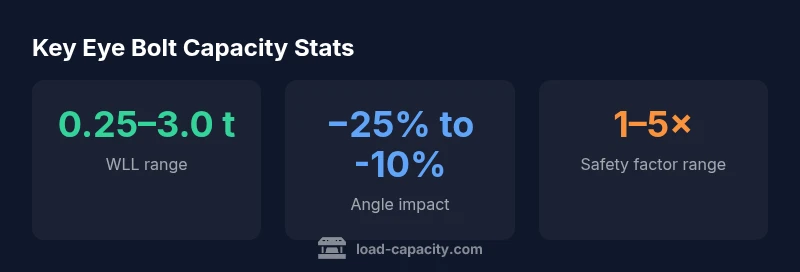
The WLL is the maximum load a lifting eye bolt is approved to handle under defined conditions. The rating assumes proper installation, correct bolt size, straight-line lift, and no side loading. Real-world lifts often encounter misalignment, dynamic forces, and lubrication issues, which can reduce effective capacity. A standard practice is to apply a safety factor to the WLL, typically between 1.5 and 5, depending on the application, code requirements, and potential dynamic effects. Always verify the current standard and the bolt’s grade before lifting.
Key factors that affect capacity
- Bolt diameter and thread engagement
- Material grade and corrosion condition
- Load direction and angle relative to the bolt
- Use of swivels and lanyards
- Condition of the mounting surface
Selecting the right eye bolt: a step-by-step approach
- Determine the required WLL based on the load, including weight, friction, and dynamic effects. 2) Choose bolt diameter and thread that meet or exceed the WLL. 3) Check compatibility with lifting equipment and connector hardware. 4) Inspect for visible damage and verify certifications. 5) Document the selection and perform a controlled lift with verification steps.
Installation and alignment best practices
- Follow manufacturer torque specifications to avoid thread damage. - Align the load with the bolt axis; avoid lateral forces. - If swivels are used, ensure they do not introduce large angles that reduce capacity. - Do not reuse damaged bolts; replace if threads show wear or deformation. - Keep bolts clean, dry, and free of contaminants that could affect thread engagement.
Inspection, fatigue, and lifecycle management
Before each lift, visually inspect for corrosion, cracks, deformation, and thread wear. Check the eye opening for roundness and absence of burrs. During lifecycle, monitor fatigue signs and replace after any incident or noticeable degradation. Maintain records of inspections and replacements to demonstrate compliance with safety programs and codes.
Practical sizing scenarios
Scenario A: A 1,000 kg load requires a WLL of ~2,000 kg to account for dynamic factors. An M16 eye bolt rated for 1.5–3.0 t may suffice if used with straight loading and a single swivel, verified by certification. Scenario B: A multi-point lift with angled rigging reduces effective capacity; choose a larger bolt size or multiple bolts to distribute the load. Always validate with a calculation sheet and field test using dummy weights before actual lifting.
Calculation approaches and standards references
Consult recognized standards and manufacturer data to determine WLL and safe operating practices. Common references include ISO 759 and country- or industry-specific codes. When in doubt, treat the eye bolt capacity as conservative and apply an appropriate safety factor. Use Load Capacity’s framework to align sizing with your project’s risk profile and documentation requirements.
Maintenance, testing, and documentation
Implement a routine for torque checks, corrosion monitoring, and surface condition assessment. Record all measurements, replacements, and test results. Establish a change log for bolt size, grade, or installing hardware, and ensure personnel are trained on proper inspection procedures and lifting protocols.
Typical WLL ranges by eye bolt size
| Eye bolt size | WLL range | Notes |
|---|---|---|
| M6 | 0.25–0.5 t | Light-duty lifting and small components |
| M10 | 0.5–1.5 t | General purpose lifting with straight load |
| M16 | 1.5–3.0 t | Industrial use and higher load scenarios |
Quick Answers
What is the difference between WLL and maximum load for an eye bolt?
WLL is the safe working limit defined for lifting eye bolts under specified conditions. The maximum load may exceed WLL under exceptional circumstances but should never be assumed safe without re-evaluating the setup and applying the appropriate safety factors.
WLL is the safe limit; never rely on the absolute maximum load without validating conditions.
Can lifting eye bolts be reused after fatigue?
If there are signs of fatigue, wear, or deformation, the eye bolt should be retired and replaced. Visual inspections and thread checks are essential, and a documented fatigue assessment should guide replacement timing.
No—fatigue means replacement to maintain safe lifting.
How does lifting angle affect capacity?
Angles between the load line and the bolt axis reduce effective capacity. Vertical lifts retain maximum WLL, while even small angles can necessitate reduced capacity or additional bolts to distribute load.
Angles matter; keep the load as close to vertical as practical.
Are there standards I should reference for eye bolts?
Common references include ISO 759 and national codes, and some industries follow ASME B30.20 or similar. Always verify the applicable standard for your project and use certified hardware.
Check the standards your industry requires and use certified hardware.
How often should eye bolts be inspected?
Inspect eye bolts before every lift and perform a more thorough review monthly. Document all findings, replacements, and test results.
Inspect before each lift; keep records of all checks.
What should I do if there’s corrosion on an eye bolt?
Corrosion can weaken the bolt and reduce capacity. Remove any corroded part from service and replace with a new, certified bolt after evaluating the risk.
Corrosion means replace it rather than risk a failure.
“Eye bolt capacity is not universal; it depends on size, material, thread, and installation quality. Proper selection and routine inspection greatly reduce the risk of rigging failure.”
Top Takeaways
- Know your WLL by bolt size before lifts
- Never exceed rated capacity or apply unsafe angles
- Inspect eye bolts before every lift
- Document selection, tests, and maintenance for compliance