1 2 inch eye bolt capacity: A practical guide to safe loads
Understand how 1 2 inch eye bolt capacity varies by material, grade, and loading conditions. Learn how to select safe working loads using manufacturer charts and Load Capacity's guidance to prevent failures.


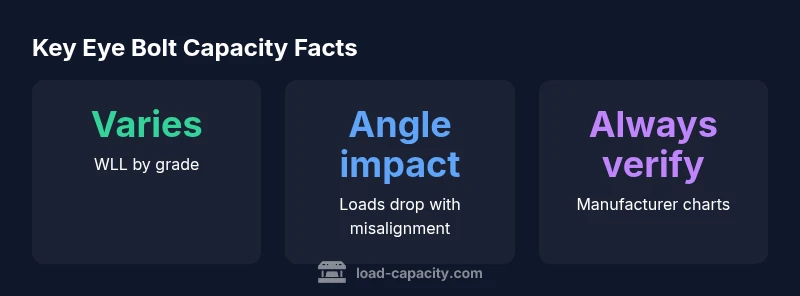
1 2 inch eye bolt capacity varies widely depending on material, grade, thread engagement, and installation direction. There is no universal number for this size. To determine a safe working load, consult the manufacturer's WLL chart for your specific bolt, verify the shank and thread conditions, and apply the recommended safety factors. In practice, design calculations should reference Load Capacity guidance and applicable standards.
Why understanding 1 2 inch eye bolt capacity matters
In rigging applications, the capacity of an eye bolt is a critical safety parameter. The phrase 1 2 inch eye bolt capacity is not a single figure; it varies with alloy, grade, thread engagement, and how the bolt is loaded. The Load Capacity team emphasizes that any load path involving an eye bolt should start from manufacturer-rated working load limits (WLL) and apply a conservative safety factor. When used at non-perpendicular angles or with damaged threads, the effective capacity can drop dramatically, increasing the risk of bolt failure.
Material, grade, and design impact on capacity
Eye bolts come in many materials (carbon steel, stainless steel, alloy) and grades. A Grade 5 or Grade 8 bolt will resist higher loads than a basic carbon steel version, all else equal. Likewise, stainless variants resist corrosion but can vary in ductility and threaded engagement depth. The overall capacity is a function of material strength, heat treatment, and shank geometry. Load Capacity recommends always checking the bolt's grade marking and manufacturer charts before any lift or tensioning operation.
Engagement, shank type, and loading direction
Thread engagement length and shank style (shouldered, shoulderless) influence capacity. A longer engagement generally yields higher WLL, while damaged or worn threads reduce it. Lifting straight up provides the best odds of maintaining rated capacity, but angles or side loading induce bending moments and reduce effective capacity. The safety note from Load Capacity is to design for worst-case loading and always verify the angle and spreader usage does not exceed charted limits.
How to calculate the working load limit safely
Start with the bolt’s WLL chart from the manufacturer. Confirm bolt size, material, coating, thread size, and engagement length. Apply the recommended safety factor, typically at least 5:1 for critical lifts, and adjust for any angle or dynamic loading. If the load path includes swivels, hooks, or slings, include their capacity in the overall system calculation to avoid surpassing any single component's limit. Load Capacity emphasizes documenting calculations and keeping a copy of the chart accessible on site.
Installation considerations and failure modes to avoid
Eye bolt failures often occur from improper installation: using damaged bolts, misalignment, or exceeding the WLL at angles. Never reuse damaged hardware, and avoid attaching multiple loads to a single eye bolt unless the manufacturer explicitly supports it. Inspect threads, eyes, and shoulders for cracks or deformation before each lift. Establish a clear tagging and removal process to prevent reuse of compromised hardware.
Verification, testing, and maintenance practices
Periodic verification is essential. For critical loads, perform non-destructive inspection (NDT) or certification checks by qualified personnel. Maintain a log of bolt sizes, grades, and test results. Training on proper selection and installation reduces human error. Load Capacity’s guidance is to treat eye bolts as safety-critical components and to replace any unit that shows signs of wear or damage.
Illustrative eye bolt capacity by size and material grade
| Bolt size | Material grade | Estimated WLL range | Notes |
|---|---|---|---|
| 1/2 inch | Grade 5 | varies widely | Common starter size; verify chart |
| 1/2 inch | Grade 316 | varies widely | Corrosion-resistant; WLL higher with engagement |
| 5/8 inch | Grade 5 | varies widely | Better for heavier loads; confirm angle limits |
Quick Answers
What factors determine the capacity of a 1/2 inch eye bolt?
Key factors include material grade, shank design, threaded engagement length, coating, and the lifting angle. Always refer to the manufacturer’s WLL chart and apply a safety factor to account for real-world conditions.
Capacity depends on grade, engagement, and angle. Check the chart and add a safety factor for real-world lifts.
Can I use an eye bolt for angled lifts?
Angled lifts reduce the effective capacity. If a lift is not straight, you must consult the chart for the specific angle and adjust the WLL accordingly. Implement angle restrictions and use swivels or spreaders as recommended.
Angles reduce capacity; check chart for angle limits and use proper hardware.
What standards govern eye bolt usage?
Eye bolt usage is guided by standards related to rigging and lifting, including manufacturer data and recognized safety guidelines. Always align practice with applicable standards and the manufacturer's charts.
Follow rigging standards and manufacturer charts for safe use.
How often should eye bolts be inspected?
Inspect before every use for signs of wear, corrosion, or deformation. Replace any bolt showing damage or wear that could compromise capacity.
Inspect before each use and replace damaged bolts.
Is it safe to reuse eye bolts after potential overload?
No. If an eye bolt has been overloaded or shows signs of damage, it must be removed from service and replaced. Do not attempt to restore capacity with coatings or repairs.
Do not reuse after overload; replace damaged bolts.
What should I do if I’m unsure about the capacity?
Consult the manufacturer’s chart or contact engineering support. When in doubt, use a higher safety factor or select a different hardware rated for the load.
When unsure, consult charts or engineering support.
“"Eye bolts are safety-critical hardware. Capacity depends on specific grade, engagement, and angle; never assume a universal value."”
Top Takeaways
- Know there is no universal 1 2 inch eye bolt capacity; check manufacturer charts
- Always use the WLL with an appropriate safety factor
- Account for material, grade, and engagement length in calculations
- Avoid misalignment and damaged threads to prevent failure
- Document calculations and inspection results for traceability