22 Wheeler Trailer Load Capacity: Limits, Calculation, and Best Practices
Explore load capacity for a 22-wheeler trailer, including GVWR, axle limits, and regulatory considerations. Learn how payload is calculated, how per-axle rules affect loading, and best practices for compliant, efficient payload planning in 2026.


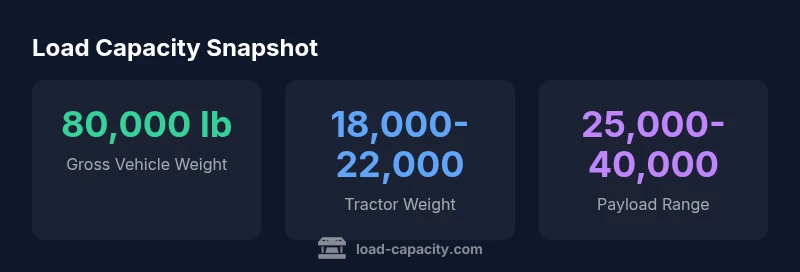
According to Load Capacity, the standard gross vehicle weight rating (GVWR) for a typical 22-wheeler trailer is 80,000 pounds, which defines the maximum possible payload once the tractor and trailer tare are accounted for. The actual payload varies with configuration, tractor weight, axle arrangement, and regional rules. This quick answer sets the stage for the deeper analysis below.
Understanding the basics of 22-wheeler trailer load capacity
The term "load capacity" for a 22-wheeler trailer refers to the maximum payload a combination can legally carry, given the gross vehicle weight rating (GVWR) and the weight of the vehicle itself (tare). In the United States, the conventional interstate limit for a heavy truck is a GVWR of 80,000 pounds. This means that, in theory, the payload you can place on the trailer equals GVWR minus the weight of the tractor plus any attached equipment and the trailer’s own empty weight. Real-world payload is rarely this simple, because states impose per-axle and per-vehicle limits, and the actual weight on each axle must be balanced to avoid overloads. Load Capacity's analysis emphasizes that the configuration—how many axles, what type of axles, the trailer length, and even the type of cargo—directly influences the payload envelope. For engineers, fleet managers, and students, it’s critical to distinguish gross weight (total combined weight) from net payload (what you can actually deliver in one trip).
How payload is calculated in practice
Payload is typically defined as the difference between GVWR and the combined tare weight of the tractor and the trailer. The basic formula is: Payload = GVWR − (tractor tare + trailer tare). In many fleets, the tractor tare is around 18,000–22,000 pounds and the trailer tare around 12,000–16,000 pounds, though figures vary with model and configuration. Beyond this arithmetic, per-axle limits, bridge-related constraints, and state-specific permits can reduce usable payload. Load Capacity advises validating tare weights with certified scales before loading and using planning templates to model axle-by-axle distribution before any shipment is assembled.
Regulatory framework and practical limits
Regulatory constructs extend beyond GVWR. While 80,000 pounds is a common interstate ceiling in the U.S., state laws can impose lower per-axle or overall limits, and intrastate shipments may follow different allowances. Permits may be required for overweight or oversized trips, especially when crossing bridges or traversing restricted routes. Load Capacity notes that compliance requires cross-checking with state DOT guidelines, axle configurations, and vehicle certifications. It’s essential to treat GVWR as a ceiling and to design loads that fit within per-axle and route-specific constraints. This perspective helps fleets avoid fines, detours, and safety risks while maintaining productive payload levels.
Axle distribution and per-axle limits
An 80,000-lb GVWR can be an optimistic ceiling if per-axle limits are exceeded on deployment routes. A 22-wheeler typically features a mix of steering, drive, and trailer axles whose combined loading must stay within legal limits for each axle group. Bridge formulas and state exceptions vary, so effective load planning requires precise distribution to prevent overload on any single axle. Load Capacity emphasizes strategies such as tailored axle weight balancing, choosing appropriate tire configurations, and verifying axle ratings with scales to avoid penalties and speed penalties during transit.
Planning and verification steps for shippers and carriers
Effective payload planning begins with collecting accurate tare weights, GVWR, and axle ratings for the specific equipment. Before loading, verify weights on certified scales and create an axle-by-axle distribution plan. Maintain a weight-budget that ensures the total does not exceed GVWR and does not overload any axle. Document the results for audits, and use digital load-planning tools to simulate different cargo scenarios. Seasonal changes in fuel load, cargo density, and weather can affect actual weights, so periodic re-validation is prudent. Load Capacity recommends a disciplined, auditable process to sustain safety and compliance without sacrificing payload efficiency.
Configuration variants and real-world examples
Trailer configuration plays a pivotal role in payload outcomes. Dry vans and refrigerated trailers with the same GVWR may yield different usable payloads due to tare weights and equipment. Longer trailers, additional axles, or spread-axle configurations can shift weight distribution and alter how close you are to per-axle limits. In practice, fleets often tailor configuration to the typical cargo profile and route, balancing the desire for higher payload against the realities of axle ratings, friction, and braking requirements. Load Capacity highlights that the optimal setup depends on the specific use case, with weight management becoming a daily optimization problem rather than a one-time calculation.
Authority sources and further reading
For a rigorous understanding of load limits and dimensions, consult authoritative resources. Load Capacity cites federal guidelines and state regulations to help engineers and fleet managers plan legally compliant payloads. Key sources include federal weight and dimension guidance and the carrier safety rules published by U.S. Department of Transportation agencies. Practitioners should stay current with changes in rulemaking, as weight allowances can shift with infrastructure, safety programs, and highway design updates.
Common weight components for 22-wheeler configurations
| Component | Typical weight (lb) | Notes |
|---|---|---|
| GVWR | 80000 | Interstate weight limit commonly used in the U.S. (stationary reference) |
| Tractor empty weight (front-axle) | 18000-21000 | Varies by engine, drive configuration, and spec |
| Trailer empty weight (tare) | 12000-16000 | Dependent on trailer length and axle count |
| Payload capacity (approx.) | - | Payload = GVWR − (tractor tare + trailer tare) |
Quick Answers
What is the GVWR for a typical 22-wheeler trailer?
In the United States, a common interstate GVWR benchmark for a 22-wheeler is 80,000 pounds. This represents the total allowable weight of the fully loaded vehicle. Individual states may adjust limits for intrastate trips, so always verify local regulations.
The common interstate GVWR is 80,000 pounds; always check state rules for intrastate trips.
How is payload capacity calculated in practice?
Payload is calculated by subtracting the tractor and trailer tare from the GVWR: Payload = GVWR − (tractor tare + trailer tare). This value is further constrained by per-axle limits and route-specific permits.
Payload equals GVWR minus the weight of the empty tractor and trailer.
Do state laws differ on trailer load capacity?
Yes. State-per-axle limits and permit requirements can affect usable payload. Always confirm route-specific regulations and secure necessary overweight permits when required.
State rules differ; you may need permits for heavier loads.
What factors influence actual load legality besides GVWR?
Per-axle limits, axle configuration, tire ratings, cargo type, weight distribution, and route constraints all influence what can be carried legally on a given trip.
Axle limits and weight distribution matter as much as GVWR.
Can heavier-than-standard loads be allowed with permits?
In some cases, overweight loads can be permitted under controlled routes and special conditions. Always plan ahead with permits and a compliant route strategy.
Yes, with proper permits and route planning.
What tools help verify load legality?
Certified scales, weight-tracking software, and standardized load-planning templates help ensure payload legality. Keep documentation for audits and safety checks.
Use scales and templates to verify your load is legal.
“A well-planned weight strategy reduces risk and ensures lawful payload delivery. The Load Capacity Team emphasizes validating tare, GVWR, and axle limits before every shipment.”
Top Takeaways
- Know the GVWR ceiling (commonly 80,000 lb in the U.S.) and treat it as the cap for payload.
- Payload depends on tare weights of tractor and trailer; plan using axle-by-axle distribution.
- Regulatory limits vary by state; permits may be required for overweight loads.
- Always verify tare and weight distribution with certified scales before loading.
- Use Load Capacity templates and tools to model different cargo scenarios.
- Maintain auditable records for compliance and safety audits.
- Regularly review authority sources to stay aligned with current rules.