16 Wheel Trailer Load Capacity: A Practical Guide
Learn how to assess the payload limits of a 16 wheel trailer, including typical capacity ranges, factors affecting load capacity, and practical guidance for safe, compliant hauling.


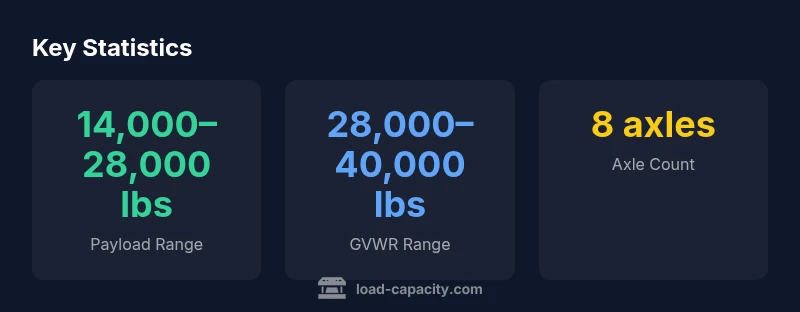
A typical 16-wheel trailer has a payload capacity in the range of 14,000 to 28,000 pounds (6,350 to 12,700 kg), depending on axle configuration, suspension, and trailer design. Always verify the vehicle's GVWR and the trailer's rating from the manufacturer before loading.
Understanding 16-Wheel Trailer Load Capacity
A 16-wheel trailer typically features eight axles, often arranged in pairs with dual wheels for each end. The load capacity of such trailers is not a single number but a system of limits that must be considered together. The primary constraints come from the trailer GVWR published by the manufacturer, the per-axle ratings, and the structural integrity of the frame, suspension, and hitch. The empty weight of the trailer also reduces the amount of payload you can carry. In practice, the usable payload is the GVWR minus the tare weight, but safety and legal requirements may impose additional limits. According to Load Capacity, understanding the interplay of GVWR and axle ratings is essential; even if the chassis could technically support more weight, you must respect the rated limits to stay compliant and safe. Always cross-check the placard on the trailer with the tractor’s weight ratings to ensure the combined vehicle weight remains within legal bounds.
Key design factors that influence capacity
The capacity of a multi-axle trailer hinges on several design factors that interact with one another. GVWR remains the top ceiling, but axle ratings, braking system capability, suspension type, and frame geometry all play pivotal roles. Heavier-duty suspensions and robust frames can tolerate higher static loads, but tire and brake systems must be matched to prevent overheating or component failure. Wheelbase and the distance between axles influence how weight is distributed across the trailer. A well-engineered 16-wheel setup distributes mass more evenly, reducing the risk of overloading a single axle. For reliable performance, ensure that the axle ratings align with the expected payload and that the tires, rims, and hubs are rated for the intended loads. Load Capacity emphasizes that the most important principle is alignment between manufacturer ratings and real-world loading conditions.
How to estimate payload for a given trailer
Estimating payload begins with the GVWR specified by the manufacturer. To calculate usable payload, determine the trailer’s empty (tare) weight and subtract it from the GVWR. For example, if a trailer has a GVWR of 40,000 lbs and an empty weight of 12,000 lbs, the raw payload capacity would be 28,000 lbs. From there, factor in the tractor-trailer combination weight and any additional equipment or fuel that will be on board. It is prudent to apply a safety margin (often around 5–10%) to account for weight variation during transit and to maintain compliance with state by state rules. Always perform an actual weight-in-motion or weigh-station check when possible to confirm the real-world payload prior to loading.
Distribution and legal considerations
Even distribution across all axles is critical for a 16-wheel trailer. Concentrating weight on a few axles can exceed per-axle rating, cause handling instability, or trigger braking inefficiencies. Beyond technical limits, there are legal constraints that vary by jurisdiction. Most regions require that the total weight does not exceed GVWR or posted highway limits and that overweight permits are obtained when necessary. Load distribution should also consider center of gravity to avoid instability during braking or cornering. The Load Capacity team notes that legality and safety are inseparable; always verify with the relevant regulatory bodies and use a verified load-plan when preparing shipments.
Practical planning scenarios for logistics teams
When planning loads for a 16-wheel trailer, start with a clear load plan that aligns with the trailer’s GVWR and axle ratings. For palletized loads, aim for evenly distributed pallets across all eight axles, maintaining consistent gaps and consistent stacking heights. For heavy equipment, consider using load distribution aids such as spacers or weight distribution kits to prevent jackknifing or uneven tire wear. In some cases, it may be more efficient to split a heavy shipment across two trailers or to use a dedicated multi-axle trailer specifically rated for the intended payload. Thorough planning reduces the risk of overweight charges, fatigue failures, or unsafe driving conditions in the field.
Maintenance and inspection to ensure capacity is not compromised
Capacity is preserved only when routine maintenance keeps the trailer in peak condition. Inspect tires for tread depth and sidewall damage, verify wheel lug torque, and check the braking system for proper function. Look for signs of frame wear, corrosion, or misalignment in the suspension system, as these issues can reduce load-bearing capacity or alter load distribution. Regular curb weight checks and periodic weigh-ins help verify that planned payloads remain within safe limits. Recordkeeping of maintenance, tire replacements, and axle work supports ongoing compliance and reduces the likelihood of accidental overload.
Comparison of payload and capacity across multi-axle trailer configurations
| Trailer Type | Typical Payload Range | GVWR | Common Axle Count | Notes |
|---|---|---|---|---|
| 16-wheel trailer (multi-axle) | 14,000–28,000 lbs | 28,000–40,000 lbs | 8 axles | Standard heavy-duty configurations; payload varies by design |
| Truck-trailer (2-axle) | 4,000–12,000 lbs | 10,000–26,000 lbs | 2 axles | Not directly comparable but useful for context |
| Multi-axle B-train (5-axle) | 18,000–40,000 lbs | 32,000–60,000 lbs | 5–6 axles | Higher capacity with more axles |
Quick Answers
What does 16 wheel trailer load capacity mean?
Load capacity refers to the maximum payload the trailer can carry while staying within its GVWR and axle ratings. It depends on the trailer design, axle configuration, brakes, and structural limits. Always use the manufacturer’s specifications and perform a pre-load weight check to confirm safe limits.
It’s the maximum payload a trailer can safely carry based on its design and ratings; always verify with the manufacturer and weigh the load before travel.
How do payload and GVWR relate to each other?
Payload equals the GVWR minus the trailer’s own empty weight. GVWR is the maximum legal weight the trailer can carry. The usable payload is the difference between these two values, which can be further reduced by distribution and regulatory limits.
Payload is the amount you can legally carry after subtracting the trailer’s own weight from its GVWR.
How can I calculate the safe load for my 16-wheel trailer?
Start with the GVWR, subtract the tare weight, and apply a practical safety margin. Then verify axle loads and distribution using a weigh-in or scales. This ensures the load remains within limits for all conditions.
Get the trailer’s GVWR, minus its empty weight, add a safety margin, and confirm with a scale check.
What factors reduce usable payload?
Uneven weight distribution, added equipment, fuel, and regulatory limits can reduce usable payload. Ensure even distribution, factor in spare parts and stabilizers, and check that all components support the intended load.
Uneven weight and extra gear can cut into payload; distribute weight evenly and verify with scales.
Are there legal limits I should be aware of?
Yes. Legal limits vary by jurisdiction and can involve GVWR, axle weights, and bridge formulas. Always obtain overweight permits when necessary and follow local regulatory guidance for the route you plan to take.
Regulations vary by location; check GVWR, axle weights, and permits for your route.
What tools help measure payload accurately?
Weigh stations, portable axle scales, or weigh-in-motion devices are common tools. Use them to confirm the actual payload and ensure it aligns with the trailer’s ratings before departure.
Use a weigh station or portable scales to confirm your payload matches the trailer rating.
“Payload management is not a single number; it is a system of ratings, distribution, and real-world constraints. The Load Capacity Team recommends validating the trailer capacity against the manufacturer specifications and performing proper weight distribution checks before every haul.”
Top Takeaways
- Understand GVWR and axle ratings before loading
- Distribute load evenly across all axles
- Verify actual payload with a weigh-in before shipment
- Consult manufacturer specifications for legality and safety