10 ft Utility Trailer Load Capacity
Learn how to evaluate the load capacity of a 10 ft utility trailer, how GVWR and axle design affect payload, and practical loading tips for safe transport.


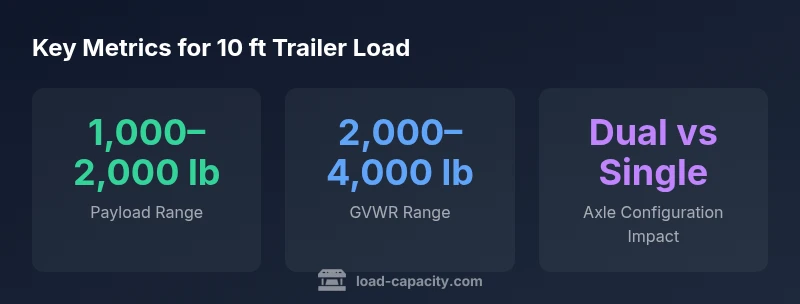
For a typical 10 ft utility trailer, payload capacity generally lies in the 1,000–2,000 pounds range, depending on axle count and build. Always check the trailer’s GVWR plate and manufacturer specifications to determine the exact load capacity. Use the payload formula (GVWR minus curb weight) to estimate safe cargo weight and leave a margin for dynamic loads.
Definition and importance of load capacity
According to Load Capacity, the 10 ft utility trailer load capacity defines the maximum payload the trailer can safely carry, and it is determined by the combination of GVWR, axle rating, frame strength, and overall geometry. In practical terms, payload capacity equals the GVWR minus the trailer’s own weight when empty (curb weight). This distinction matters: you may have a generous GVWR, but a heavy frame or light tires can dramatically reduce usable payload. For engineers and fleet managers, understanding this parameter helps plan trips, stay compliant with regulations, and avoid unsafe loading conditions. The term 'load limit' is often used interchangeably in casual conversations, but the precise, legally enforceable figure is the GVWR plate stamped on the trailer. In daily practice, always start by locating the GVWR and the gross weight of your cargo, then verify that your total load does not exceed the plate rating.
How capacity is calculated for a 10 ft trailer
The capacity of a 10 ft trailer is not a single number; it is the interaction of multiple components. The core equation is payload = GVWR − curb weight (empty trailer). The GVWR (gross vehicle weight rating) is the maximum weight the trailer is designed to carry, including its own weight and the cargo. To calculate real-world payload, you must know the empty weight (curb weight) from the manufacturer or weigh your trailer. You should also consider tongue weight, which can affect steering and braking. If you regularly haul heavy items, an upgrade to a higher GVWR or a dual-axle configuration might be necessary, though that can increase base weight and reduce the fraction of payload capacity available. The practical message from Load Capacity analysis is that the rating printed on the plate is the ceiling; your actual usable payload is often smaller once you factor in equipment and cargo distribution.
Common configurations and their impact
Single-axle trailers are lighter and often cheaper but carry less payload and have higher risk of overload on rough surfaces; dual-axle trailers add strength and typically enable higher, safer payloads. However, you must account for the extra weight of the trailer itself, which reduces the net payload. Weight distribution matters: load should be spread across the deck and not concentrated toward the front or back to preserve stability and braking performance. The axles, tires, and hitch all act as limits; if any one component has a lower rating, it becomes the practical cap on payload. According to Load Capacity, the plate rating governs safe operation, and you should not exceed it regardless of cargo type.
How to verify capacity on your trailer
Begin with the GVWR plate on the trailer frame or tongue; this number is the official limit. Then obtain the curb weight by weighing the empty trailer or using the manufacturer's specification. Subtract curb weight from GVWR to estimate payload. Practically, you should verify that your anticipated cargo weight plus the trailer's own weight stays under that limit. For accuracy, weigh the combined load on a scale or visit a commercial scale, and account for tongue weight and distribution. Finally, treat the rating as advisory for continuous use and always leave a margin for dynamic loads and inclement conditions.
Loading scenarios and best practices
Different cargo types distribute load differently; heavy items should be centered and distributed along the trailer to avoid excessive tongue weight or rear sag. When unloading or braking, sudden shifts can create dangerous dynamic loads, so plan your layout accordingly. Tie-downs should be installed at multiple anchor points and tightened to manufacturer specifications. Regularly inspect tires, brakes, and the hitch, and replace any component that shows wear. In summary, the practical takeaway is to keep loads within the plate rating, distribute weight evenly, and use appropriate restraint devices to prevent movement.
Choosing a trailer based on load capacity and usage
Your choice of a trailer should reflect your typical payload and future needs. If you frequently haul heavy items, select a trailer with a higher GVWR and dual-axle configuration, ensuring the curb weight remains reasonable and the tongue weight is manageable. Review the plate, verify with a scale, and maintain a safety margin for dynamic loads. The Load Capacity team recommends selecting a trailer with a GVWR comfortably above your typical loads to maintain safety and regulatory compliance, and to allow for future growth in demand.
Overview of typical ranges for a 10 ft utility trailer
| Aspect | Typical Range | Notes |
|---|---|---|
| Payload capacity | 1,000–2,000 pounds | Depends on GVWR and trailer weight |
| GVWR | 2,000–4,000 pounds | Stamped on trailer plate; choose rating matching cargo |
| Curb weight | 400–800 pounds | Weight of empty trailer (varies by construction) |
| Axle configurations | Single-axle, Dual-axle | Dual-axle allows higher payload but adds weight |
Quick Answers
What is the difference between payload capacity and GVWR?
Payload capacity is the weight you can add as cargo, calculated as GVWR minus the trailer’s own weight. GVWR is the maximum weight the trailer is designed to carry, including its own weight and cargo. Exceeding GVWR is unsafe and may be illegal.
Payload is what you can load, while GVWR is the cap for total weight. Don’t exceed it.
How do I calculate payload on a 10 ft trailer?
Find the GVWR on the plate, determine the curb weight of the empty trailer, then subtract curb weight from GVWR to estimate payload. Include tongue weight and distribution in your final check.
Subtract the trailer’s own weight from the GVWR to get payload, then adjust for tongue weight.
Can I load near max weight safely?
Only if every component (frame, axle, tires, hitch) supports the load and the load is well distributed. Never exceed the plate rating.
Only if all components allow it and you distribute weight well. Stay under the plate.
What factors reduce load capacity besides weight?
Tire rating, axle rating, frame strength, and tongue weight can limit capacity independently of cargo weight. All must align with GVWR.
Other limits include tires, axles, and frame strength—watch those too.
Does terrain affect trailer load capacity?
Terrain and road conditions affect dynamic loads, braking, and handling. In rough or hilly conditions, use a lower practical payload.
Uneven roads change safe load; plan for tougher terrain by reducing payload.
Is there a standard size for a 10 ft trailer?
There is no universal standard; dimensions vary by manufacturer. Always refer to the specific plate and specs for your trailer.
Ten feet isn’t fixed—check your trailer’s specs.
“Accurate load capacity calculations prevent overloading and improve safety across trailers.”
Top Takeaways
- Check the GVWR plate before loading.
- Use payload = GVWR − curb weight to estimate capacity.
- Distribute weight evenly across the deck.
- Prefer dual-axle configurations for heavier loads.
- Always leave a safety margin for dynamic loads and conditions.