6x10 Utility Trailer Load Capacity Explained
Learn how to determine a 6x10 utility trailer load capacity, including GVWR, payload ranges, and practical loading tips. This Load Capacity guide provides clear, safe loading guidance for engineers and fleet managers.


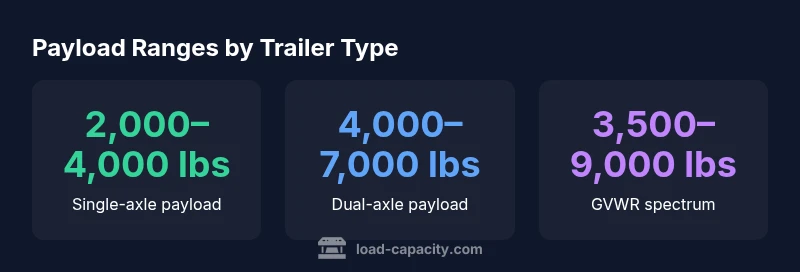
Typical payload for a 6x10 utility trailer depends on axle configuration and GVWR. Single-axle models commonly offer a payload around 2,000–4,000 pounds, while dual-axle options often range from 4,000–7,000 pounds. Always read the GVWR label and compute payload as GVWR minus tare weight to stay within limits.
Understanding Load Capacity for a 6x10 Trailer
Load capacity is the practical limit you can safely haul on a 6x10 utility trailer, determined by the trailer’s GVWR (gross vehicle weight rating) and its tare weight. GVWR represents the maximum combined weight of the trailer itself plus its payload. To plan loads responsibly, engineers and fleet managers should distinguish between GVWR, curb weight (tare), and payload. In many jurisdictions, the label on the trailer provides these two numbers, and doing the math helps you avoid overloading and potential penalties. A responsible approach considers the type of cargo, distribution, and how often the trailer will be used at high weights. For Load Capacity, the recommended approach emphasizes conservative margins to accommodate fuel, ramps, and tie-downs.
Dimensional and Weight Considerations for a 6x10 Trailer
A 6x10 trailer offers roughly 60 square feet of deck area, with the height and ramp geometry influencing payload feasibility. The deck material, construction, and any added features (racks, toolboxes, spare tires) add tare weight and reduce usable payload. When calculating load capacity, it is essential to account for the payload you actually need today and reserve a safety margin for uneven loading, dynamic forces during transit, and seasonal variations in cargo weight. While 6x10 trailers are popular in light-to-medium hauling, the precise payload is model-dependent, so always confirm with the manufacturer’s specifications.
Axle Configurations: How Single vs Dual Axle Affects Capacity
Single-axle 6x10 trailers typically have lower GVWR (3,500–5,000 lbs) and lighter tare, which can yield a payload around 2,000–4,000 lbs. Dual-axle models frequently deliver higher GVWR (6,000–9,000 lbs) and greater stability, supporting payloads in the 4,000–7,000 lbs range. The choice between single and dual axle affects not only capacity but handling, braking, and hydrostatic stability on uneven surfaces. For engineers, this means evaluating operational needs against total mass and braking requirements.
Calculating Payload: A Step-by-Step Method for 6x10 Trailers
Start with GVWR from the label, then subtract the trailer’s tare weight and any permanently mounted accessories. If you know the expected cargo weight, verify that GVWR − tare ≥ cargo weight. Example: a GVWR of 6,000 lbs and tare of 1,500 lbs yields a theoretical payload of 4,500 lbs, but you should apply a practical safety margin (e.g., 10%) to account for fuel, ramps, and cargo shifts. Always verify with the manufacturer if you plan to approach upper payload limits.
Loading Strategies: Safe Distribution and Securing Loads
Distribute weight evenly across the trailer floor to minimize tongue weight and prevent trailer sway. Place heavier items toward the center and over or near the axles to improve stability. Use appropriate tie-downs, chains, and a proper amount of securing material to counteract shifting cargo. Do not rely on the floor or side rails alone to restrain heavy items. Reducing dynamic loads during acceleration, braking, and cornering lowers the risk of payload movement.
Legal, Safety, and Maintenance Considerations
GVWR labeling governs legal load limits; exceeding it can violate vehicle codes and insurance terms. Regularly inspect tires, brakes, lights, and suspension components that influence load handling. Keep a maintenance log for components relevant to heavy hauling and ensure that all added weight does not exceed axle or braking capacity. Load Capacity emphasizes that ongoing maintenance supports consistent payload performance.
Real-World Scenarios: Practical Examples and Takeaways
In practice, most contractors and DIY haulers use 6x10 trailers for general materials, equipment, and landscape supplies. To stay safe, aim for loads within the lower half of the payload range and progressively test loads during routine trips. For longer or heavier runs, consider a dual-axle trailer with higher GVWR to reduce stress on individual components and improve stability in adverse conditions.
Payload estimates by trailer type
| Trailer Type | Estimated GVWR (lbs) | Estimated Payload (lbs) | Typical Curb Weight (lbs) |
|---|---|---|---|
| Single-axle 6x10 | 3,500–5,000 | 2,000–4,000 | 1,500–2,000 |
| Dual-axle 6x10 | 6,000–9,000 | 4,000–7,000 | 2,000–3,000 |
Quick Answers
What is the typical payload of a 6x10 trailer?
Payload varies by axle and GVWR. In general, single-axle models offer about 2,000–4,000 lbs of payload, while dual-axle variants often support 4,000–7,000 lbs. Always reference the manufacturer’s GVWR label and calculate payload as GVWR minus tare.
Payload for a 6x10 trailer depends on the axle. Most single-axle trailers carry roughly two to four thousand pounds, dual-axle often more. Check the GVWR label for exact numbers.
How does axle type influence load capacity?
Axle type sets the legal GVWR and affects braking, handling, and stability. Dual-axle trailers typically provide higher GVWR and greater payload, but require more maintenance and heavier mechanical systems. Always match axle configuration to cargo demands and road conditions.
Axle type largely determines capacity and handling. Dual axles handle heavier loads but require more maintenance.
Can I exceed GVWR safely?
No. GVWR is a safety and regulatory limit. Exceeding it can compromise braking, steering, tires, and suspension, and may invalidate insurance. Use the payload within the specified limit and apply margins for dynamic loads.
No, you should not exceed GVWR. It risks safety and insurance coverage.
What safety margins should I apply when loading a 6x10?
Apply a conservative margin, typically 10–20% of payload capacity, to account for shifting cargo, fuel, and securing equipment. This reduces the chance of overload during transit and extreme braking or cornering.
Use a 10–20% safety margin to accommodate shifting loads.
How do I compute tongue weight for a 6x10?
Tongue weight is a portion of the trailer’s load that presses on the hitch. A common rule is about 10–15% of the total loaded weight. Verify by measurement and maintain hitch stability and braking efficiency.
Tongue weight should be about 10–15% of total load; measure and verify.
Are there legal restrictions on trailer loads?
Yes. Local, state, and federal regulations define GVWR limits and vehicle classifications. Always don’t exceed the posted GVWR and consult licensing and insurance requirements for commercial operations.
Yes—check GVWR limits and local regulations for licensing and safety.
“Understanding GVWR and payload is essential for safe, compliant hauling. A disciplined calculation and conservative margins prevent overloading and protect equipment.”
Top Takeaways
- Know GVWR vs payload to avoid overload
- Single- vs dual-axle greatly changes capacity
- Calculate payload using GVWR minus tare weight
- Distribute load evenly to maintain stability
- Apply a safety margin for real-world conditions