Timber Beam Load Capacity Calculator: Educational Guide
Learn how a timber beam load capacity calculator estimates safe bending loads for wooden beams. Understand factors, use cases, and how to interpret results for early-stage design.


Overview of timber beam load capacity and the calculator
According to Load Capacity, a timber beam load capacity calculator is a practical tool that estimates the maximum safe load a wooden beam can carry over a given span. It combines simple geometric inputs with a conservative bending stress value to produce a preliminary capacity figure. This calculator is especially useful for engineers, technicians, students, and DIY enthusiasts who are planning framing layouts, retrofits, or wood-frame projects where quick, approachable checks are helpful before moving to detailed design. It supports educational exploration, helping you connect theoretical beam theory with real-world sizing decisions while highlighting how changes in size, span, or strength influence capacity. As with all structural tools, use the result as a starting point and always verify with applicable codes and professional guidance.
Key factors affecting timber beam capacity
The capacity of a timber beam is not a single constant; it depends on a combination of material properties, geometry, and loading conditions. The most important factors include the allowable bending stress (Fb) for the chosen wood species and grade, the beam's cross-sectional area and shape, and the span between supports. Other influential factors are moisture content, knots, grain orientation, and the presence of defects. Because wood is anisotropic and sensitive to humidity, any changes in moisture can reduce Fb and, therefore, the calculated capacity. In practice, designers use species tables and engineering judgment to select Fb values that reflect real-world conditions. The timber beam load capacity calculator leverages these concepts to deliver an educational approximation that can guide layout decisions and flag when professional input is warranted.
The simple bending theory behind the calculator
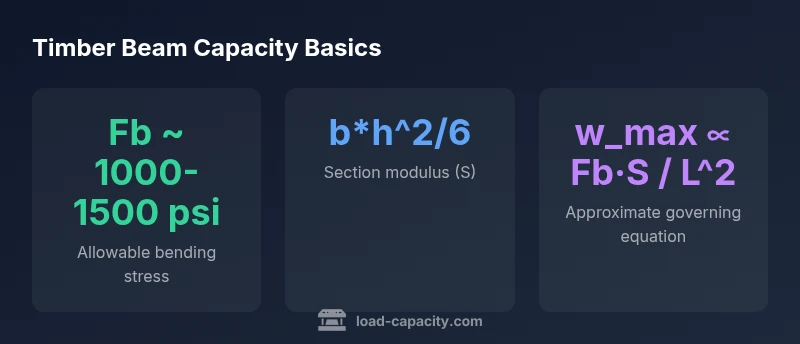
At the heart of the timber beam load capacity calculator is a simplified bending theory. For a simply supported rectangular beam with a uniform line load w (lb/ft), the maximum bending moment is M = wL^2/8, where L is the span in feet. The bending stress equals M/S, where S is the section modulus (S = b*h^2/6 for a rectangle with width b and depth h). Setting Fb as the allowable stress and solving for w gives an approximate allowable uniform load: w_max ≈ (Fb * b * h^2) / (9 * L^2). This compact formula makes it easy to see how expanding any one dimension or increasing Fb raises capacity, while longer spans reduce it. The calculator uses this approachable relationship to present a practical, educational estimate rather than a code-compliant design value.
Calculator inputs and how to choose values
The timber beam load capacity calculator uses a small, targeted set of inputs to keep things approachable:
- Span between supports (feet): The distance over which the beam must carry load. Longer spans reduce capacity due to bending moment effects. Recommended range: 4–25 ft, default 12 ft.
- Beam width (inches): The flat dimension of the beam’s cross-section. A wider beam increases capacity. Recommended range: 2–12 in, default 6 in.
- Beam depth (inches): The vertical height of the beam’s cross-section. Depth has a strong influence on capacity because S ∝ h^2. Recommended range: 4–24 in, default 9 in.
- Fb (allowable bending stress) in psi: A material property reflecting wood species and grade. Higher Fb yields higher capacity but requires appropriate species data. Recommended range: 300–2400 psi, default 1200 psi.
The formula used is w_max = (Fb * b * h^2) / (9 * L^2). Values are intentionally conservative to illustrate the concept for educational purposes. In real designs, consult structural codes and a licensed engineer to confirm suitability and safety.
Worked example 1: medium-span beam
Let’s walk through a concrete example to illustrate how the calculator works in practice. Suppose span L = 12 ft, beam width b = 6 in, depth h = 9 in, and Fb = 1200 psi.
Compute S ≈ bh^2/6 = 6(9^2)/6 = 681/6 = 81 in^3. Using w_max ≈ FbS/(1.5L^2) simplifies to w_max ≈ Fbbh^2/(9L^2) = 1200681/(9*144) = 583,200/1,296 ≈ 450 lb/ft.
Thus, this 12 ft, 6x9 beam with Fb ≈ 1200 psi has an approximate allowable uniform load around 450 lb/ft. In practical terms, this is a rough guide for preliminary sizing and planning. Always compare against dead and live loads applicable to your project and seek professional confirmation for final design.
Worked example 2: short-span beam with higher depth
Consider a shorter span with a deeper section: L = 8 ft, b = 8 in, h = 12 in, Fb = 900 psi.
w_max ≈ (900 * 8 * 12^2) / (9 * 8^2) = (900 * 8 * 144) / (9 * 64) = (1,036,800) / 576 ≈ 1,800 lb/ft.
This demonstrates how increasing depth or Fb can dramatically raise capacity, even at a shorter span. As always, these figures are educational estimates and should be validated against code requirements and practical considerations such as connections and load duration.
Practical design considerations and limitations
While the timber beam load capacity calculator offers valuable intuition, several practical considerations limit direct application to real buildings:
- Connection details: Screws, joist hangers, and posts influence how loads are transferred and can become future failure points if not properly designed.
- Lateral-torsional stability: Deep beams over long spans can experience lateral-torsional buckling; this calculator does not address those stability concerns.
- Load types: Live loads, dead loads, snow loads, and impact loads differ in duration and distribution; the simple formula assumes a uniform live load for educational purposes.
- Moisture and seasoning: Elevated moisture reduces Fb; seasoned lumber or species data should be used for accurate planning.
- Code compliance: Final designs must comply with local building codes and professional engineering assessment.
In short, use the results for learning and quick checks, not as a substitute for formal design documentation.
Next steps: when to consult a structural engineer
If your project involves critical safety considerations, irregular spans, or complex loading, consult a structural engineer. The timber beam load capacity calculator helps you frame questions, estimate preliminary sizes, and compare options, but a licensed professional can verify design assumptions, assess interactions with other members, and prepare stamped drawings when required by code. For educational purposes, you can document your calculations and note any conservative assumptions, which supports a transparent design process and smoother reviews with authorities or clients.