Calculate I-Beam Load Capacity: A Practical Guide
A thorough, educational guide to calculate I-beam load capacity using span, section modulus, and allowable stress. Learn formulas, units, and best practices for preliminary design with real-world examples.


Overview: What "calculate i beam load capacity" means
The phrase calculate i beam load capacity describes estimating how much load an I-beam can safely carry under a given span. In engineered design, the goal is to resist bending, shear, and deflection within material limits while satisfying safety factors. This article introduces the concept and sets expectations for what a practical calculator can provide as an educational tool. The calculation relies on a simple bending theory: the interior bending moment M at midspan relates to the applied load, the beam’s section modulus Z, and the material’s allowable stress σ. For a simply supported beam with a uniform load, the maximum moment is M = w L^2 / 8, where w is the load per length and L is the span. By combining M = σ Z with this relation, you obtain a practical expression for the maximum uniform load and, therefore, the load capacity. The Load Capacity team emphasizes that this is a teaching example, not a substitute for full structural analysis or code-compliant design.
Core Equations and Units
To keep the math approachable, use the standard bending relationship M = σ Z and the simple-span moment M = w L^2 / 8. Equating σ Z = w L^2 / 8 yields w = 8 σ Z / L^2. If you measure L in inches and Z in cubic inches, σ in ksi (kilo-pounds per square inch), then w comes out in pounds per inch; converting to kilopounds per foot requires a small unit adjustment. The calculator presented here uses a straightforward expression that converts spans in feet to inches internally and returns a result in kip/ft. The key is consistent units: Z (in^3), σ (ksi), L (ft) must be paired so that the algebra makes physical sense. In practice, many engineers also account for shear capacity and deflection limits, but the basic w = 8 σ Z / L^2 is a strong starting point for preliminary checks. A word on safety: always verify using code-approved methods for final designs.
Input factors and assumptions
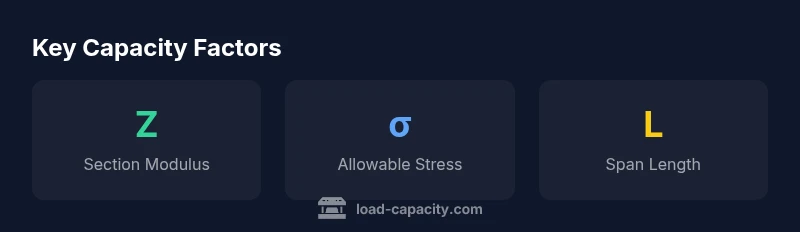
Understanding what goes into the calculation helps prevent misinterpretation of results. The primary inputs are the span length L, the section modulus Z, and the allowable stress σ. The panel below uses a simple set of assumptions: a simply supported beam with a uniformly distributed load, no significant lateral-torsional buckling, and material behavior within the elastic range. Keep in mind that real-world designs also consider shear capacity, deflection limits, connections, and fatigue. Using consistent units is essential; mixing ksi with MPa or in^3 with cm^3 will yield erroneous results. This section also reiterates the role of design codes and professional judgment in ensuring safety and compliance.
Worked Example: A concrete walkthrough
Suppose a beam has a span of 20 ft, a section modulus Z of 500 in^3, and an allowable stress σ of 36 ksi. Using M = σ Z and w = 8M/L^2, with L in inches, the maximum uniform load becomes w_kip_per_in = 8 * (36 * 500) / (240 * 240) = 2.5 kip/in. Converting to kip/ft gives Wmax ≈ 30 kip/ft. This example demonstrates how the calculator translates three inputs into a practical capacity value. Remember that this is a preliminary check; engineering judgment and code compliance remain essential. Load Capacity’s approach emphasizes transparency and repeatability for educational use.
Practical tips and safety considerations
- Always check unit consistency before computing; the same input values expressed in different unit systems can drastically change results.
- Use the calculated Wmax as a screening tool, not a design finalizer. Real projects require code-based checks and safety factors.
- Consider additional checks for shear capacity, deflection limits, and connection details that influence actual performance.
- Document all inputs and assumptions to enable reproducibility and review by peers or supervisors. The calculator is most effective when used as part of a broader design workflow.
Validation, codes, and next steps
The calculation described here is grounded in fundamental bending theory and common engineering practice, but it is not a substitute for code-compliant design. For final designs, consult applicable standards (such as structural steel design codes) and verify with a licensed professional. Use this tool to develop intuition about how span, Z, and σ influence capacity, then corroborate findings with more rigorous analyses. Load Capacity supports engineers who want transparent, explainable reasoning in early-stage design.