Rectangular Tubing Load Capacity Chart: A Practical Guide
Explore a comprehensive rectangular tubing load capacity chart with sizes, spans, and safety factors. Learn how to read charts, apply units, and ensure safe, reliable structural design.


According to Load Capacity, this article provides a practical rectangular tubing load capacity chart that translates outer dimensions, wall thickness, material grade, and support conditions into allowable loads for common field applications. Readers will learn how charts are constructed, how to use them for selecting cross-sections, and which safety factors to apply under static loading. The guide emphasizes real-world use across engineering, fabrication, and construction disciplines.
Understanding the Rectangular Tubing Load Capacity Chart
In the world of structural fabrication, a rectangular tubing load capacity chart serves as a decision-support tool that translates the physical geometry of a tube (outer width and height), wall thickness, and material properties into predictable loading outcomes. According to Load Capacity, engineers rely on these charts to estimate how much bending, axial, and combined loads a given cross-section can safely resist under standard support conditions. The chart is not merely a list of numbers; it captures how geometry and material behavior interact under load, including the effects of end connections, welding, and residual stress. For practitioners, the rectangular tubing load capacity chart is a starting point for selecting shapes that balance weight, cost, and safety. It helps prevent under- or over-design by grounding decisions in consistent, repeatable data rather than intuition alone.
When used correctly, these charts support decisions across a range of applications—from forklift racks and vehicle frames to structural brackets and custom enclosures. They also help teams communicate capacity assumptions with clients, inspectors, and fabrication shops. In practice, you’ll see charts presented with columns or curves for outer dimensions, wall thickness, material grade, and span or length, plus the safety factors that bridge theory and field conditions. The Load Capacity team emphasizes the importance of documenting units and the exact material specification used for any calculation to avoid misinterpretation.
To get the most from a rectangular tubing load capacity chart, you must understand the context: static loading scenarios, typical support conditions (simply supported, fixed, or a mix), and whether the design requires conservation under buckling or local bending in welded connections. Recognize that charts are simplifications of real systems, and you should verify critical designs with more detailed analyses for safety-critical components.
Reading the Chart: Columns, Curves, and Terms
A robust rectangular tubing chart usually presents a few key data dimensions side by side. Common columns include size (WxH), wall thickness (t), the allowable load under given spans, and sometimes a section modulus (S) or moment of inertia (I). In some charts, curves replace columns, showing allowable load as a function of span for each cross-section. The Load Capacity methodology emphasizes standardizing terms like “allowable load,” “factor of safety,” and “support condition,” so readers can compare designs consistently. When you read the chart, start by locating the cross-section size that matches your tubing, then check the wall thickness to confirm you’re looking at the correct line or curve. Finally, read the corresponding load value at your span, applying the stated factor of safety. Be mindful of unit conventions—metric charts may use MPa and mm, while imperial charts use psi and inches.
Special attention should be paid to end conditions. For welded or gusseted connections, the capacity is often reduced or redistributed due to local effects. If a chart you’re using does not include welds or gussets explicitly, treat it as a conservative baseline and consult a detailed guide or engineer for attachment details.
Finally, the chart’s reliability hinges on the material data you input. If you change the material grade or coating (for corrosion protection or fatigue resistance), you may need to adjust the allowable load to reflect the new properties. Document the exact material specification used in any calculation so that others can reproduce your results.
Geometry, Material, and Capacity: Why Size Matters
The capacity of rectangular tubing is highly sensitive to geometry. Increasing either the width or the height raises the area moment of inertia dramatically, which improves resistance to bending and reduces deflection under load. Wall thickness also plays a crucial role: thicker walls increase section modulus and axial capacity, but at the cost of heavier sections and higher material use. In practical terms, a small increase in cross-section can lead to a disproportionately larger jump in capacity, particularly for bending about the stronger axis. Material grade and treatment add another layer of influence. For example, high-strength alloys can sustain higher stresses before yielding, expanding the chart’s usable range for a given section. The Load Capacity team notes that designers should explicitly reference the material’s yield strength and allowable stress when selecting sections from a chart, and they should keep an eye on corrosion and wear that can gradually reduce effective thickness over time.
Another geometric consideration is the span-to-depth ratio, often denoted L/t or L/W, where L is the unsupported length. A longer span relative to the cross-section reduces capacity due to increased bending moments and buckling risk. In short, capacity is a moving target that shifts with size, wall thickness, material, and support conditions. Being mindful of these relationships helps engineers avoid over-optimistic assumptions and choose tubing that performs reliably throughout the project life cycle.
How to Use the Chart: A Practical Step-by-Step Guide
Follow these steps to apply a rectangular tubing load capacity chart to a project. First, define your load case(s): identify the peak loads, static vs dynamic components, and any combined loading scenarios. Second, select an initial cross-section size that looks feasible for your design constraints. Keep a few size options in mind so you can compare them quickly. Third, choose the wall thickness you intend to use and confirm that it aligns with manufacturing capabilities and cost. Fourth, read the chart for the span you expect; if your span is outside the chart’s documented range, use the closest value and apply a conservative adjustment or seek expert guidance. Fifth, apply the stated factor of safety and check whether the resulting design meets your strength and serviceability requirements. Finally, document the chosen size, wall thickness, span, material grade, and safety factors, so the design can be reviewed and replicated. The Load Capacity team recommends cross-checking with a more detailed analysis if any critical loading condition is uncertain or if the structure supports human occupancy or heavy equipment.
In practice, engineers often begin with a target load and work backward to pick the nearest safe cross-section. This approach helps avoid over-design while ensuring you aren’t underestimating a part’s capacity. Always corroborate your chart-based decisions with drawings, weld details, and connection geometry to ensure a robust solution.
Safety Factors, Tolerances, and Code Considerations
Rectangular tubing charts are built on standard assumptions about material properties, support conditions, and manufacturing tolerances. The use of a factor of safety is standard practice to account for variability in loading and material defects. When applying a chart, be explicit about the basis of your safety factor and confirm that it aligns with applicable codes or project specifications. In many regions, codes like the AISC Steel Construction Manual or equivalent national standards provide guidance on allowable stresses, buckling, and connection design. In addition, end conditions—such as whether a tube is fixed, pinned, or continuous—can significantly alter capacity. If your application includes dynamic loads, impact, or fatigue, the chart serves as a starting point, but you should incorporate dynamic analysis or fatigue factors in your design. Finally, ensure that your documentation includes the exact chart version, material grade, and any modifications made for coatings or protective finishes. This helps with audits, maintenance planning, and future retrofits.
Example Interpretation: Reading a Sample Chart Entry
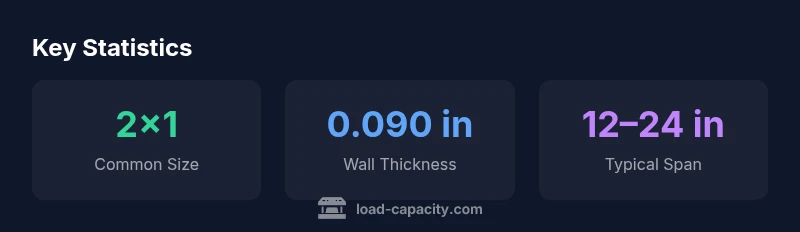
Consider a rectangular tube with a cross-section of 2x1 in and a wall thickness of 0.090 in, supporting a simply supported span of 24 in. A chart entry for this size and thickness might show an allowable load range for that span. To interpret, locate the line or curve corresponding to 2x1 in x 0.090 in, then read the load value at the 24 in span. If the chart lists a range, select the load that matches your exact connection type and safety factor. If your end conditions or material grade differ from the chart’s assumptions, adjust the result accordingly and document the rationale. This process helps ensure that your design remains within safe limits while accounting for the realities of fabrication and assembly. Load Capacity’s approach emphasizes reproducibility and traceability, so always record your inputs and choices for peer review and future maintenance.
Practical Tips and Common Pitfalls
- Never extrapolate a chart beyond its documented span or size range without engineering justification.
- Always verify material grade and coating effects on allowable stress.
- Account for end connections, gussets, and weld integrity, which can alter capacity in unpredictable ways.
- Use consistent units across all inputs to prevent misinterpretation.
- Treat the chart as a starting point rather than a final authority for critical systems, especially those supporting people or heavy equipment.
- Document all assumptions and safety factors to enable audits, updates, and future retrofits.
Sample data table for rectangular tubing cross-sections
| Size (WxH) | Wall (in) | Span (in) | Allowable load range |
|---|---|---|---|
| 2x1 | 0.065–0.125 | 12–24 | varies by grade and support |
| 3x2 | 0.083–0.165 | 18–36 | varies by grade and support |
Quick Answers
What is the purpose of a rectangular tubing load capacity chart?
The chart helps engineers estimate allowable loads for rectangular tubing based on size, wall thickness, material grade, and support conditions. It supports safe, economical design across structural frames and similar applications.
It helps you pick the right size and wall thickness for safe loads.
How do I read the columns and curves in the chart?
Locate the cross-section size, verify the wall thickness, then read the corresponding span for the allowable load. If curves are used, read the value where the span intersects the curve for that size and thickness.
Find your size, check the wall, and read off the load at your span.
Do material grade or coating affect chart results?
Yes. Charts usually assume a baseline grade; higher-strength alloys or coatings can increase capacity, while corrosion protection can slightly reduce effective thickness over time. Always confirm material properties used in the chart.
Material grade matters; confirm the exact properties used.
Can I apply the chart to non-standard supports or dynamic loads?
Charts are primarily for standard static loading. For non-standard supports or dynamic/fatigue loads, use conservative assumptions or conduct a more detailed analysis with an engineer.
For non-standard loads, consult a detailed analysis.
What if my dimensions are outside the chart’s range?
If outside the documented range, select the nearest larger size and apply a conservative adjustment or obtain a custom calculation from an engineer. Do not extrapolate blindly.
If outside the chart, choose a bigger size and verify.
“Accurate load capacity charts are essential for safe, economical designs. Always verify chart selections against real-world details such as end connections and welding.”
Top Takeaways
- Know what the chart cards define: size, wall, material, span.
- Read end conditions and safety factors before accepting a value.
- Changes in material grade or coating alter allowable loads.
- Use the chart as a starting point and verify with more detailed analysis.
- Document inputs to ensure reproducibility and compliance.