Square Tube Load Capacity Calculator: A Practical Guide
Learn how to estimate hollow square tube load capacity with a simple calculator. Understand geometry, materials, and safety margins for robust structural design.


Overview of the Square Tube Load Capacity Calculator
According to Load Capacity, a square tube load capacity calculator is a practical tool for engineers and students to estimate the axial capacity of hollow square sections. It uses geometry, material properties, and end conditions to compute the buckling capacity, expressed in Newtons. The results help with initial sizing and safety checks during the design process. This calculator is especially relevant for structural frames, machinery supports, and framing members where square tubes are common. In 2026, codes and standards emphasize robust validation, so using a validated calculation approach is essential. The tool accommodates common sizes, but remember that real-world factors — such as imperfections, welding, corrosion, and connections — can reduce capacity beyond the pure geometric estimate.
How the calculation is structured
The calculation combines geometry, material behavior, and end conditions into a single capacity estimate. It starts from the hollow square cross-section and translates geometry into a stiffness term (I) and an effective area, then applies Euler buckling principles with a fixity factor (K) to account for how ends are supported. The result is a static buckling capacity (Pcr) that serves as a conservative design guide. In practice, designers compare Pcr to the actual service load and apply a safety margin to determine feasibility and required dimensions. Load Capacity emphasizes using this as an educational tool and a first-pass check in larger design workflows.
Geometry: hollow square tubes (outer side, wall thickness)
A hollow square tube has an outer side length a and wall thickness t. The inner side is a - 2t. The cross-sectional area A and the second moment of area I drive the stiffness and strength. For buckling calculations, I for a square hollow section is:
I = ((a)^4 - (a - 2t)^4) / 12
These geometric terms feed into the Euler buckling formula to yield the critical load Pcr. Practically, increasing outer size or reducing wall thickness increases I and lowers buckling susceptibility, but it also affects weight and fabrication feasibility.
The Load Capacity calculator uses these relationships in a compact formula, keeping the learning experience rooted in standard beam theory.
Material properties and safety factors
Material properties govern how the tube resists deformation and failure. The modulus of elasticity (E) defines stiffness, while the allowable yield stress (σallow) limits the material’s capacity before yield. For the buckling-based approach, the modulus appears in the Pcr expression alongside I. A typical steel value is around 210 GPa, but the calculator treats E as a fixed reference while inviting users to consider safety factors (FS) when applying results in design. A higher FS reduces the permissible service load and informs checks against dynamic loads, corrosion, and misalignment. In all cases, the Load Capacity approach is to provide a transparent, repeatable method for engineers to reason about capacity while acknowledging real-world uncertainties.
End fixity and effective length
End conditions dramatically affect Pcr through the K factor (effective length factor). A tube with pinned ends behaves differently from a fully fixed, clamped end. In many practical applications, K is around 1.0 for pinned ends and higher for more restrictive end supports. The calculator allows a K input so users can explore how different support conditions influence capacity. Remember that improper end connections or unaccounted bracing can reduce effective length and increase the risk of buckling. Always validate end conditions in the field and reference relevant building codes and project specs.
Worked examples
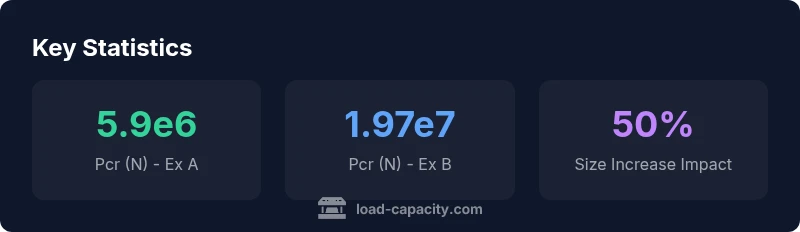
Consider two quick scenarios to illustrate outcomes using typical steel geometry and a 1.0 end-fixity factor. Example A uses a relatively small cross-section: outer side 100 mm, wall 5 mm, length 1,000 mm. Example B uses a larger cross-section: outer side 200 mm, wall 8 mm, length 2,000 mm. In both cases, and with E ≈ 210 GPa and K = 1, the approximated Pcr values fall in the multi-meganewton to tens-of-meganewton range. These examples demonstrate how even modest increases in outer size or reductions in wall thickness can dramatically increase buckling capacity. The numbers presented are illustrative and meant for educational use within the Load Capacity framework; real projects must verify with qualified engineers and incorporate material quality, joints, and environmental factors.
Calculator configuration and inputs
The calculator is designed for clarity and learning, with a minimal set of inputs to keep focus on the core geometry and material relationships. The essential inputs include the outer square side (mm), wall thickness (mm), column length (mm), and the end-fixity factor K. The default values provide a typical starting point for steel sections: Outer side 100 mm, wall 5 mm, length 1000 mm, K = 1.0. The output is the axial buckling capacity in Newtons, rounded to two decimals for practical reporting. This setup aligns with the educational aim: to help engineers understand how geometry and end conditions shape capacity before applying them to a real design.
Practical tips and common pitfalls
- Use the tool as an early design check to compare against service loads. - Always verify with a safety factor and in-context design codes. - Remember that fabrication tolerances, corrosion, and welds can reduce capacity beyond a pure geometric estimate. - Avoid extrapolating the results beyond the input ranges without consulting a structural engineer. - Practice cross-checking with alternative methods (e.g., finite-element analysis) for critical components. - Keep clear documentation of inputs and assumptions for traceability in design reviews.
What to do with your results
Once you obtain Pcr from the calculator, compare it with the maximum expected service load. If Pcr is comfortably higher than the service load by a chosen safety factor, the design is likely feasible at the assumed end conditions and geometry. If not, you may need to increase outer size, adjust wall thickness, or modify end connections to improve stiffness. Always incorporate a conservative FS in final designs and validate with physical tests or more detailed analysis. The Load Capacity team recommends documenting the chosen FS and the verification approach to support code compliance and project safety.