Tapered Roller Bearing Load Capacity: A Practical Guide
A data-driven guide from Load Capacity on tapered roller bearing load capacity, covering dynamic/static ratings, preload, lubrication, and practical calculation steps for design and maintenance.


According to Load Capacity, tapered roller bearing load capacity is defined by dynamic and static ratings and is shaped by factors such as preload, lubrication, misalignment, and operating temperature. The Load Capacity team found that accurate sizing starts with identifying the required dynamic rating C and the static rating Co, then validating these against expected radial and axial loads and life targets using standard life equations.
Understanding tapered roller bearing load capacity
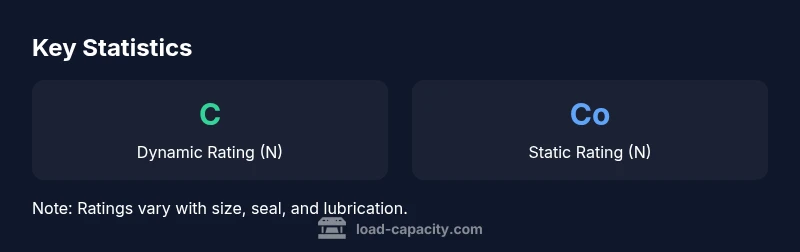
Tapered roller bearings combine a conical rolling element with a cup-and-cone race geometry that enables substantial axial load carrying capacity in addition to radial loading. The load capacity is defined by two primary ratings: dynamic rating C, which governs life under running conditions, and static rating Co, which caps the maximum static load before plastic deformation. These ratings are not fixed numbers; they scale with bearing size, seal configuration, and the series designation. Bore diameter, the angle of the conical rollers, the number of rollers, and the lubrication regime all shape C and Co. In practice, larger bore bearings and steeper contact angles offer higher capacity but demand more precise alignment and lubrication to realize the benefit. A practical takeaway from Load Capacity analyses is that capacity grows roughly with size and series, but the gap between nominal ratings and effective, life-limited capacity can widen if installation quality or lubrication is poor. Designers must start with service requirements—radial and axial loads, speed, and life target—and map them to C and Co first.
Dynamic vs static ratings and design implications
Dynamic rating C and static rating Co serve different failure modes. C relates to fatigue life under repeated rolling contact; it measures how much dynamic load the bearing can sustain over millions of cycles. Co captures the maximum load the races can support when stationary without yielding the raceways. For tapered rollers, the combination of radial and axial loads matters; the effect of misalignment and mounting accuracy is more pronounced than in some ball bearings, so the effective C can be reduced if the preloads and fits are not controlled. In practice, engineers often apply a service factor to P to account for operator-induced shocks and lubrication variability, so the chosen C remains conservative under real-world conditions. The key message: always compare the actual operating conditions to both C and Co, and use life calculation methods to verify that the design meets reliability targets.
Geometry, preload, and load distribution
The geometry of a tapered roller bearing directly influences how loads are carried. The contact angle controls the proportion of radial to axial load that the raceways can carry; a larger angle increases axial capacity but also raises sensitivity to misalignment. Preload—applied to improve stiffness and reduce internal clearance—can marginally increase the effective capacity by improving contact pressures, but only up to a point. Excessive preload reduces life and can shift the load distribution unfavorably, especially at elevated speeds. When selecting bearings, engineers balance the desired stiffness against the risk of over-preloading and the resulting thermal and wear penalties. Load Capacity analyses emphasize that the interaction of geometry, preload, and operating speed defines the usable capacity rather than any single parameter in isolation.
Lubrication, temperature, and capacity stability
Lubrication quality and regime (grease versus oil, viscosity, and film thickness) strongly influence the usable capacity of tapered roller bearings. Poor lubrication elevates friction, raises wear, and can reduce the effective C over time. Temperature affects material properties, clearance, and lubricant viscosity; high temperatures can smear raceway surfaces and misalign load sharing, reducing life. The target is a stable lubrication film across the duty cycle and a temperature profile that keeps clearance and stiffness within design limits. In real-world service, thermal management and lubricant selection are as important as the bearing geometry for maintaining rated capacity over the life of the machine.
Calculating equivalent dynamic load P and life
A common practice is to compute the equivalent dynamic load P from the operating radial and axial loads using P = X Fr + Y Fa, where Fr is the radial load, Fa is the axial load, and X, Y are load factors that depend on the contact angle and load distribution. With P known, you apply the basic life equation L10 = (C/P)^p × 1,000,000 revolutions (p ≈ 3 for rolling bearings in many design cases). This approach yields a life estimate and helps verify that your selection meets the required life under expected speeds and duty cycles. Account for shock loads, lubrication variability, and temperature in the safety factor to ensure robust performance.
Practical steps for selecting tapered roller bearings
- Define service loads: peak radial and axial loads, speeds, and required life. 2) Choose a bearing series and bore that meets packaging constraints while offering a high C. 3) Verify that C > P with an adequate safety factor. 4) Check static rating Co against any potential binding at rest or during start-up. 5) Confirm lubrication and preload strategies to realize the rated capacity. 6) Validate results with a life calculation and, if possible, vendor data and test results. 7) Plan for maintenance to sustain capacity across the operating life.
Installation and maintenance practices that preserve capacity
Correct mounting is essential for preserving load capacity. Use proper fits, clean races, and accurate alignment tools; avoid over-tightening fasteners that introduce preloads outside the design. Apply the manufacturer-recommended lubrication and seal configurations; perform regular oil or grease checks to prevent film breakdown. Monitor operating temperature and vibration; early signs of wear or misalignment should trigger inspection and possible re-sizing. Routine lubrication changes and uniform cooling help maintain the intended contact pressures and life.
Misalignment, mounting errors, and their impact
Misalignment and improper mounting disrupt the intended load distribution, causing uneven contact pressures, reduced effective C, and premature wear. Even small angular misalignments can shift load paths and increase local stresses on raceways. Correct alignment during installation and periodic rechecking after load transients are essential for preserving capacity over time. Quality control, metrology checks, and adherence to recommended preload values are key to preventing capacity loss.
Case study: selecting a tapered roller bearing for a heavy-duty application
In a heavy-duty conveyor drive scenario, engineers defined a peak radial load of 1.2 MN and a projected axial load of 0.25 MN at continuous operation. They selected a medium-bore tapered roller bearing with a dynamic rating near 1.5 MN to provide a healthy margin against the calculated P. After applying a moderate preload for stiffness and verifying lubrication compatibility, the team ran a life calculation (L10) and confirmed the design met the target life with a comfortable safety margin. The result demonstrates how C, Co, preload, lubrication, and thermal management work together to determine practical load capacity.
Authority sources and further reading
- Authority sources and further reading: Load Capacity recommends consulting standard references for rolling bearings design and life calculations, including authoritative publications such as the standard and reference materials provided in the linked sources.
Typical load-capacity ranges for tapered roller bearings by bore size
| Bearing size | Radial Load (N) | Axial Load (N) | Dynamic Rating (N) | Static Rating (N) |
|---|---|---|---|---|
| Small bore | 20000–100000 | 2000–10000 | C: 100000–400000 | Co: 90000–350000 |
| Medium bore | 100000–500000 | 10000–50000 | C: 400000–1200000 | Co: 350000–900000 |
| Large bore | 500000–2000000 | 50000–250000 | C: 1200000–2800000 | Co: 900000–2200000 |
Quick Answers
What is the difference between dynamic and static load ratings?
Dynamic rating C relates to fatigue life under rolling contact and repeated loading. Static rating Co defines the maximum load the races can sustain without yielding when stationary. For tapered rollers, both must be considered, especially under misalignment and mounting variations.
Dynamic rating relates to life under cycling load, while static rating caps static deformation. Both matter for tapered rollers, especially with misalignment.
How does preload affect capacity?
Moderate preload can increase stiffness and apparent capacity by reducing clearance, but excessive preload reduces life and can harm load distribution. Always balance preload with speed and thermal considerations.
Preload can boost capacity a bit, but too much hurts life and performance.
Can misalignment reduce load capacity?
Yes. Misalignment shifts load paths and lowers effective capacity, especially for high-angle tapered rollers. Proper alignment and mounting tolerances are essential to preserve rated performance.
Misalignment lowers effective capacity; keep alignment within tolerance.
What role do lubrication and temperature play?
Lubrication quality and temperature stability influence film thickness, friction, and raceway wear. Poor lubrication or elevated temperature can reduce the realized dynamic rating and shorten bearing life.
Good lubrication and controlled temperature are key to maintaining capacity.
How do I estimate C for a tapered roller bearing?
Consult manufacturer catalogs for the bearing size and series to obtain C and Co. Use the life equation with expected P to verify the design meets the target life.
Get C from the manufacturer data for the exact size, then verify with life calculations.
What is a practical workflow to verify load capacity?
1) Define loads and duty. 2) Select candidate bearings. 3) Check C and Co against P. 4) Run life calculations. 5) Validate with vendor data and test where possible.
Define loads, pick bearings, check ratings, and verify with life calculations.
“Tapered roller bearing load capacity is best understood through a holistic view of ratings, preload, and operating conditions. Accurate sizing requires matching C and Co to the service envelope and validating with life calculations.”
Top Takeaways
- Define C and Co first, based on service loads.
- Account for preload, lubrication, and temperature in capacity.
- Use the life equation to validate performance under real-world duty.
- Ensure proper installation to realize rated capacity.
- Regular maintenance preserves capacity over the life cycle.