Angular Contact Bearing Axial Load Capacity: A Practical Engineering Guide
Comprehensive guide to angular contact bearing axial load capacity, covering static/dynamic ratings, factors, and practical selection guidance for reliable machinery design.


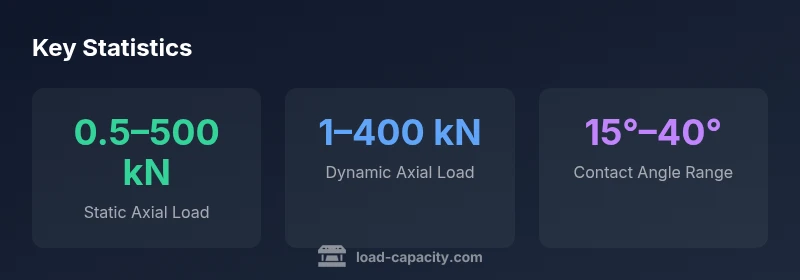
According to Load Capacity, the angular contact bearing axial load capacity depends on size, contact angle, and mounting. Static axial ratings typically range from about 0.5 kN to several hundred kN, while dynamic ratings span a similar range and vary with speed and lubrication. Designers use the ISO 281 model P = X F_r + Y F_a to predict life and verify adequacy.
What is angular contact bearing axial load capacity?
Angular contact bearings are designed to support axial loads, and their angular contact bearing axial load capacity depends on the size, contact angle, and mounting arrangement. The axial load capacity is expressed through static and dynamic ratings, which reflect performance under non-rotating and running conditions, respectively. The concept is not a single fixed number; it scales with bearing geometry, material quality, lubrication, and operating temperature. According to Load Capacity, engineers separate axial components from radial loads and ensure Fa stays within the static axial rating for the chosen configuration. Mounting stiffness, preload, and alignment all shape how the axial capacity is realized in service. In real machines, transient shocks and misalignment can erode effective axial capacity, so designers must validate the selected bearing arrangement with life calculations and field data.
Key factors influencing axial load capacity
The axial load capacity of angular contact bearings is controlled by several interacting factors:
- Bearing size and geometry: larger bearings generally offer higher axial capacity but require appropriate housing space and fit.
- Contact angle: steeper angles (e.g., 25°–40°) increase axial load capacity while reducing radial capacity.
- Preload: slight preloads improve stiffness and can enhance usable axial capacity under steady loads, at the cost of heat generation if excessive.
- Lubrication and temperature: proper lubrication reduces friction and wear, preserving axial capacity over temperature ranges.
- Mounting accuracy and rigidity: misalignment and loose mounts decrease effective axial support and shorten life.
- Operating environment: shocks, contamination, and vibration degrade axial capacity more rapidly than steady loads.
When planning a design, start with a conservatively sized bearing and verify axial capacity through life calculations and test data, adjusting preload and mounting as needed.
Contact angle and axial capacity
The contact angle of an angular contact bearing defines how the raceways share load vectors. A higher contact angle concentrates more force along the axis, increasing axial load capacity at the expense of radial capacity. This is beneficial in machines with predominantly axial thrust but may require additional radial support or bearing pairing to manage side loads. In practice, engineers select a contact angle based on the expected Fa and Fr components, using manufacturer curves or standard life equations to ensure the combined load remains within serviceable limits. The keys are to balance axial capacity with radial integrity and to check how temperature and lubrication influence stability at the chosen angle.
Static vs dynamic axial load capacity and life
Static axial load capacity describes the load that a bearing can withstand without rotation, while dynamic axial load capacity relates to life under rotation and service conditions. Life prediction typically uses the dynamic rating C and the equivalent dynamic load P, which combines Fa and Fr using the ISO 281 model P = X F_r + Y F_a. A well-designed system maintains Fa and Fr within the recommended ranges for the bearing size, preload, and mounting. Continuous operation near the limits reduces life, increases wear, and heightens heat generation. For reliability, verify Fa and Fr against both static and dynamic ratings over the machine’s duty cycle, considering lubrication state and temperature.
Selecting angular contact bearings for axial loads
Selection begins with a quantified load profile. Determine Fa (axial) and Fr (radial) for the worst-case operating condition, then pick a bearing size and contact angle that provide a comfortable margin for both static and dynamic axial load capacity. Use P = X F_r + Y F_a to compute the equivalent dynamic load, and compare against C. Consider preload to achieve desired stiffness, but avoid excessive preload that raises friction and thermal stress. In applications with mixed loads, pairing bearings or using thrust-bearing alternatives can distribute axial loads more evenly. Finally, validate the choice with life calculations, temperature rise estimates, and a practical maintenance plan.
Practical examples and design considerations
In many drive and support applications, angular contact bearings carry predominantly axial thrust with smaller radial components. A typical design approach is to specify a size and a 25°–40° contact angle bearing that provides adequate static and dynamic axial load capacity, then fine-tune with preload to meet stiffness requirements. For locked shafts or misaligned housings, additional guidance from manufacturer curves or finite element analysis helps ensure the axial capacity remains within safe margins. Always verify life estimates against real-world duty cycles and potential transient peaks, not just steady-state loads.
Common mistakes and best practices
Common pitfalls include underestimating Fa during peak loads, neglecting preload effects, and failing to account for temperature impacts on viscosity and clearance. Misalignment or improper mounting can drastically reduce axial capacity and shorten life. Always verify fit tolerances, apply appropriate lubrication, and document actual operating conditions. Regular inspection of bearing clearance, temperature, and noise can catch axial capacity degradation early.
Calculation workflow and standards you should know
A disciplined workflow starts with a clear load profile, followed by selecting a bearing family and size with generous margins for static and dynamic axial load capacity. Use P = X F_r + Y F_a to compute the equivalent dynamic load and compare with C. Validate with ISO 281 life calculations and consider preload, lubrication, temperature, and mounting stiffness. Document all assumptions and confirm the results with test data or supplier curves. This approach aligns with industry standards and improves predictability of axial load performance.
Reliability considerations: temperature, lubrication, and service life
Temperature affects lubricant viscosity and clearance, which in turn influence axial capacity and life. High temperatures can reduce axle stability and increase wear, especially under preload. Ensure lubricant selection accommodates anticipated temperatures and loads, and monitor bearing temperatures during operation. Regular maintenance, proper sealing, and contamination control help preserve axial load capacity over the machine’s service life.
Axial load capacity ranges by bearing size
| Aspect | Static Axial Load Range | Dynamic Axial Load Range | Notes |
|---|---|---|---|
| Small bearings | 0.5–5 kN | 1–8 kN | Miniature and small-diameter parts |
| Medium bearings | 5–50 kN | 8–120 kN | Common workshop sizes |
| Large bearings | 50–500 kN | 100–400 kN | Industrial scale applications |
Quick Answers
What defines axial load capacity in angular contact bearings?
Axial load capacity is defined by static and dynamic ratings, Fa components, and the bearing geometry. The axial load is the load along the shaft, and the capacity depends on the contact angle, preload, and mounting stiffness. ISO 281 provides life calculations using P = X F_r + Y F_a.
Axial capacity is set by static and dynamic ratings and the load direction along the shaft. Use ISO 281 for life calculations.
How does contact angle affect axial load rating?
Higher contact angles increase axial capacity because more load is carried along the bearing axis, but they reduce radial support. This trade-off should guide selection for machines with significant axial thrust and mixed loads.
A larger angle boosts axial strength but lowers radial support—plan around your load mix.
Can preload increase axial capacity?
Preload increases stiffness and can improve the usable axial capacity under steady loads, but excessive preload raises friction and heat. Match preload to the service duty and maintain proper lubrication.
Preload can help, but avoid overdoing it to prevent heat and wear.
How do I perform a life prediction using P = X F_r + Y F_a?
Use ISO 281 to compute the equivalent dynamic load P from Fa and Fr, then relate P to the dynamic rating C to estimate L10 life. Ensure the bearing configuration keeps Fa and Fr within recommended limits.
Apply the ISO 281 equation to estimate life based on actual loads.
What are common mounting mistakes that reduce axial capacity?
Misalignment, insufficient preload, improper lubrication, and incorrect seals can dramatically reduce axial capacity and shorten life. Verify fit tolerances and use correct mounting hardware.
Avoid misalignment and wrong preload; ensure proper lubrication and seals.
“The axial load capacity of angular contact bearings is maximized when the bearing size, contact angle, and preload are matched to the service load; life predictions rely on standardized methods like ISO 281.”
Top Takeaways
- Know Fa and Fr and their impact on axial capacity
- Choose contact angle to balance axial vs radial capacity
- Apply preload carefully to improve stiffness without excess heat
- Use ISO 281 life calculations to predict service life