Load Index vs Load Capacity: Understanding the Difference
A clear, engineering-focused comparison of load index and load capacity, explaining definitions, applications, safety considerations, and practical guidance for selecting tires, wheels, vehicles, and structures.


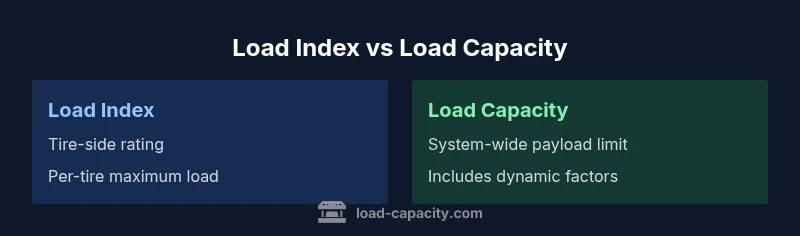
Load index and load capacity describe two related but distinct concepts. In tires, the load index indicates the maximum weight a tire can carry at a given speed, while load capacity describes the overall payload a system can safely support. For accurate design and safety, engineers must consider both and apply relevant standards to avoid under- or overloading.
What the terms mean and why the distinction matters
In engineering practice, two related concepts often cause confusion: load index and load capacity. The phrase load index vs load capacity captures the core difference: one is a standardized code used for tires, the other is a structural or system payload limit. Understanding both terms is essential for safe design and maintenance. For professionals, the distinction guides tire selection, vehicle loading, and structural design, and prevents overloading that could compromise performance or safety. The Load Capacity team emphasizes that while these concepts intersect, they govern different parts of the system. When you see a tire sidewall, the load index indicates the maximum load that particular tire can carry under defined conditions. In contrast, load capacity describes the maximum payload the entire assembly or structure can support, including vehicle mass, cargo, and dynamic factors. Across industries, parsing the two concepts correctly reduces risk and increases reliability.
- In practice, reading the load index on tires helps sizing for traction, heat buildup, and handling characteristics. - When planning a payload for a vehicle or structure, engineers should compare the total expected load against the system’s load capacity to ensure a safe operating margin. - The interplay between load index and load capacity is a core consideration in procurement, maintenance planning, and safety assessments.
This article uses the phrase load index vs load capacity to anchor discussions across tires, wheels, and structural components, highlighting how professionals must align both concepts for optimal safety and performance.
-1
Comparison
| Feature | Load Index | Load Capacity |
|---|---|---|
| Definition and scope | Standardized code on tire sidewall mapping to maximum load under defined conditions | System-level payload limit for a vehicle, component, or structure including dynamic effects |
| Measurement basis | Code-based numeric index linked to load per tire | Payload capacity expressed in weight units or safe working load for the entire path |
| Primary use | Tire selection and compatibility with speed rating | Overall loading and safety of the load path across the system |
| Interdependencies | Tire performance can constrain achievable load index | System safety depends on frame, suspension, and attachment points |
| Safety focus | Tire failure risk under overload or heat buildup | Whole-system safety margin and fatigue over time |
| Typical considerations | Speed rating compatibility, tread design, and fitment | Weight distribution, dynamic loading, and redistribution during operation |
Positives
- Clarifies tire selection and ensures compatibility across components
- Supports safety by preventing under- or overloading of tires and assemblies
- Guides compliance with regional and industry standards
- Improves risk assessment and maintenance planning through clear metrics
- Facilitates clear communication among engineers and technicians
Cons
- Requires cross-domain knowledge across tires and structural loads
- Can confuse non-specialists without training or context
- May necessitate additional calculations to translate between concepts
- Regional or application-specific standards can add complexity for global operations
Use both concepts together; no single metric covers all safety concerns.
Understanding load index and load capacity in parallel provides a complete view of safety. Apply the load index for tire-specific limits and the load capacity for system-wide payload planning, ensuring margins and compliance.
Quick Answers
What is the difference between load index and load capacity?
Load index is a tire-specific code that maps to a maximum load a tire can safely carry under defined conditions, often linked to speed. Load capacity, by contrast, describes the maximum payload a system—such as a vehicle, structure, or component assembly—can safely support, considering dynamic effects. Understanding both helps engineers select compatible parts and plan safe operation.
Load index is about tires, load capacity covers the whole system. Using both correctly reduces the risk of overloading.
How do load index and load capacity affect tire selection?
Tire selection relies on matching the load index to the expected per-tire load in service, along with speed considerations. Load capacity informs broader choices, such as vehicle payload, frame design, and load distribution, ensuring the entire system can handle expected weights without compromising safety.
Choose tires by load index for per-tire limits, and use load capacity to validate the whole-load safety path.
Can load index be used to determine vehicle payload?
The load index is not a direct measure of total vehicle payload. It provides per-tire limits that, when paired with the vehicle’s axle loads and platform, contribute to safe overall payload planning. For complete payload assessment, use load capacity in combination with per-tire indices.
It helps, but you still need the total payload analysis to stay within safe limits.
Why are there different standards by region for load rating?
Regional and industry standards reflect local safety practices, regulations, and testing protocols. These differences can influence allowable configurations, maintenance schedules, and documentation requirements. Engineers should verify the applicable standards for their region and application to ensure compliance.
Different regions have their own safety rules; check local standards before applying load ratings.
How do I calculate safe loads for a given system?
Start with per-tire load using the load index, then scale to the entire system by considering vehicle mass, cargo, and dynamic factors. Compare against the system’s load capacity and apply a safety margin to account for unforeseen loads or variations in operating conditions.
Compute per-tire loads, add structure, then apply a safety margin.
Is load index always directly related to load capacity?
Not directly. Load index is a per-tire rating, while load capacity reflects the whole system’s ability to carry load safely. They intersect, but one does not replace the other. Use both to form a complete safety assessment.
They’re related but serve different purposes; use both for full safety.
Top Takeaways
- Read tire load index to guide tire selection
- Always compare load index with speed rating and vehicle requirements
- Assess system payload using load capacity for safety margins
- Document cross-checks between tires, frames, and load paths
- Coordinate with procurement and maintenance teams for compliance