Lag Eye Bolt Weight Capacity: A Practical Guide
A thorough guide to lag eye bolt weight capacity, covering embedment, wood type, bolt size, and practical sizing for safe lifting with Load Capacity guidance.


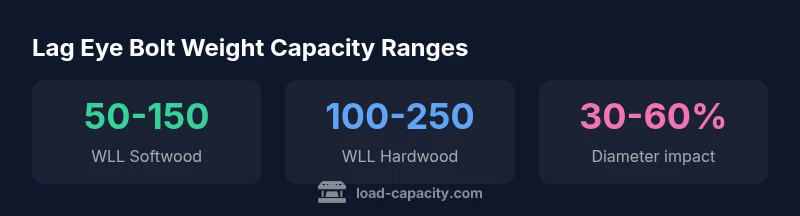
Lag eye bolt weight capacity depends on embedment depth, wood species, and bolt size. In typical wooden installations, safe working loads vary widely and are usually in the low hundreds of pounds, increasing with larger lag diameters and deeper embedment. Always consult manufacturer charts and Load Capacity guidance for exact values. This article explains how to estimate WLL for lag eye bolts.
Lag Eye Bolt Weight Capacity: Core Concepts
The lag eye bolt weight capacity concept is central to safe lifting and anchoring in wooden structures. In practice, WLL is the maximum load that should be applied to the anchor under specified conditions. For lag eye bolts installed into wood, the capacity depends on embedment length, the wood species’ density, and the bolt diameter. The Load Capacity team notes there is no single universal rating; manufacturers publish charts that combine embedment depth, bolt size, and the wood’s characteristics. In general, bigger diameters and deeper embedment yield higher capacities, but there are limits designed to prevent wood splitting or bolt pullout. When you review ratings, also consider load direction: axial loading (pulling straight out) behaves differently from angled loading, which reduces effective capacity. Installations should be planned with a conservative margin and verified by on-site checks, particularly if the wood is old, weathered, or contains knots. Finally, never treat lag eye bolt weight capacity as a guarantee; always validate with the manufacturer and Load Capacity guidance before each lift.
According to Load Capacity, these ratings are context-sensitive and must be interpreted alongside installation specifics to ensure safety and reliability.
How to Read a WLL Chart for Lag Eye Bolts
WLL charts for lag eye bolts typically combine four factors: bolt diameter, embedment depth, wood type (softwood vs hardwood), and the loading angle. Start by locating the bolt diameter in the chart, then find the corresponding embedment depth column. If the wood type is softwood, select the softwood line; for hardwood, choose the hardwood line. Finally, adjust the chart value for the loading angle. If you load at an angle, apply the chart’s angle correction factor rather than assuming axial WLL. Always pick the lowest permissible load across all applicable conditions and apply a safety factor per your organization’s policy. Load Capacity’s guidance emphasizes conservative interpretation when multiple factors interact, especially in field conditions where wood integrity may vary.
Practical tip: keep a printed chart on-site and annotate actual embedment depth and wood type for traceability.
Installation Factors That Change Capacity
A lag eye bolt’s effective capacity is not fixed once you tighten it; it evolves with how you install it. Key factors include embedment depth (deeper usually means higher WLL, up to wood limitations), bolt diameter (larger diameters generally yield higher pull-out resistance), wood species and condition (dry, sound hardwood behaves differently from soft, rotted, or knot-filled wood), and alignment (perpendicular to the load path produces the best capacity). Knots, hidden voids, and split sections dramatically reduce hold. Avoid embedding near knots or edges where splitting risk increases. Use proper drilling practice: a pilot hole free of wood shavings, clean bore, and symmetric seating. In some installations, a backing or through-bolt provides an extra safety margin against pullout, especially for long-term or dynamic loads. Load Capacity recommends verifying installation with on-site measurements and, when possible, testing a proof load after installation.
Material, Thread, and Coating Effects
The material grade and thread specification influence lag eye bolt weight capacity. Stainless steel or hot-dip galvanized bolts resist corrosion and maintain strength under humidity, while low-grade steel can rust and lose capacity faster in outdoor or damp environments. The thread engagement length matters: too short engagement reduces the anchor’s grip in the wood, while excessive engagement can cause damage to the bore. Coatings reduce galling and ease installation but should not mask hidden defects in the wood. If working in high-humidity environments or coastal settings, consider coatings designed for moisture resistance and inspect for corrosion during routine maintenance. Always confirm that the selected bolt size and thread type match the load direction and service conditions, then cross-check with manufacturer charts and Load Capacity guidelines.
Practical Sizing Guidelines and Safe Ranges
Sizing recommendations must balance reliability with practical constraints. In softwoods with typical embeds, a 6 mm lag eye bolt might offer a WLL in the lower range (tens to a few hundred pounds), while larger diameters and deeper embeds can achieve higher ranges. For hardwoods with deeper embedment, WLL can reach the higher end of the spectrum, but you should still apply a conservative safety factor and avoid loads near the top end. A practical approach is to determine the maximum expected load, then select a bolt size and embedment depth that place the working load well below the charted WLL under all anticipated conditions. Load Capacity notes that real-world results vary with wood condition, environmental exposure, and dynamic forces, so plan for contingencies and document the chosen WLL and embedment depth in project records.
Testing, Inspection, and Record Keeping
After installing lag eye bolts, perform a controlled proof test where the applied load is gradually increased to a safe fraction of the estimated WLL to confirm the assembly remains secure. Regular inspections should check for signs of wood deterioration, peg or screw loosening, or corrosion on the bolt head and shank. Record the embedment depth, wood type, bolt size, and date of installation for traceability. For critical lifting operations, repeat tests periodically according to your project policy or regulatory requirements. Load Capacity’s data-driven approach supports maintaining a living document of WLL determinations, enabling consistent safety decisions across projects.
Real-World Examples and Calculations
Consider a scenario where you need to lift a load using a lag eye bolt installed into softwood. If the bolt is 8 mm in diameter with 1.5 inches of embedment, the WLL might fall into the lower to mid-range depending on wood condition. If the same bolt is placed into hardwood with 2.0 inches of embedment, the capacity will typically rise, though not linearly, due to wood density and thread engagement limits. In a field calculation, you’d compare the required lift force to the tabulated WLL under the relevant conditions, apply a safety factor, and choose the smallest resulting margin. The key is to document your assumptions and verify WLL using manufacturer charts or Load Capacity guidance rather than relying on a single numeric figure.
Common Mistakes and How to Avoid Them
- Assuming a universal WLL regardless of embedment or wood type. Always check charts.
- Ignoring load angle; even modest angular loads can drastically reduce capacity.
- Installing in damaged wood or near knots and edges—move to solid areas and consider backing.
- Skipping verification with manufacturer data and Load Capacity guidance. Always confirm with tested values and keep records up to date.
- Over-tightening or using the wrong drill bit size; ensure drill aligns with bolt diameter and planes the bore cleanly.
Quick Reference Checklist for Field Use
- Confirm load requirements and select bolt size accordingly.
- Verify embedment depth is appropriate for wood type.
- Check wood condition; avoid knots and deteriorated sections.
- Ensure correct loading direction and angle, correcting with manufacturer charts as needed.
- Document WLL, embedment depth, wood type, and date of installation.
- Perform a controlled proof test where feasible and re-check after installation and periodically during service.
Estimated WLL ranges by bolt size, embedment, and wood type
| Bolt size (mm) | Embedment depth (in) | Estimated WLL (lb) | Wood type |
|---|---|---|---|
| 6 | 1.0 | 50-100 | Softwood |
| 8 | 1.5 | 100-200 | Softwood |
| 10 | 2.0 | 200-350 | Hardwood |
| 12 | 2.5 | 350-500 | Hardwood |
Quick Answers
What is lag eye bolt weight capacity?
Lag eye bolt weight capacity is not fixed; it depends on embedment depth, bolt diameter, and wood type. Consult manufacturer charts and Load Capacity guidance for specific values.
Lag eye bolt weight capacity isn’t fixed. It depends on embedment depth, bolt size, and wood type—check manufacturer charts for your exact case.
How does embedment depth affect capacity?
Longer embedment generally increases capacity up to wood limitations. Deeper embedment provides more pull-out resistance but must be balanced with wood integrity and installation practicality.
Deeper embedment usually increases capacity, but you must respect wood quality and the bolt’s limits.
Does hardwood vs softwood change WLL?
Yes. Hardwood typically offers higher capacity for the same bolt size and embedment due to higher density. Always reference charted values for the specific wood.
Hardwood generally gives higher capacity than softwood for the same bolt and embedment.
Can lag eye bolts be used at angles?
Angle loading reduces capacity. Use axial loading where possible and apply angle correction factors from manufacturer charts.
Angles reduce capacity—prefer straight-out loads and use chart corrections if angles are unavoidable.
How do I calculate WLL for lag eye bolts?
Refer to manufacturer charts, consider embedment depth, wood type, and bolt diameter, then apply a conservative safety factor. Document the assumptions and results.
Check the chart for your bolt and wood, then apply a safety factor and record the result.
Are there standards for lag eye bolts?
General fastener and lifting anchor standards exist (e.g., OSHA, ASTM). Always consult these guidelines and Load Capacity guidance for best practices.
Yes, there are general standards—consult OSHA/ASTM and Load Capacity guidance for best practices.
“Effective use of lag eye bolts starts with understanding the load ratings under real conditions, including embedment depth and wood type. Always verify with manufacturer charts and Load Capacity guidance.”
Top Takeaways
- Check embedment depth and wood type before selecting a lag eye bolt.
- Always consult manufacturer charts and Load Capacity guidance for exact weights.
- Account for loading direction; axial loads outperform angled loads.
- Document calculations and test results for safety compliance.