How to Calculate Wire Rope Load Capacity
Learn how to calculate the load capacity of wire rope with a clear, step-by-step method. This guide covers key factors, safe working load, and practical calculator usage for lifting, rigging, and crane applications.


Understanding why load capacity matters for wire rope
According to Load Capacity, selecting the correct wire rope load capacity is essential to prevent rope failure, equipment damage, and injuries during lifting, pulling, or rigging operations. The capacity is not a single fixed number; it represents the maximum safe load the rope can sustain under a given construction, operating conditions, and application. A rope used at the limit of its strength can fail abruptly, leading to dropped loads, entanglement, or whipped strands. Engineers rely on the concept of Safe Working Load (SWL) as a conservative estimate that accounts for dynamic effects and wear over time. The Load Capacity team emphasizes that context matters: a rope rated for static hoisting may behave differently under dynamic lift, shock, or multi-point rigging. Always document all variables and consult manufacturer data to confirm the applicable values.
Key factors that influence wire rope capacity
Wire rope capacity hinges on several interrelated factors. Diameter largely determines strength: larger ropes resist higher loads, but bending, wear, and installation constraints can offset gains. Construction and material matter deeply: different strand patterns (e.g., standard, compacted) and steel alloys offer varied tensile properties and fatigue resistance. The core type (fiber or steel) influences how well the rope maintains its shape under bending and how heat dissipates under heavy use. Environment and service conditions—temperature, lubrication, corrosion, and exposure to chemicals—can degrade strength over time. Finally, dynamic loading, misalignment, drum and sheave geometry, and wear from cycles reduce effective capacity. The Load Capacity approach always considers these variables together, not in isolation, to arrive at a safe working load that balances performance with safety.
Basic calculation framework: SWL and capacity
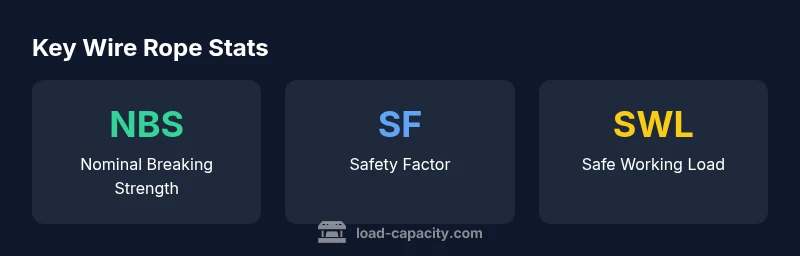
In practice, engineers relate capacity to nominal breaking strength (NBS) and apply a factor of safety (SF) to derive the Safe Working Load (SWL). Conceptually, SWL = NBS / SF, where NBS is estimated from rope diameter, construction, and material, and SF reflects risk and service conditions. For educational purposes, you can view NBS as a scalable value (e.g., diameter-based) and adjust SF according to standards and the specifics of the lift. Always acknowledge that dynamic loads, shock loading, and environmental factors may require additional de-rating beyond a simple NBS/SF calculation.
Step-by-step calculation workflow (practical approach)
- Gather data: rope diameter, construction, material, and the planned service conditions. 2) Determine a SF from applicable standards or manufacturer guidelines. 3) Estimate NBS using a diameter-based rule of thumb or manufacturer data (the exact method may vary by rope type). 4) Compute SWL as NBS divided by SF and apply any known derating factors (dynamic effects, wear, temperature). 5) Validate the result against the actual load and rigging geometry, then adjust as needed. 6) Document inputs, assumptions, and derived SWL for future reference.
Temperature, wear, and aging: real-world considerations
Temperature affects steel strength: high heat can reduce tensile capacity, while cold temperatures may embrittle certain steels. Wear from passing over pulleys, drums, or sharp sheaves reduces effective diameter and weakens strands, especially in outer layers. Corrosion from moisture or chemicals also lowers strength over time. Regular inspection and maintenance become critical: replace rope showing frayed strands, broken wires, or corrosion damage, and re-evaluate SWL after any significant wear or environmental change. The Load Capacity guidance consistently highlights that de-rate decisions should be data-driven and documented.