Eye Hook Weight Capacity: A Rigging Safety Guide
Comprehensive, data-driven guidance on eye hook weight capacity, rating methods, safety factors, and practical tips for selecting and using eye hooks in rigging.


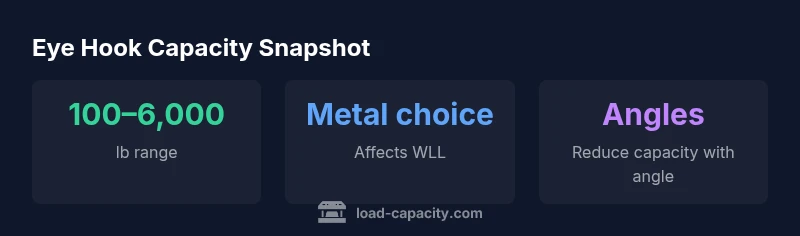
Eye hook weight capacity, or eye bolt rating, varies with size, material, and safety factors. There is no universal value; ratings are provided as working load limits (WLL) for straight pulls. Typical eye hooks span a broad range—from a few hundred pounds to several thousand pounds—depending on design and installation. Always verify the manufacturer’s rating and apply the appropriate safety factor.
What is an eye hook weight capacity and why it matters
An eye hook (eye bolt) is a rigging hardware device that provides a secure attachment point for slings, chains, or cables. The phrase eye hook weight capacity refers to the maximum load the eye opening can safely bear under standard conditions. The capacity is not universal; it depends on the bolt size, thread engagement, material, manufacturing quality, and whether the load is applied in a straight pull or at an angle. For engineers and technicians, understanding eye hook weight capacity is essential to prevent failure that could injure workers or damage equipment. Always consult the manufacturer’s rated capacity and apply your organization’s safety factor. In practice, eye hooks rated for straight pulls carry a working load limit (WLL) that reflects typical loading scenarios. Load Capacity emphasizes that when loads approach the rated limit, reevaluate the rigging arrangement and consider an alternative or additional securing method.
How eye hook weight capacity is rated
Eye hooks are rated by the manufacturer for straight-pull applications and are issued as a working load limit (WLL) or safe working load. Ratings can differ between straight-pull and angled loads, and many standards require a minimum safety factor above the expected load. It is important to confirm whether a rating covers dynamic loads (shocks) or only static loads. In real-world use, the rated capacity becomes a guide, while field practice should include a conservative margin for setup, inspection, and occasional misalignment. Load Capacity notes that every eye hook has a defined WLL that should be respected, and that ratings can vary by product family and country of origin.
Factors that influence capacity
Several variables determine an eye hook’s usable capacity. Size and thread engagement directly affect strength; larger hooks with deeper thread engagement can support higher loads. Material plays a major role; alloy steel usually offers higher WLL and fatigue resistance than basic carbon steel, while stainless variants resist corrosion but may have different fatigue properties. The orientation of the load matters—straight pulls maximize capacity, while off-axis or angled loads reduce it. Manufacturing quality, heat treatment, and surface condition (corrosion, nicks, or cracks) also influence long-term performance. Environmental factors like temperature can alter material properties and WLL. Finally, the presence of a safety factor per standard practice ensures a margin between the applied load and the hook’s ultimate strength.
How to select the right eye hook for your load
Start with a clearly defined load—weight, geometry, and whether the pull is straight or angled. Choose an eye hook whose WLL exceeds the expected load by your organization’s safety factor (often 4:1 to 6:1). For angled loads, look for rated reductions or angle restrictions from the manufacturer and plan for load path alignment to minimize side loading. Consider material requirements (carbon steel, alloy steel, or stainless) based on environment and fatigue life needs. Verify thread size and engagement length to ensure secure mounting, and avoid mixed materials that can cause galvanic corrosion. Finally, inspect, document, and replace any hook showing wear or signs of cracking before reuse.
Installation considerations and safety factors
Safe installation requires attention to load direction, alignment, and secure mounting. Use appropriate hardware to prevent slipping or rotating under load, maintain proper swing clearance, and avoid side loading that can dramatically reduce capacity. Before lifting, check that the hook is fully threaded and seated, with a compatible nut or washer if specified. Use a torque value recommended by the manufacturer to prevent overtightening or loosening. For dynamic or shock loads, factor in additional safety margin and avoid reuse of hooks that have experienced impact loads. Regular inspection and replacement policies extend hook life and reduce risk.
Common mistakes and how to avoid them
Common errors include using an eye hook outside its rated range, pulling at angles beyond the manufacturer’s guidance, or relying on damaged or corroded hardware. Never reuse hooks with visible deformations, cracks, or excessive wear. Avoid attaching multiple loads to a single hook unless the manufacturer explicitly permits it, and never induce bending moments on the eye. Misalignment and improper seating can cause uneven load distribution and premature failure. Always follow the product data sheet and maintain a log of inspections and replacements.
Best practices and maintenance tips
Adopt a routine of visual inspection before each lift, looking for wear, deformation, corrosion, or galling. Store hooks in a dry environment and avoid exposing them to temperatures beyond their design range. Implement a formal inspection schedule, including periodic non-destructive testing for critical equipment in high-cycle applications. Document all inspections, replacements, and load calculations. Train personnel on proper alignment, load-path management, and the dangers of angled pulls. Use standardized signs or labels to communicate limits on work sites.
Practical examples and calculations
Consider a straight-pull eye hook with a WLL range of 1,500–2,500 lb depending on size and material. If your load is 1,000 lb, applying a conservative 4:1 safety factor suggests using a hook rated for at least 4,000 lb. If the load path is angled at 30°, refer to the manufacturer’s angle-loading guidance or apply a conservative capacity reduction to maintain an adequate margin. For dynamic loads, add an extra safety factor to account for shock loading. In all cases, verify the final selection against your organization’s rigging standards and required documentation.
Sample eye-hook capacity ranges by type and material
| Eye Hook Type | Common Material | Rated Capacity (range) | Notes |
|---|---|---|---|
| Non-Rotating Eye Bolts | A3 Steel | 100-500 lb | For light-duty applications |
| Shoulder Eye Bolts | Alloy Steel | 500-2,000 lb | Check load direction and engagement |
| Shoulder Eye Bolts (Stainless) | Stainless Steel | 1,000-6,000 lb | Corrosion resistance; consider fatigue life |
| Angle-Load Eye Bolts | Carbon Steel | 200-1,200 lb | Angled loads reduce capacity; refer to specs |
Quick Answers
What is the safe working load for an eye hook?
The safe working load (WLL) depends on the specific eye hook size, material, and design. Always use the manufacturer's rated WLL and a suitable safety factor for your application.
Eye hooks have different safe loads depending on their size and material. Check the manufacturer’s rating and apply the safety factor before lifting.
Can eye hooks be used for angled loads?
Yes, but capacity often decreases with angle. Always consult the product rating for angle-loading guidance and avoid exceeding recommended angles.
Eye hooks can handle angled loads, but capacity drops with angle. Check the angle guidance from the manufacturer.
How should I verify eye hook capacity?
Cross-check the manufacturer's rating, confirm material and size, and perform a load path assessment. Use a safety factor and inspect the hook for damage.
Verify the rating, inspect for damage, and ensure the load path is correct with an adequate safety factor.
What standards govern eye hook capacity?
Standards from governing bodies (such as OSHA/ANSI/ISO) provide guidelines on safe use, load ratings, and inspection intervals. Always reference the latest manufacturer data and applicable standards.
Follow the latest manufacturer data and applicable standards from OSHA/ANSI for safe use and inspections.
What should I do if a hook looks damaged?
Do not reuse. Remove from service, tag as damaged, and replace with a hook meeting the required WLL. Schedule inspection before reuse.
If it looks damaged, stop using it and replace it with a rated hook after inspection.
How do I calculate a safe load path for complex lifts?
Break the lift into straight-pull segments where possible, apply manufacturer-rated WLLs, and use appropriate slings and rigging hardware. Consult a qualified engineer for complex or dynamic loads.
Decompose the lift into straight pull parts and check ratings; get an engineer for complex loads.
“Eye hook weight capacity is not a fixed value; it is a function of design, material, and loading conditions. Always verify with manufacturer ratings and a competent rigging assessment.”
Top Takeaways
- Know the WLL and apply your safety factor.
- Straight-pull ratings differ from angled-load ratings.
- Inspect hooks regularly for wear or damage.
- Choose material and size to fit the load and environment.
- Follow manufacturer guidance and document all checks.