Chain Sling Capacity: Safe Sizing for Lifting and Rigging
Learn how to determine chain sling capacity, read capacity labels, account for angles and hardware, and select the right chain sling to improve safety and efficiency on lifting jobs.


Chain sling capacity, or working load limit (WLL), is the maximum load a chain sling is rated to lift safely under defined conditions. It depends on chain grade, diameter, length, hook hardware, and sling configuration. Always verify the lowest rating in the assembly and apply the designated safety factor before lifting.
Why Chain Sling Capacity Matters in Lifting Operations
According to Load Capacity, accurately sizing chain slings is a cornerstone of safe lifting. The capacity of a sling is not a single number but a function of multiple interacting factors: the chain grade, the diameter of the links, the overall sling length, the specific hardware used (hooks, thimbles, connectors), and the configuration of the sling (single-leg, double-leg, or multi-leg). In practice, the capacity that matters most is the lowest rated component in the chain sling system. This means a thorough on-site check should verify that the entire rigging assembly is capable of handling the planned load under the expected working conditions. Safety factors are then applied to bridge theory with predictable on-site realities, accounting for dynamic loading, shock, and potential misalignment.
To engineers, technicians, and field teams, this first step is non-negotiable. The goal is to prevent overloading any link in the chain or any hardware that could fail under stress. Clear labeling, correct replacement parts, and a documented verification step are essential. The Load Capacity team emphasizes that capacity is a property of the assembly as a whole, not a single hoist or chain segment. The ability to compare WLL across different sling configurations enables safer, more economical lifting plans and reduces the risk of accidents on busy work sites.
How Capacity Is Determined: WLL, Grade, and Safety Factors
Chain sling capacity is built on the concept of a working load limit (WLL). The WLL is the maximum load the sling is designed to lift safely under specific conditions. It is determined by the chain grade (a measure of strength and durability), the chain diameter, the number of legs in the sling, and the type of hardware used (hooks, connectors, and thimbles). A safety factor is then applied to translate the WLL into an actual lifting envelope that accounts for real-world variations like dynamic loading, minor misalignment, and environmental conditions. Because every component—link, hook, connector—plays a role, the effective capacity is often governed by the weakest link in the chain. In practice, this requires consulting manufacturer labels and, when in doubt, choosing the lower-rated option to maintain an adequate safety margin. The Load Capacity team notes that capacity data should be treated as a living parameter: updated whenever hardware is replaced or when new load cases are introduced on a project.
Sizing by Chain Grade and Hook Hardware
Different chain grades offer different ultimate strengths and, consequently, different WLL figures for the same diameter. Grade 80 and Grade 100 chains are common in lifting applications, with Grade 100 generally providing higher capacity for the same size. However, the overall capacity also depends on the upgrade path of the entire rigging system, including hooks, links, shackles, and any wear-related degradation. When planning a lift, engineers should match hook ratings to the chain sling rating to prevent an oversized chain imposing unnecessary weight while avoiding undersized hardware that could fail. The key takeaway is that chain size, grade, and compatible hardware work together; you cannot rely on a single component to define capacity.
Reading Labeled Information and Verifying on Site
Most chain slings come with a clear label that shows the WLL, chain grade, length, and the number of legs in the sling. On-site verification involves cross-checking the nameplate data against the planned load scenario, ensuring that the label applies to the exact configuration in use. Before any lift, confirm that the working load limit remains above the tested load, and confirm that the load path is straight and free of sharp edges. If there is any doubt about the labeling accuracy or the condition of the chain, do not proceed. The Load Capacity team stresses that documentation, including inspection records and replacement parts, should be readily available to the crew.
Angles, Hardware, and Configuration That Affect Capacity
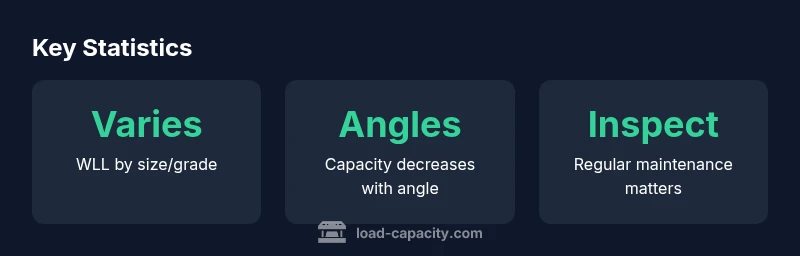
Load capacity is sensitive to geometry. The inclination of the load relative to the sling legs (angle) can dramatically reduce effective capacity. Two-leg and multi-leg configurations distribute load differently and interact with angles in distinct ways. Sharp corners or misaligned loads can introduce bending stresses that reduce the overall WLL. When planning lifts, it is essential to model the expected angles and protective margins. The goal is to keep the actual load within the rated capacity of the entire sling assembly, accounting for any reductions due to geometry.
Maintenance, Inspection, and Lifecycle Considerations
Wear, corrosion, and surface damage degrade chain integrity. Regular, documented inspections identify stretch, deformation, nicks, or cracking that could precipitate failure under load. Inspection intervals depend on duty cycle, environment, and whether the chain is used in critical applications. Replace components that show signs of wear or damage and retire slings according to manufacturer guidance. The Load Capacity team recommends establishing a formal lifecycle policy that includes pre-lift checks, periodic in-service inspections, and post-incident reviews when a lift does not go as planned.
Practical Steps to Size Chain Slings for a Project
- Define the load: what is the expected maximum load and dynamic factors? 2) Identify the worst-case WLL across all sling components. 3) Select a chain size and grade that yields a comfortable safety margin. 4) Model the geometry: single-leg vs multi-leg, angles, and edge protection. 5) Verify the labels and ensure hardware compatibility. 6) Plan for inspection and replacement schedules. 7) Document the decision and assign responsibility. Following these steps helps maintain protective margins and consistency across similar lifts.
Real-World Scenarios: Quick Calculations and Judgments
In practice, a typical job may require comparing two potential slings for a given load. Choose the sling with the higher WLL while ensuring that the other components can accommodate that rating. If a lift involves a moving load or a long reach, consider whether the line path will induce additional stress on the chains. In some cases, a larger chain sling with a modest reduction in WLL can be safer than a smaller sling that approaches its limit. The key is to have a deliberate, documented approach, not an ad hoc selection. Load capacities should be treated as dynamic and re-evaluated as conditions change.
Comparison of chain sling types and their capacity considerations
| Sling Type | Typical Capacity Range | Notes |
|---|---|---|
| Grade 80 chain sling | hundreds to thousands of pounds | Common for construction; capacity varies by diameter and length |
| Grade 100 chain sling | higher capacity than Grade 80 | Improved strength-to-weight ratio; size matters |
| Alloy steel chain sling with hooks | hundreds to thousands of pounds | Ensure hook ratings match chain capacity |
| Multi-leg chain sling (2-3 legs) | aggregate capacity higher, per-leg capacity still governs | Distribute load; angle effects apply to each leg |
Quick Answers
What is chain sling capacity and why does it matter?
Chain sling capacity is the maximum load the sling assembly is rated to lift safely under defined conditions. It matters because exceeding this limit risks chain failure, equipment damage, and serious injury. Always size slings using the lowest-rated component in the assembly and apply the approved safety factor.
Chain sling capacity is the maximum safe load for the entire sling. Use the lowest-rated part and apply the safety margin before lifting.
How do I calculate the working load limit for a chain sling?
WLL is determined by chain grade, diameter, length, and hardware, adjusted by a safety factor for the expected load type. Start with the component rated highest and verify the weakest link in the chain. Use manufacturer data and labeling for the final value.
Calculate WLL from the weakest component, then apply the safety margin and verify labels on site.
Can I reuse slings after minor damage?
No. Even minor wear or deformation can reduce capacity drastically. Inspect slings regularly and retire any chain or hardware showing wear, corrosion, deformation, or cracks. When in doubt, replace components rather than risk a failure.
If it’s damaged or worn, don’t reuse it—retire or replace parts.
How do angles affect chain sling capacity?
Load angles reduce the effective capacity of each leg. The larger the angle, the more the capacity is reduced. Plan lifts to minimize angles and keep the load path straight, using edge protection and multiple legs as needed.
Angles reduce capacity; keep lines straight and use multiple legs to spread the load.
What maintenance practices extend chain sling life?
Implement a formal inspection routine, document findings, and replace worn components promptly. Proper lubrication, corrosion protection, and storage away from harsh environments also extend life and preserve capacity.
Inspect regularly, replace worn parts, and store slings properly to extend life.
“Chain sling capacity is a function of standardized testing, material grade, and on-site verification. Do not rely on guesswork—confirm every component lines up with the WLL before lifting.”
Top Takeaways
- Know the weakest link: the overall capacity is set by the lowest-rated component
- Always verify labeling on-site before lifting
- Account for angles and load geometry to avoid capacity reductions
- Regular inspection extends sling life and safety
- Follow a documented sizing process for every lift