Capacity testing vs load testing: A comprehensive comparison
A rigorous comparison of capacity testing vs load testing, outlining objectives, metrics, methodologies, and decision factors to guide engineers and managers.


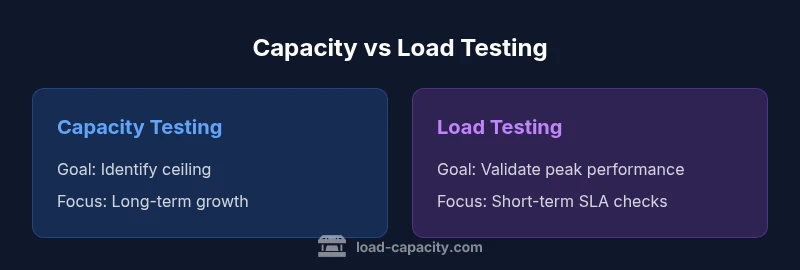
Capacity testing vs load testing are distinct approaches used to understand how a system behaves under pressure. Capacity testing focuses on determining the maximum sustainable load a site, device, or component can support before performance degrades beyond an acceptable threshold. In contrast, load testing examines performance under high, but typically expected, levels of demand to validate SLA commitments and user experience. The distinction matters because teams often conflate the artifacts of these tests—latency, throughput, error rates, and resource utilization—and draw incorrect conclusions about scalability. When you align the test design with the intended goal, you gain actionable signals: the capacity ceiling, the resilience under stress, and the point at which additional resources yield diminishing returns. For engineers, technicians, and managers, the practical takeaway is that capacity testing informs long-term growth planning, while load testing validates near-term performance under peak conditions.
Capacity testing vs load testing: Defining the terms
According to Load Capacity, capacity testing vs load testing are complementary yet distinct methods for understanding how systems scale and perform under pressure. Capacity testing seeks the system’s maximum sustainable load and tolerance to growth, while load testing validates performance under realistic peak demand. The difference is not only in the question asked but in the signals captured: ceiling thresholds versus real-world response under peak. When you apply the right model to the problem, you obtain clear guidance on scaling, budgeting, and risk—signals that drive architectural decisions and governance. Practically, capacity testing informs long-term capacity planning and infrastructure evolution, whereas load testing confirms current performance commitments and user experience under stress. A disciplined program blends both approaches to minimize risk and maximize predictability across releases and capacity cycles.
Core definitions and distinctions
At a high level, capacity testing asks: 'What is the system’s ceiling?' It aims to quantify the maximum load the infrastructure can handle while maintaining defined service levels over time. For example, you increase traffic, requests, or jobs until latency, error rate, or resource usage exceed tolerances, and you measure the tipping point. Load testing asks: 'Can the system sustain peak demand under realistic conditions?' Here the emphasis is on response times, throughput, and stability when the system operates at or near the expected maximum, often for a fixed duration. The two approaches complement each other: capacity testing reveals growth limits, while load testing validates the real-world performance envelope. In practice, a well-designed program will include both to create a robust forecast for capacity planning, budgeting, and risk management. The decision on which to run first depends on urgency, environment maturity, and the business questions you need answered.
Comparison
| Feature | Capacity testing | Load testing |
|---|---|---|
| Purpose | Identify maximum sustainable load and growth ceiling | Validate performance under peak, realistic demand |
| Primary focus | Ceiling, resilience, and scaling efficiency | Latency, throughput, and stability under peak |
| Key metrics | Time-to-threshold, degradation onset, resource saturation | Response times (percentiles), error rates, and sustained throughput |
| Typical duration | Often longer, includes soak and ramp phases | Can be shorter, focused on peak windows |
| Best for | Growth planning, capacity budgeting, risk assessment | SLA validation, user-experience assurance |
| Cost considerations | Higher upfront due to thorough ramp and scale testing | Cost-effective when aligned with release cadences |
Positives
- Clarifies scalability limits before committing resources
- Supports data-driven capacity planning and budgeting
- Reduces risk of unexpected outages during growth
- Provides a clear baseline for architectural decisions
Cons
- May require complex environments and long test cycles
- Can be expensive and time-consuming to execute
- Results can be challenging to translate into immediate actions
Use both capacity testing and load testing for a balanced, forward-looking strategy
Capacity testing uncovers ceilings and growth tolerance, while load testing validates performance under peak conditions. Together, they provide a robust foundation for scalable, reliable systems.
Quick Answers
What is the main difference between capacity testing and load testing?
Capacity testing aims to identify the maximum sustainable load and growth ceiling of a system, while load testing examines performance under realistic peak conditions to validate SLA commitments. Both provide complementary insights for planning and execution.
Capacity testing finds the ceiling; load testing checks performance at peak demand. Together they guide planning and validation.
When should I run capacity testing in a project?
Run capacity testing during early design phases and prior to major scale or lifecycle changes. It informs provisioning strategies, budget planning, and risk assessment for future growth.
Run capacity tests when planning for growth and capacity expansion.
What metrics are most important for load testing?
For load testing, prioritize latency percentiles, error rates, and sustained throughput. Also monitor resource saturation and back-end bottlenecks to understand how the system behaves under peak.
Focus on latency, errors, and throughput under peak load.
Can I replace one test with the other?
No. Capacity testing and load testing answer different questions. Replacing one with the other risks misinterpreting scalability and performance under stress.
They answer different questions; don't substitute.
How often should capacity testing be repeated?
Repeat capacity testing with major architectural changes, growth milestones, or after significant performance regressions to update capacity plans and budgets.
Repeat when architecture changes or growth milestones occur.
Top Takeaways
- Define clear objectives before testing
- Blend both tests for comprehensive coverage
- Model realistic workloads and ramp patterns
- Align testing with business goals and budgets
- Embed tests into the development lifecycle