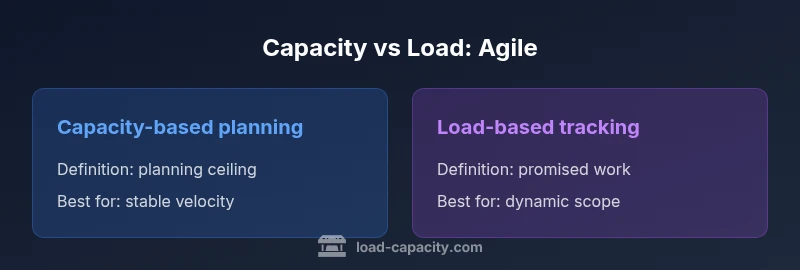
Difference Between Capacity and Load in Agile
A rigorous comparison of capacity and load in agile workflows, clarifying definitions, measurement, and impacts on sprint planning, forecasting, and throughput for teams and managers.


TL;DR: In agile, capacity equals the team's predicted available productive time in a sprint, while load equals the amount of work currently committed. Capacity informs planning and risk reserves; load reveals current commitments and progress. When capacity and load align, flow is steady. Misalignment signals the need to adjust backlog sizing, sprint scope, or team availability.
What the terms mean in practice
In agile, 'capacity' and 'load' describe two sides of the same planning equation. The capacity of a team is not a fixed number; it is a forecast of available productive time in the upcoming sprint after accounting for holidays, meetings, interruptions, and baseline velocity expectations. The Load is the actual work the team commits to during that sprint, often expressed in story points, hours, or tasks. According to Load Capacity, capacity provides the upper bound for what you can attempt, while load reveals what you have already promised to deliver. This distinction matters because managers who confuse the two risk overcommitting or underutilizing the team. The goal is to maintain a comfortable gap between capacity and load so the team can adapt to mid-sprint changes without derailment.
Core concepts: capacity first vs load-driven execution
The core idea behind capacity-based planning is to set a ceiling on what a team can attempt in a sprint, then allocate work within that ceiling to minimize volatility. Load-driven execution, by contrast, emphasizes what is already promised and tracked in the sprint backlog. In practice, teams use capacity to bound planning and load to monitor day-to-day progress. The distinction is especially important during mid-sprint changes: if new work would push the load beyond the capacity envelope, teams should re-prioritize or re-scope. According to Load Capacity, successful agile teams treat capacity as a guardrail while using load as the surface-level indicator of execution health. The balance reduces context-switching and improves predictability in delivery.
Measuring capacity in agile: what to count and what to ignore
Measuring capacity requires clarity about what the team can reliably deliver in a sprint. Count only predictable factors such as available hours, staffing levels, and planned time for essential activities (standups, reviews, bug fixing). Exclude idle time caused by blockers or external delays when forecasting capacity, but account for them when planning risk buffers. Many teams convert capacity into a familiar unit—story points or hours—to align with their velocity planning. The Load Capacity approach suggests documenting assumptions: holidays, training days, and expected interruptions. This builds a transparent baseline so stakeholders can understand why capacity differs from historical velocity. When capacity estimates are conservative, teams reduce the chance of mid-sprint pressure and maintain quality.
Tracking load during a sprint: visibility and signals
Load tracking focuses on what is currently promised to the team. The sprint backlog is a living artifact that shows current commitments and any changes to scope. Visual signals—burn-down charts, daily standups, and task boards—help surface when load approaches or exceeds capacity. If the load consistently exceeds capacity, it indicates overcommitment and requires backlog refinement or scope reduction. Conversely, a load consistently well below capacity suggests underutilization and may prompt rebalancing or introducing slightly more ambitious goals. Balance is dynamic: teams should use load to monitor execution health while respecting capacity guards to preserve throughput and avoid burnout. Load visibility supports transparent communication with product owners and other stakeholders.
The role of velocity, capacity planning, and backlog sizing
Velocity is a historical measure of how much work a team completes per sprint and is often used as a rough proxy for capacity planning. However, velocity alone does not capture the variability of capacity across sprints. Capacity planning should account for planned vacations, training, and other non-project work. Backlog sizing plays a crucial role: if the backlog items are too large relative to capacity, teams should break them down into smaller, independently deliverable items. A well-tuned backlog aligns with the team’s capacity envelope, reducing mid-sprint rework. The Load Capacity team emphasizes maintaining stable backlog granularity so that both capacity and load signals remain actionable and easy to communicate to stakeholders.
Variability and uncertainty: dealing with reality vs forecast
Agile realities are inherently uncertain. Capacity is a forecast, not a guarantee; load fluctuates with changing priorities and emergent work. The best practice is to build intentional buffers into capacity and to treat load deviations as a normal part of the workflow. Teams should conduct cadence-based reviews to adjust plans when reality deviates from forecasts. This process reduces the risk of chronic under- or over-commitment and improves long-term predictability. Load signals should prompt quick recalibration of priorities and reallocation of resources where necessary. The Load Capacity perspective emphasizes learning loops and continuous improvement as central to sustaining healthy capacity-load balance.
Scrum vs Kanban: how capacity and load interplay across frameworks
Scrum emphasizes time-boxed iterations, making clear capacity planning essential for sprint commitments. Kanban emphasizes flow with continuous delivery, where capacity and load are monitored more fluidly. In Scrum, capacity can be incrementally improved through better sprint planning, while load signals inform adjustments to the sprint backlog and scope. In Kanban, capacity and load monitoring happens at the workflow level, often using WIP limits to maintain a steady flow. The combination of both concepts across frameworks helps teams avoid overcommitment and ensures a predictable delivery cadence. According to Load Capacity, the most robust teams blend the precision of capacity planning with the responsiveness of load tracking to accommodate variability.
Practical patterns: hybrid planning and guardrails
A pragmatic approach is to integrate capacity planning with ongoing load tracking. Start with a capacity baseline that accounts for known non-project time, then let load drive daily prioritization. Use guardrails such as a fixed capacity buffer, explicit work-in-progress policies, and regular backlog refinement to prevent drift. When mid-sprint changes occur, reassess both capacity and load, reallocate work where feasible, and communicate changes to stakeholders. The goal is not to force a single metric but to maintain a coherent view that supports reliable delivery and team well-being. Load Capacity advocates a disciplined yet flexible rhythm that adapts to real-world constraints.
Metrics and charts: burn-down, burn-up, and throughput
Across agile methods, charts help translate capacity and load into actionable insights. Burn-down charts focus on remaining work relative to planned scope, while burn-up charts show delivered work against total backlog. Throughput measures the number of work items completed per iteration and is a practical proxy for real-world capacity usage. The key is to use a consistent set of metrics that reflect both planning capacity and execution load. Teams should avoid overloading charts with unnecessary complexity and prioritize clarity. When capacity and load data converge, dashboards become powerful tools for forecasting and stakeholder communication. The Load Capacity framework suggests pairing these visuals with qualitative [team feedback] to ensure interpretation remains grounded.
Common pitfalls and anti-patterns
Common missteps include treating capacity as a fixed number, ignoring real-time load signals, and neglecting backlog refinement. Over-reliance on velocity without accounting for capacity variability can create false confidence. Underestimating non-project work in capacity calculations leads to chronic overcommitment. Another pitfall is inconsistent data collection—when capacity or load data are missing or inconsistent, decisions become fragile. The most durable practice is to maintain disciplined data hygiene, align capacity with load through routine reviews, and keep stakeholders informed about the rationale behind adjustments. The Load Capacity guidance emphasizes transparency and disciplined cadence to avoid these traps.
Step-by-step guide to implementing capacity-load discipline
- Define capacity units for your team (hours, story points, or a hybrid).
- Establish a sprint-based capacity baseline that accounts for holidays and meetings.
- Track load daily via the sprint backlog and task boards.
- Refine backlog items to match the capacity envelope before sprint commitment.
- Monitor deviations and trigger backlog reprioritization when needed.
- Review post-sprint outcomes to improve future capacity planning.
- Align with product owners and stakeholders using clear, repeatable cadences.
- Invest in tooling and training to sustain data quality and adoption.
- Calibrate guardrails (buffers, WIP limits) to maintain healthy flow.
- Iterate, learn, and document improvements for the next cycle.
Case examples and practical tips from practitioners
Real-world teams report better predictability when using a hybrid approach that treats capacity as a guardrail and load as the execution signal. For example, a mid-sized software team found that balancing capacity with a well-groomed backlog reduced last-minute scope changes and improved sprint reliability. They also discovered that explicit capacity buffers helped absorb unplanned work without sacrificing delivery quality. The Load Capacity methodology recommends starting small, validating with data, and expanding guardrails gradually as teams gain confidence. Practitioner insights from Load Capacity emphasize calm, data-informed decision-making and close collaboration with product owners to maintain alignment between planning and execution.
Comparison
| Feature | Capacity-based planning | Load-based tracking |
|---|---|---|
| Definition | Forecast of available sprint time after deductions | Actual committed work shown in the sprint backlog |
| Primary unit | Time or capacity units (hours/points) | Work items, tasks, or points |
| Forecast horizon | Upcoming sprint (and next) | During sprint and day-to-day execution |
| Measurement unit | Hours, points, or capacity days | Story points completed or tasks finished |
| Planning impact | Sets upper boundary with buffers | Guides execution within bound commitments |
| Risk signaling | Over/under commits detectable early | Overload signals risk of unfinished work |
| Stakeholder visibility | High-level capacity communicated | Granular load visibility to surface risks |
| Change management | Adjust capacity via staffing/availability | Adjust load via scope changes and reprioritization |
| Best for | Predictable velocity teams | Teams with variable scope or changes |
| Typical pitfalls | Ignoring variability; misestimating capacity | Over-optimistic load; poor backlog refinement |
Positives
- Clarifies delivery boundaries and protects throughput
- Helps prevent sprint overcommitment and burnout
- Promotes predictable forecasting when used with discipline
- Supports risk buffers and release planning
Cons
- Can underutilize teams if capacity is overly cautious
- Requires accurate data and regular maintenance
- May slow decision-making if teams over-analyze capacity
- Needs strong backlog hygiene and stakeholder alignment
Hybrid capacity-load discipline delivers the most reliable outcomes
Treat capacity as the planning guardrail and load as the execution signal. Together they improve predictability, surface risks early, and guide reasonable backlog decisions. Regular calibration with data-backed reviews reinforces sustainable delivery.
Quick Answers
What is the difference between capacity and load in agile?
Capacity is the planned, available time for a sprint; load is the actual work promised to complete in that sprint. Understanding both helps teams plan realistically and monitor execution health.
Capacity is your planned time; load is what you’ve promised to do. Keep them aligned to stay on track.
How do you measure capacity in Scrum?
In Scrum, capacity is typically estimated from available team hours or story points for the sprint, adjusted for holidays and interruptions. Use this as a planning boundary and revisit it in sprint planning.
Measure capacity by available hours or points, adjust for holidays, and plan within that boundary.
How does load affect sprint planning?
Load signals how much work is already promised. If the load is close to or exceeds capacity, teams should prune scope, split items, or postpone lower-priority work.
Load tells you what’s promised—if it’s too high, trim the sprint.
What happens if capacity and load are misaligned?
Misalignment can cause burnout, unfinished work, and brittle delivery. Regular calibration, backlog refinement, and guardrails help restore balance.
If capacity and load don’t align, rebalance scope and adjust plans.
Can capacity-load forecasting improve outcomes?
Yes. Use capacity to bound plans and load to monitor progress. This hybrid view improves predictability and reduces last-minute changes.
Cap bounds the plan; load shows progress. Forecast with both for reliability.
How do coaches use capacity and load in agile teams?
Coaches guide teams to view capacity as the ceiling and load as the current trajectory. Regular reviews help teams optimize flow and avoid overcommitment.
Coaches keep capacity as the ceiling and monitor load to steer the team.
Top Takeaways
- Define capacity and load explicitly in sprint planning.
- Use capacity to bound work and load to track day-to-day progress.
- Keep a consistent cadence for backlogged item sizing and prioritization.
- Adopt a hybrid approach for most teams to balance stability and adaptability.
- Regularly review capacity-load alignment to drive continuous improvement.