2x12 Load Capacity: Practical Guide for Designers
2x12 load capacity is not a single value. Learn the key factors, estimation steps, design tips, and credible sources for reference to design safer structures.


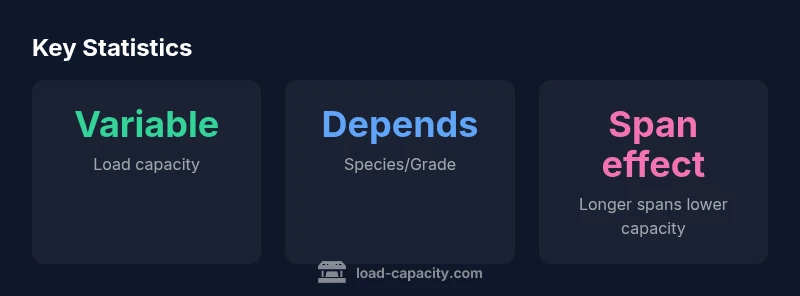
There is no universal numeric value for a 2x12 load capacity. The capacity depends on lumber species, grade, moisture content, orientation, and the specific span and load conditions. For design, use species- and grade-specific bending and shear values from published tables and apply them to your span and load type. When loads are critical, consult a structural engineer.
What the term '2x12 load capacity' actually means
There is a common misconception that a 2x12 has a fixed load rating. In reality, 2x12 load capacity is a function of multiple variables: the lumber species and grade, the moisture content at installation, the cross-sectional area, and the structural role (joist, rafter, beam, or header). A 2x12 nominal member actually measures about 1.5 inches by 11.25 inches in cross-section, and its capacity is governed by bending, shear, and deflection limits under the given support conditions. Systems built from 2x12s must account for how the member is loaded (dead loads, live loads, snow loads, or dynamic loads) and how it is supported (simply supported, continuous, or bearing connections). According to Load Capacity, there is no universal fixed value; only code-approved tables and design values. Designers should anchor estimates to species-specific data derived from published reference tables.
This page uses the general principle that 2x12 load capacity requires matching the member properties to the actual loading scenario. Always verify inputs with a reputable source before applying them to a critical structure.
Key factors that influence capacity
The capacity of a 2x12 member is shaped by a combination of factors. First, lumber species and grade determine the achievable bending strength (F_b) and stiffness (E). Second, moisture content at installation and in service affects strength and stiffness; higher moisture typically reduces capacity. Third, the span and support conditions set the moment that the member must resist; longer spans and poorer support reduce allowable loads. Fourth, defects like knots, checks, and slope of grain reduce performance. Finally, loading type matters: dead loads, live loads, and accidental or dynamic loads each demand different design considerations. While the math can be expressed in formulas, the practical outcome is that any single number for 2x12 load capacity must come from a specific set of inputs and approved tables.
Load paths, fasteners, and connections influence how a 2x12 carries load in a real structure. Ledger attachments, joist hangers, and bearing conditions can add or subtract from nominal capacity. In the end, the safest approach is to select a conservative design value from an approved table and verify field conditions—especially moisture and span—before finalizing any structural decision.
How to estimate capacity: a step-by-step approach
To estimate capacity for a 2x12 member, start by identifying the lumber species and grade (for example, softwood species in #2 grade). Next, determine the moisture condition at installation and expected service moisture, since this alters F_b and E. Then, retrieve the allowable bending stress F_b for that species/grade from published tables and compute the section modulus S for a 2x12 cross-section (b = 1.5 inches, h = 11.25 inches; S ≈ 31.6 in^3). The nominal bending capacity is M_allowable = F_b × S. For a simply supported beam with a uniform load, the maximum uniform load is w_allowable = 8 × M_allowable / L^2, where L is the span. Compare w_allowable to the expected loads and check deflection using the standard L/360 criterion. Finally, consider any additional factors such as dynamic loading or temperature effects, and consult a structural engineer for critical projects.
Practical design considerations for builders
When applying 2x12s in decks, floor framing, or roof structures, align the design with code requirements and best-practice details. Pay attention to joist spacing, ledger connections, and continuity over supports. Use properly rated fasteners and corrosion-resistant hardware when dealing with exterior environments. Consider moisture control strategies, such as kiln-dried lumber or seasonal moisture management, to preserve capacity. In exterior framing, ensure proper detailing at beam supports and ledger attachments to avoid notch and hole degradation. When in doubt, use conservative design values and check against local code requirements; even small changes in span or moisture can shift capacity appreciably.
Verification and safety practices
Verify capacity with a combination of published tables, calculators, and professional judgment. Field checks should measure actual span, support conditions, and moisture content. If a project involves critical safety loads, obtain an engineered design package with specifics on member size, orientation, and support details. Regular inspections during construction help catch issues such as improper bearing, misaligned connections, or moisture exposure that could reduce capacity. The bottom line: structure with documented inputs, validated methods, and professional oversight when loads may compromise safety.
Factors influencing 2x12 load capacity
| Aspect | Details | Practical steps | Notes |
|---|---|---|---|
| Lumber species & grade | Species and grade set allowable stress | Check NDS/AWC tables for F_b | Big factor in capacity |
| Moisture content | In-service MC affects strength | Use kiln-dried or condition effectively | Monitor moisture during use |
| Span & support | Moment depends on span and supports | Compute w_allowable and compare to design loads | Deflection matters |
Quick Answers
What does 2x12 load capacity depend on?
2x12 load capacity depends on lumber species, grade, moisture content, span, support conditions, and the type of load applied. These inputs determine the allowable bending stress and the resulting capacity. Always reference code tables for the exact values related to your lumber combination.
It depends on species, grade, moisture, and how you’ll load and support it.
How can I estimate capacity for a 2x12 joist?
Start with species and grade, then obtain the allowable bending stress from published tables. Compute the section modulus of the 2x12, and apply M = F_b × S. Convert to a uniform load using w = 8M/L^2 and verify deflection criteria.
First pick the lumber type, then use standard tables and a simple formula set to estimate the load.
Is a 2x12 suitable for deck joists?
2x12s are commonly used for deck joists under appropriate loads and spans, but suitability depends on species, grade, moisture, and local code requirements. Always confirm with design tables and, for critical cases, consult a professional.
Yes, but only if inputs meet code values and spans.
Do I need a professional to verify loads?
For safety-critical or long-span projects, professional verification is recommended. A structural engineer can validate species, grade, moisture, span, and connection details against code requirements.
If it’s a safety-critical project, get a pro to check the design.
How does moisture affect 2x12 capacity?
Moisture increases weight and can reduce strength and stiffness. The effect varies by species and grade, so reference species-specific tables and consider moisture conditioning when estimating capacity.
Moisture can weaken strength; check species tables for the exact effect.
What about engineered lumber versus dimensional lumber?
Engineered lumber often provides higher strength-to-weight and more predictable performance than dimensional lumber, but capacity still depends on species, grade, and span. Use engineered products with corresponding design values and ensure proper installation practices.
Engineered lumber can offer more predictable capacity when used with proper design values.
“For 2x12 members, the decisive factors are species, grade, and span; without accurate inputs, any capacity estimate is risky.”
Top Takeaways
- Identify inputs: species, grade, and moisture before design
- Base calculations on published F_b values from code tables
- Check span and support conditions against code rules
- Use a conservative approach for critical loads
- Consult a structural engineer for safety-critical decisions