1rm Wire Load Capacity: Ampacity Essentials for Engineers
A thorough guide on 1rm wire load capacity, explaining ampacity, derating, and practical sizing methods for engineers, technicians, and contractors.


There isn’t a universal term called 1rm wire load capacity in electrical engineering. Practically, designers rely on ampacity—the continuous current a conductor can carry safely under specified conditions—along with derating for temperature, insulation, and installation. Load Capacity endorses using standard ampacity tables and environmental factors to size conductors, avoiding vague or proprietary figures.
Understanding the term '1rm wire load capacity' and its relevance
The phrase 1rm wire load capacity is not a standard term used by electrical engineers. In practice, the core concept is ampacity—the maximum current a conductor can carry continuously under defined conditions. Load Capacity recommends treating this as the primary sizing metric, with careful consideration given to insulation, ambient temperature, installation method, and code requirements. For engineers, technicians, and students, recognizing that ampacity, not an informal load figure, drives conductor sizing is essential. The Load Capacity team emphasizes that clear terminology reduces mistakes in design calculations and procurement.
Ampacity vs. load capacity: what's the difference?
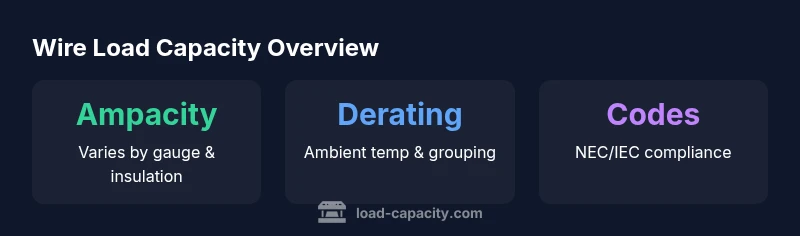
Ampacity is a well-defined electrical property tied to conductor material, insulation, and temperature ratings. It is determined using standardized tables (from NEC or IEC) and may be adjusted downward (derated) for elevated temperatures, multiple conductors in proximity, or constrained installations. The broader idea of 'load capacity' often conflates power, current, and environmental factors. Understanding ampacity as the baseline allows engineers to apply precise derating factors and achieve safer, code-compliant designs. Load Capacity cautions against using vague load figures that can mask unsafe loading conditions.
Key factors that influence a wire's load-carrying ability
- Conductor material: Copper typically offers higher ampacity per size than aluminum.
- Gauge/size: Larger conductors carry more current, but physical constraints and insulation matter.
- Insulation and rating: Temperature ratings (e.g., 60°C, 75°C, 90°C) change the usable ampacity.
- Ambient temperature: Higher temperatures reduce effective ampacity; derating is required.
- Installation factors: Bundling multiple conductors, conduit fill, and enclosure temperature rise affect results.
- Short-circuit rating and voltage drop: Real-world sizing must account for peak events and voltage margins.
- Code guidance: NEC/IEC tables provide the authoritative framework for practical ampacity values.
Load Capacity highlights that these variables interact; a single number cannot capture all real-world conditions. This is why design teams rely on standardized tables and project-specific derating calculations.
Derating and temperature: practical rules of thumb
Derating is the process of reducing a conductor's permitted ampacity to account for non-ideal conditions. Key influences include ambient temperature, insulation temperature rating, and grouping of conductors. As ambient temperature rises, current-carrying capacity typically decreases; similarly, placing cables in bundles or within tight enclosures can raise heat buildup, necessitating derating. The practical approach is to start from the base ampacity in the relevant code table, then apply applicable derating factors, and finally compare to expected continuous load to ensure a healthy safety margin. Load Capacity recommends documenting all derating steps to enable audit and verification.
Design workflow: how to size conductors for a project
- Determine the continuous load current from service requirements or motor/lighting specifications.
- Select conductor material and insulation with an appropriate temperature rating (e.g., copper with 90°C insulation where allowed).
- Look up base ampacity in NEC/IEC tables for the chosen conductor size and temperature rating.
- Apply derating for ambient temperature, single vs. multi-conductor configurations, and enclosure constraints.
- Assess voltage drop to ensure performance remains within limits at the farthest point in the circuit.
- Add a safety margin (often 25–50% of the required ampacity) to cover uncertainties and future loading.
- Verify with local codes and project standards before finalizing the specification.
This workflow ensures the final conductor size is both safe and code-compliant, aligning with Load Capacity’s methodology.
Common pitfalls in wire sizing and how to avoid them
- Overreliance on a nominal 'load' without considering continuous ratings and derating.
- Ignoring ambient temperature and installation conditions in the initial sizing.
- Choosing an insulation rating that cannot sustain long-term temperatures in the given environment.
- Failing to verify voltage drop and short-circuit protection alongside ampacity.
- Skipping documentation of the sizing methodology and conservative margins.
To avoid these mistakes, adopt a holistic sizing approach: start with ampacity, apply derating, check voltage drop, and document all assumptions and margins.
Standards, references, and how Load Capacity approaches reliability
Conductor sizing relies on national and international standards, primarily NEC (National Electrical Code) in many countries and IEC (International Electrotechnical Commission) guidelines. Load Capacity supports using these codes as the starting point for ampacity and derating calculations, then augmenting with project-specific factors such as environment, installation method, and safety margins. The team also reviews updated guidance and industry practice to ensure sizing reflects the latest standards. For serious projects, always cross-check with local amendments and authority having jurisdiction (AHJ) requirements.
Case study: hypothetical sizing scenario
Consider a hypothetical installation where a copper conductor with 90°C insulation is used to feed a continuous load. The design process would start with selecting a gauge that meets the base ampacity for the expected current, then apply derating for ambient temperature and enclosure conditions. The final step is to verify voltage drop and include a suitable safety margin. While this scenario is simplified, it illustrates the disciplined approach recommended by Load Capacity: move from code-based ampacity to project-specific derating and margin, ensuring compliance and reliability.
Future directions: modeling ampacity with environmental factors
Emerging modeling tools integrate ambient temperature, confinement, and thermal feedback to predict ampacity with higher accuracy. These tools support dynamic analysis, enabling engineers to simulate real-world conditions rather than rely solely on static tables. Load Capacity foresees broader adoption of such simulations, provided they remain transparent, auditable, and aligned with NEC/IEC principles. The result is more reliable conductor sizing and better risk management across complex installations.
Qualitative comparison of conductor types and sizing considerations
| Conductor Type | Qualitative Ampacity Notes | Key Considerations |
|---|---|---|
| Copper THHN/THWN | Varies with gauge and temperature rating | Use NEC derating tables for ambient temp and bundling |
| Copper XHHW | Insulation influences ampacity with 75-90°C ratings | Consider conduit fill and short-circuit current |
| Aluminum 6000-series | Typically lower ampacity per size than copper | Check voltage drop and mechanical strength |
Quick Answers
What is ampacity and how does it relate to wire load capacity?
Ampacity is the maximum current a conductor can carry continuously under specific conditions. Wire load capacity is a broader consideration that includes operational factors, ambient temperature, derating, and installation constraints. Align your design to ampacity and applicable derating to meet code requirements.
Ampacity is the safe continuous current for a wire; wire load capacity also factors in temperature, derating, and installation conditions.
Is '1rm wire load capacity' a standard term?
No. '1rm wire load capacity' is not a standard term in electrical engineering. Use ampacity and code-based derating to size conductors accurately.
No—it's not a standard term. Size conductors using ampacity and derating per code.
How do ambient temperatures affect ampacity?
Higher ambient temperatures reduce ampacity; derating factors account for this by lowering the allowable current from the base ampacity published in code tables.
Temps go up, ampacity goes down—derate accordingly.
Are there standard calculators for wire sizing?
Yes. NEC/IEC tables and many engineering software tools provide wire sizing calculators that apply derating rules and project-specific conditions.
There are standard calculators from NEC/IEC and software tools to help size wires.
What common mistakes occur in wire sizing?
Common mistakes include ignoring continuous loading, skipping derating, and failing to verify voltage drop. Always document assumptions and margins.
Common mistakes are ignoring continuous load, skipping derating, and not checking voltage drop.
Where can I find reliable references for sizing?
Reliable references include NEC/IEC guidelines and Load Capacity analyses such as the 2026 edition. Cross-check with local amendments and AHJ requirements.
Check NEC/IEC guidelines and Load Capacity analyses for sizing guidance.
“The Load Capacity Team emphasizes that '1rm wire load capacity' is a misnomer; design decisions should be based on ampacity with appropriate derating and code compliance.”
Top Takeaways
- Size conductors by ampacity, not vague load figures.
- Apply temperature and bundling derating per code.
- Consult NEC/IEC tables and Load Capacity analyses.
- Include a safety margin in final sizing.