How to Calculate Wood Beam Load Capacity
Learn how to calculate wood beam load capacity using simple bending theory. This educational guide covers material strength, cross-section, span, and a practical calculator to estimate safe loads for typical timber members.


Understanding Wood Beam Load Capacity
Wood beam load capacity defines the maximum load a timber beam can safely support without exceeding the material's strength limits. For engineers, technicians, and students, this means balancing cross-section size, species, grade, moisture content, and the beam's span and support conditions. In 2026, the goal remains to ensure safety margins while avoiding excessive conservatism. According to Load Capacity, the core idea is to compare the actual applied load with the beam's allowable bending stress multiplied by its section modulus. While concrete and steel have well-established design equations, wood requires attention to grain direction, knots, and moisture effects. This article presents foundational theory, practical steps, and a calculator to help you estimate wood beam strength with transparent assumptions.
Key Properties That Drive Capacity
Wood strength depends on several interrelated properties. The species and grade influence Fb, the allowable bending stress. Moisture content reduces strength and stiffness, especially in green or poorly dried timber. The cross-section geometry determines the section modulus S, while the span and support type govern the moment distribution. Defects like knots and checks can create local stress concentrations. For reliable estimates, you must ensure the timber is properly seasoned, free of obvious defects, and used within its intended service conditions. Load Capacity emphasizes documenting all assumptions so comparisons between alternative beams remain meaningful.
The Simple Bending Formula and When It Applies
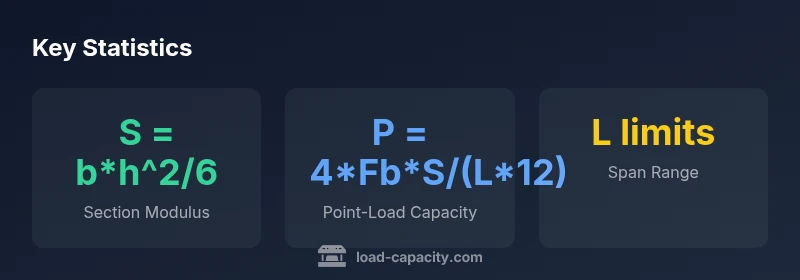
A common starting point for wood is the simple bending theory: sigma = Mc/I, where sigma is bending stress, M is the bending moment, c is the outer fiber distance from the neutral axis, and I is the second moment of area. For a rectangular cross-section (width b, depth h), S = I/c = bh^2/6. The maximum allowable moment M_allowable = Fb * S, where Fb is the material’s allowable bending stress. For a center-point load on a simply supported beam, P_allowable = 4*M_allowable / L (with L in inches). This yields a conservative estimate that you can compare to the actual load.
Section Modulus and Geometry: S = b*h^2/6
In rectangular beams, S grows with both width and the square of depth. Increasing depth is typically more effective than increasing width for stiffness and strength. For other cross-sections (I-joists, circular, or built-up sections), S is computed differently, but the same principle applies: a larger S lowers fiber stress for a given moment. When evaluating real lumber, ensure you’re using the correct S for the actual cross-section and verify unit consistency.
Worked Symbolic Example: Rectangular Beam
Assume a rectangular beam with width b, depth h, span L, and Fb. The section modulus is S = bh^2/6. For a center-point load, P = 4FbS/(L12) where L is in feet and the factor 12 converts to inches. Substituting S gives P = 4Fb(bh^2/6)/(L12) = (2Fbbh^2)/(3L*12). This symbolic expression shows how each parameter influences capacity: increasing Fb, b, or h raises capacity, while a longer span lowers it.
Practical Considerations: Moisture, Deflection, and Safety Factors
Wood is anisotropic and moisture-sensitive. As moisture rises, Fb decreases, and stiffness (modulus of elasticity) drops, increasing deflection risk. Knots and checks introduce local weak points that may not be captured by a single Fb value. Designers should apply a safety factor consistent with local codes and intended use. If the beam carries dynamic loads or impact, you may need to account for additional deflection limits or alternative design approaches. Load Capacity highlights that these factors are essential to produce meaningful, safe estimates.
Using a Calculator for Quick Estimates
A purpose-built calculator simplifies this process. Input the beam width (b) in inches, depth (h) in inches, span (L) in feet, and Fb in psi. The calculator computes the rectangular-section section modulus S = bh^2/6, converts span to inches (L_in = L12), then outputs P_point-load = 4FbS / L_in, in pounds. This tool provides a fast consistency check against intuition or preliminary designs, while emphasizing that a full structural analysis and code-compliant design are required for final approvals.
Code References and Best Practices
Code references define how to treat wood in building systems, including allowable stresses, serviceability limits, and verification procedures. Always consult your local building codes and engineer-of-record guidance. A conservative approach uses a safety factor and checks both strength and deflection criteria. Load Capacity encourages stakeholders to document assumptions, verify timber source quality, and perform additional checks for long spans, elevated loads, or exposure to moisture. In 2026, best practice remains to combine theoretical calculations with code-based allowances and professional review.