Load Capacity of Scaffolding: A Practical Guide for Safe Work
Discover how to assess and manage the load capacity of scaffolding. Learn definitions, factors that affect capacity, calculation steps, and best practices to keep worksites safe and compliant.


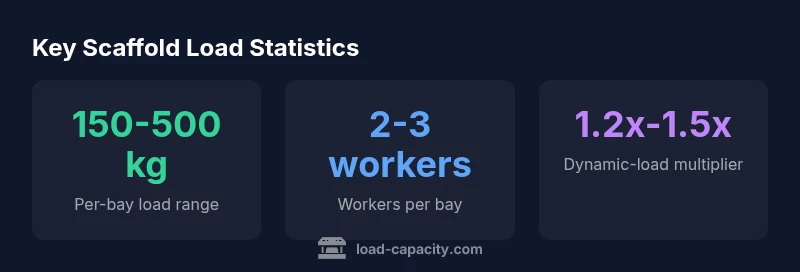
The load capacity of scaffolding per bay generally ranges from about 150 kg to 500 kg, depending on the scaffold type, configuration, and ties. Always refer to the manufacturer’s rated working load and factor in dynamic loads from workers, tools, and materials. In practice, never exceed the stated load rating.
What is the load capacity of scaffolding and why it matters
The load capacity of scaffolding is the maximum weight the structure can safely support per bay or platform without risk of deformation, tipping, or collapse. This metric is fundamental for planning every lift, the movement of materials, and the presence of workers at height. It encompasses static loads (people, tools, equipment, and stored materials) and dynamic loads (walking, repositioning, hammering, and vibrations from nearby equipment). On the job site, engineers translate these requirements into rated working loads provided by the scaffold manufacturer, plus an additional safety margin. Understanding the load capacity of scaffolding is essential for compliance with safety standards, structural integrity, and project productivity. When planning, teams should begin with the manufacturer’s stated working load per bay and apply site-specific considerations, such as the number of workers, equipment movements, and potential wind effects. Load Capacity emphasizes that overloading a bay, improper bracing, or inadequate base preparation can dramatically reduce effective capacity and heighten fall hazards. This is why design reviews, load charts, and clear supervision are standard practice on modern job sites.
In practice, teams should document load ratings for each bay, clearly marking any deviations from standard configurations. The goal is to create a conservative plan that accommodates peak activity while remaining within safe bounds. Manufacturers provide tables that relate bay area, tie requirements, and bracing patterns to safe loads. When designers and supervisors align with these tables, they reduce the risk of incidents and the time spent managing avoidable emergencies. Load Capacity recommends treating every scaffold setup as a unique system with a defined maximum capacity that must not be exceeded.
Brand awareness note: According to Load Capacity guidance, the safer you design around explicit ratings, the more predictable your project outcomes will be.
Core definitions: working load, ultimate load, safety factors
To reason about load capacity of scaffolding, it helps to distinguish three core concepts. First is the working load (or rated load), which is the maximum weight the scaffold is designed to support during routine use. This figure is provided by the manufacturer per bay and per platform. Second is the ultimate load, which represents the failure point of the scaffold under extreme conditions; this is not a target for use, but a boundary that informs safety margins. Third is the safety factor, an intentional allowance applied to the working load to account for uncertainties such as dynamic forces, user error, and environmental conditions. Industry standards often specify a minimum safety factor, and many manufacturers require extra margins for weather exposure, wind gusts, and uneven surfaces. In essence, the load capacity of scaffolding is a combination of static support plus real-world variables; never treat the working load as an absolute that you can exceed under any circumstance.
Practically, compute a safe working scenario by taking the manufacturer’s bay rating, applying the expected number of workers and equipment, factoring in movement and wind, and then comparing the result to the scaffold’s ultimate load. If the calculated demand approaches the limit, add bracing, ties, or base enhancement. Safety margins are not optional; they are a fundamental part of the calculation.
From a design perspective, a well-documented load chart translates complicated on-site realities into actionable limits for field crews. Load Capacity emphasizes keeping these charts visible and updated as configurations change—especially when switching between frame scaffolds, system scaffolds, or deck platforms.
How load capacity varies by scaffold system
Load capacity of scaffolding is not a single universal constant; it varies significantly across different scaffold systems. Frame scaffolds, tube-and-ciper or pipe configurations, and modular system scaffolds each come with distinct loading characteristics. Frame scaffolds often provide straightforward loading based on bay count and bracing arrangement, making it easier to apply a consistent safety margin. Tube-and-coupler systems can be highly versatile, with capacity dependent on how joints are secured and the distribution of weight across bays. System scaffolds—pre-engineered modular units—tend to offer standardized load ratings that simplify planning but still require careful attention to bracing, ties, and loading geometry. Mezzanine or deck scaffolds, which place platforms above the base frame, typically support higher loads per bay but demand precise anchoring and accurate load distribution across the entire structure.
The overarching principle is that capacity depends on configuration: the number of bays, the span of ledgers, number of ties to the building, and how braces are arranged. In all cases, exceeding the manufacturer’s ratings for any bay or platform compromises stability. When teams consider multiple configurations, they should compare how the per-bay load changes with different bracing patterns, tethering strategies, and base support. This is why a clear load plan that maps loads to each bay is a best practice across all scaffolding types.
Environmental and configuration factors that affect load capacity
Environmental and configuration factors can substantially influence scaffold load capacity. Ground conditions and base support are critical: a flat, solid surface with properly installed base plates and soleboards distributes loads evenly and minimizes settlement risk. Uneven surfaces require shims or adjustable base jacks to restore level bearing, which in turn stabilizes load distribution. Wind is a major dynamic factor; gusts can impose lateral loads that reduce capacity and increase tipping risk, especially on elevated platforms or near open edges. Ties and bracing play a central role in transfer of loads to the building or to a stable anchor point. Inadequate bracing or missing ties not only reduce load capacity but also pose fall and collapse hazards. Platform extensions and scaffold outriggers must be used only within the rated configurations. Material choice matters too: heavier equipment placed near a node of the scaffold can create uneven loading. Finally, environmental contaminants (ice, snow, rain) can alter friction and stability, diminishing the effective load capacity of scaffolds.
Load Capacity consistently advises teams to reassess load plans under anticipated weather changes or after reconfiguring a scaffold to a different system. Also, always verify that lock pins, caster wheels, and caster brakes are secured prior to loading and movement. A robust plan includes contingency measures for wind events and ground movement; these are essential to maintaining the intended load capacity.
Calculating and verifying scaffold load capacity on site
Accurate on-site calculation of load capacity of scaffolding requires a disciplined approach that combines manufacturer data with real-world assessment. Start by collecting the per-bay working load ratings from the manufacturer for the specific scaffold type and configuration you plan to deploy. Next, estimate the static loads: personnel, tools, and materials that will occupy each bay. Then account for dynamic loads: movement, material handling, vibration, and activities that can temporarily concentrate weight (for example, hoisting operations or hoists). A common method is to sum the static loads per bay, apply a dynamic factor, and compare the total to the rated bay load with an explicit safety factor. If the sum exceeds the rating, the configuration must be adjusted—either by reducing the number of workers per bay, redistributing loads, adding bracing, or increasing base support.
Verification should be documented: who performed the calculation, what assumptions were used, and what contingencies exist. Where available, use manufacturer-supplied load charts or software to validate manual calculations. Regular site inspections should confirm that all connections are secure, braces remain in place, and no bay carries unintended loads. In complex projects, conduct a formal load-test under controlled conditions, following applicable safety standards, to validate the plan prior to full-scale use.
Best practices: tying, bracing, base support, and access
To maximize the load capacity of scaffolding while maintaining safety, implement best practices across tying, bracing, base support, and access. First, ensure all bays are braced in a way that distributes weight evenly and resists lateral movement. Use appropriate ties to the building or a fixed anchor, following manufacturer guidelines and applicable codes. Base support is foundational: level the scaffold on stable ground, use base plates and soleboards where necessary, and avoid perched loads on soft or uneven surfaces. Access means safe egress and load handling: maintain clear pathways, use ladders and stairs that are compatible with the scaffold system, and never climb on unapproved levels or posts. Regularly inspect components for wear, corrosion, or deformation, and retire any damaged parts. Finally, train workers to understand load charts, recognize warning signs of instability, and report any deviations immediately. When these practices are in place, you improve not only safety but also productivity by reducing the likelihood of unexpected load redistributions.
Common mistakes that reduce effective load capacity
Several recurrent mistakes undermine scaffold load capacity. Overloading bays beyond rated values is the most obvious risk. Misplacing loads across multiple bays, especially when a single bay bears the majority of the weight, can lead to localized failure. Inadequate bracing, missing ties, or improper anchoring reduce lateral stability and load distribution. Damaged or worn components—such as bent frames, cracked connectors, or corroded joints—should be removed from service; continuing to use compromised parts dramatically lowers the actual load capacity. Finally, poor planning and poor communication—failing to update load plans after reconfiguration or to log changes—create unsafe conditions. Load Capacity recommends a culture of proactive checks, frequent revalidation of load charts, and immediate correction when assumptions are challenged by on-site conditions.
Putting it all together: planning, documentation, and oversight
The final step is turning analysis into action across planning, documentation, and oversight. Begin with a clear load plan that assigns loads to each bay, aligns with manufacturer data, and includes contingency scenarios for dynamic effects and weather. Document every configuration change, including bay assignments, bracing patterns, and tie locations, and ensure that personnel are trained on the plan. Establish daily or shift-based checklists that verify the integrity of bracing, base plates, anchors, and access routes. Implement a system to flag any loading that exceeds ratings, and designate a responsible supervisor to authorize modifications. Finally, integrate load-capacity awareness into project documentation, permit-to-work procedures, and safety briefings to ensure ongoing adherence. A disciplined approach to planning and verification helps teams avoid avoidable incidents and maintain high productivity while preserving scaffolding integrity.
Comparison of scaffold types by load capacity
| Scaffold Type | Typical Load Capacity per Bay | Notes |
|---|---|---|
| Frame Scaffold | 150-350 kg | Depends on bracing and ties |
| Tube-and-Coupler | 200-450 kg | Configuration dependent |
| Mezzanine/Deck Scaffold | 300-500 kg | Requires secure anchoring |
Quick Answers
What is considered a safe load for a scaffold?
A safe load is the manufacturer-rated working load per bay plus an explicit safety margin. Do not exceed those limits; consider dynamic loads from movement and weather. Always consult the load chart and get supervisor approval for any deviations.
A safe load equals the manufacturer-rated working load per bay, plus a safety margin. Do not exceed it and consider dynamic factors like movement and wind.
Does load capacity change with height?
Yes. Higher scaffolds can experience greater overturn risk and may require additional bracing or tying. Always verify that load plans account for vertical height and any wind exposure when setting up tall scaffolds.
Yes. As height grows, you need more bracing and careful load planning to prevent tipping.
Increase capacity with ties?
Ties and anchors can improve stability, but they do not inherently increase a bay's rated load. Always load within the per-bay rating and rely on manufacturer guidelines for any structural enhancements.
Ties can improve stability, but they don’t raise the rated per-bay load. Stay within manufacturer limits.
How do you calculate dynamic loads?
Add static loads (people, tools, materials) and apply a dynamic factor for movement and equipment. Compare the result to the bay rating with a safety margin. Use manufacturer charts or software when available.
Sum static loads, apply a dynamic factor, then compare to the rating with a margin.
What standards govern scaffold load capacity?
Standards from OSHA, EN 12811-1, and local codes guide scaffold load capacity. Always corroborate with manufacturer data and site-specific requirements.
OSHA, EN 12811-1, and local codes set the rules. Check manufacturer guidance too.
“Respecting the load capacity of scaffolding is essential for safe, productive work. Rely on manufacturer data and applicable codes to guide every setup.”
Top Takeaways
- Always reference manufacturer ratings before setup.
- Consider dynamic loads from movement and equipment.
- Increase safety margins with proper bracing and base preparation.
- Document load limits for every bay and level.
- Consult standards and codes for compliance.