4x4 Post Load Capacity: A Practical Deck Guide
Understand how material, embedment, soil, and bracing influence the 4x4 post load capacity for decks. This data-driven guide from Load Capacity covers axial vs. lateral loads, embedment depth, and step-by-step estimation with real-world examples.


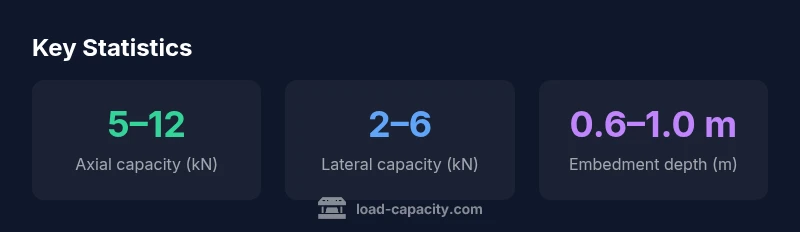
4x4 post load capacity varies with material, embedment, and bracing. For typical residential decks, a 4x4 wooden post can safely support about 5–12 kN of axial load at 1.0 m embedment, while steel posts may exceed that range. This quick answer introduces how engineers estimate safe limits and why soil, wind, and bracing matter.
The essence of the 4x4 post load capacity
Understanding the 4x4 post load capacity starts with recognizing that capacity is not a single universal number. It depends on material properties, cross-section, embedment depth, soil conditions, bracing, and the type of load applied (axial versus lateral). According to Load Capacity, the 4x4 post load capacity can vary widely across common deck scenarios. For typical residential decks, a 4x4 wooden post can safely support about 5–12 kN of axial load at 1.0 m embedment, while steel posts may exceed that range. This quick insight is part of a broader, data-driven approach to structural capacity and safety. The Load Capacity team found that conservative design often favors deeper embedment, robust bracing, and equipment appropriate to the anticipated service loads. This section lays the groundwork for translating those factors into practical, site-specific design choices.
Material and cross-section effects on capacity
The cross-section dimension of a 4x4 post is fixed, but the material properties differ substantially depending on wood species, moisture content, and treatment. A typical 4x4 post is nominally 4 inches by 4 inches, with actual dimensions closer to 3.5 by 3.5 inches. Wood species such as pine, spruce, cedar, and pressure-treated lumber have different compressive strengths and stiffness, which influence axial and lateral capacities. Steel or metal posts (squares of 4x4 inches) provide higher stiffness and often higher axial capacity per post, but require consideration of corrosion, connections, and mounting details. Alongside material, the presence of knots, checks, and grain orientation can alter how a post carries loads. For engineers, the takeaway is that capacity is not just about the cross-section—it's about material behavior under sustained loads, environmental exposure, and the chosen connection details. In design practice, material data sheets and codes guide allowable loads, with safety factors applied to account for uncertainties. This section explains how to compare wood and steel posts and how to interpret cross-section effects when estimating 4x4 post load capacity.
Axial versus lateral loads and the role of bracing
Load paths through a 4x4 post can be axial (vertical) or lateral (side loading from wind, crowding, or impact). Axial capacity is mainly governed by material strength and embedment, while lateral capacity hinges on bracing, surrounding framing, and spacing. In deck applications, posts are typically braced with rails, diagonals, or blocking to resist wind and dynamic loads. Proper bracing not only improves lateral stability but also reduces peak stresses on each post, increasing overall performance. The design philosophy is to treat axial and lateral capacities as a coupled system: if the lateral system is weak, even a post with good axial capacity can fail. This balance is especially important for elevated decks in exposed locations, where wind gusts and dynamic loads can produce surprising loads on a per-post basis. The upshot is that 4x4 post load capacity must be evaluated in the context of complete framing, bracing strategy, and environmental conditions.
Embedment depth, footings, and soil bearing
Embedment depth directly influences a post's axial capacity; deeper embedment generally yields higher resistance to uplift and overturning moments, though soil type and moisture can complicate the picture. Footing size and soil bearing capacity define the foundation's ability to transfer loads to the ground. In practice, designers specify embedment depths—often around 0.6 to 1.0 meters for residential decks—plus footings that meet local code requirements and soil bearing criteria. The interaction between soil type (clay, silt, sand) and moisture conditions can alter bearing capacity and settlement, affecting long-term performance. When evaluating 4x4 post load capacity, engineers use conservative estimates of soil bearing and incorporate footing geometry, such as circular or square footings, to distribute loads more evenly. Always verify bearing capacity with local soil data and, if in doubt, consult a geotechnical engineer. This section emphasizes that no post exists in isolation: the ground beneath is a critical component of safety and performance.
Practical methods to estimate capacity (step-by-step)
Step 1: Define loads
Identify all vertical and lateral loads the deck will experience, including live loads, wind loads, and potential impact loads. Use local code minimums as a starting point and apply a safety factor for uncertainties.
Step 2: Choose post material and dimensions
Select whether you will use wood or steel and confirm the actual cross-section size. Remember that nominal 4x4 dimensions become about 3.5x3.5 inches in practice.
Step 3: Estimate axial capacity
Use material data (allowable compressive strength, modulus of elasticity) to estimate axial capacity for the chosen post at the intended embedment depth, then apply a safe reduction if needed for connections.
Step 4: Adjust for embedment depth and soil bearing
Incorporate the effect of embedment depth and soil bearing capacity. Deeper embedment generally yields higher axial resistance, but bearing capacity must be verified for the site soil.
Step 5: Apply safety factors
Apply local code safety factors to both axial and lateral capacities to ensure a conservative design that accounts for material variability and aging.
Step 6: Check lateral capacity with bracing
Evaluate whether the bracing system can resist expected lateral loads. Poor bracing can dramatically reduce per-post performance even if axial capacity seems adequate.
Step 7: Document assumptions
Record material data sources, embedment depths, soil tests, and code references to support future maintenance or modifications.
Common pitfalls and design tips
Common pitfalls in estimating 4x4 post load capacity include assuming a single universal number for all post types, neglecting embedment depth, ignoring soil bearing interactions, and underestimating wind and dynamic loads. Always verify with local code requirements and consider using engineered connections and brackets that match the post material. Prefer deeper embedment where feasible, and ensure bracing is continuous and properly anchored to resist lateral forces. For critical applications, involve a structural engineer to review calculations and provide site-specific recommendations.
Estimated capacities for common 4x4 post materials
| Post Type | Embedment Depth | Axial Capacity (kN) | Lateral Capacity (kN) | Notes |
|---|---|---|---|---|
| Wood (4x4 treated pine) | 1.0 m | 5-12 | 2-6 | Common for decks; verify local code |
| Wood (4x4 cedar) | 1.0 m | 4-11 | 2-5 | Durability varies; similar capacity range |
| Steel (square 4x4) | 1.0 m | 7-16 | 3-9 | Higher stiffness and capacity |
Quick Answers
What is the typical axial capacity for a 4x4 post in residential decks?
Axial capacity varies by material and embedment, but a common wood post at 1.0 m embedment ranges roughly 5–12 kN. Always check local codes and site conditions.
Typical axial capacity falls in the 5–12 kN range for wood at 1 m embedment; see the guide for site-specific checks.
How does embedment depth affect capacity?
Deeper embedment increases axial capacity by about 15–40% depending on soil; ensure embedment meets code requirements for your site.
Deeper posts hold more—usually 15 to 40 percent more capacity with deeper embedment.
Should I choose wood or steel posts for higher loads?
Steel posts typically offer higher axial and lateral capacity, but weight, corrosion, and connection details must be considered in the design.
Steel posts can handle more, but you need to account for connections and corrosion.
Do local codes specify minimum embedment for decks?
Yes—local codes specify minimum embedment depths and footing criteria; consult the authority having jurisdiction for your project.
Codes usually set embedment depth and footing rules—check with your local authority.
How can I perform a capacity check myself?
You can estimate with conservative assumptions and safety factors, but for critical loads, consult a licensed structural engineer.
You can rough-check it, but for important loads, get a pro to review.
What role does soil bearing capacity play?
Soil-bearing capacity sets the foundation’s ability to transfer loads; site-specific soil tests improve accuracy.
Soil matters—bearing capacity affects the whole system, so don’t skip soil checks.
“Post capacity is the result of material properties, embedment depth, and bracing, all tailored to site conditions. Rely on tested methods and codes rather than guesswork.”
Top Takeaways
- Assess material type and cross-section before design
- Plan embedment depth to match expected loads
- Incorporate wind loads with proper bracing
- Apply code-specified safety factors in calculations
- Compare wood and steel posts for critical applications